

The Fraunhofer ISE has defined new technical procedures to test the performance of large Perovskiet-Silicon Tandem PV modules using the spectral variability of the LED sun simulator. The proposed approach is said to reduce the handling, time and therefore financial efforts of devices.
Researchers from the German Fraunhofer Institute for Solar Energy Systems (Fraunhofer Ise) have developed a new one Procedure for the precise and traceable spectral adjustment of LED-based solar simulators for measurements of large perovskiet-silicon tandem solar modules.
“We showed, For the first time, a complete calibration of perovskite with a large area on silicon tandem solar cell modules can be carried out by consistently using the spectral variability of LED -based solar simulators, ”said the main author of the research, David Chojniak, said PV Magazine.
‘Performing external quantum efficiency (EQE) measurements, power measurements, determining temperature coefficients, as well as studies of module performance under variable spectral conditions in a single measurement, the setup offers enormous potential for setting up tandem calibrations with LED-Solar-Simulators.
In the study “Traceable efficiency determination of perovskiet with a large area on silicon tandemmodules-insights from the perspective of a calibration laboratories“Published in Progress in photovoltaic” Chojniak And his colleagues explained that the proposed procedure can be carried out on a single measurement setup for full module salibration, while the full module measures EQE measurement based on the narrow emission spectra of the various LED types used in the setup.
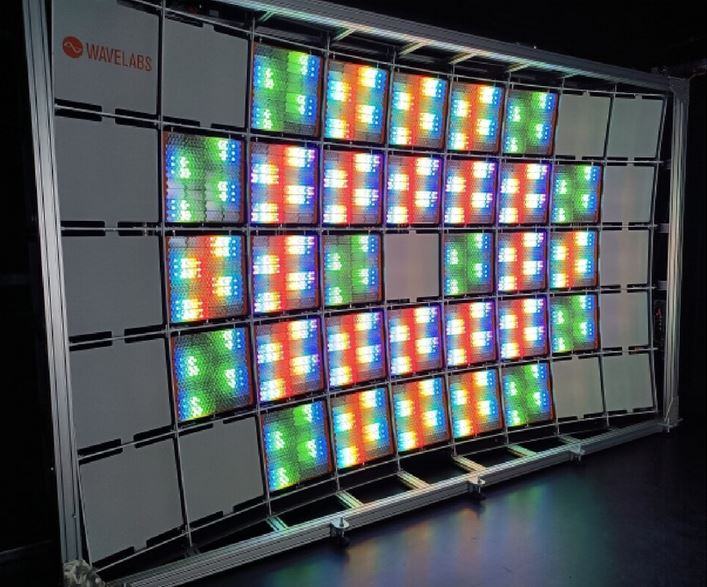
For their experiments they used a Wavelabs Sinus-3000 advanced LED-based solar simulator equipped with 26 spectral different light sources. It was checked with the help of the in-house Labview software.
“The distance between the sun simulator and the device to be tested was 7 m,” the paper is. “The size of the enlightened area was 2.86 m2for which an average spectral non -uniformity of 0.95% was achieved. “The simulator was set up in a temperature -controlled laboratory that is painted in black to reduce reflections.”
The research team also investigated how the limited resolution and accuracy of the LED -Eqe influence the spectral adjustment of the solar simulator.
The analysis showed that the new procedure offers a “good qualitative” agreement with EQE measurements with the LED setup carried out on modules with large parts and encapsulated cells in the Callab PV cells of Fraunhofer ISE.
The academics have also adapted the spectrum of LED-based solar simulators for the measurements of tandem cells and modules in accordance with the IEC60904-1-1 standards. , which describes the procedures for measuring the power voltage characteristics of photovoltaic devices with multiple junction.
“This procedure for refining the simulator’s spectrum depends on the making of only minimal changes in the form, eliminating the need to recalculate spectral mismatch factors (SMM), and therefore avoids an iterative and time-consuming adjustment process,” the researchers have noticed.
“The proposed procedure considerably reduces the device handling, time and financial efforts,” concluded Chojniak.
This content is protected by copyright and may not be reused. If you want to work with us and reuse part of our content, please contact: editors@pv-magazine.com.
