

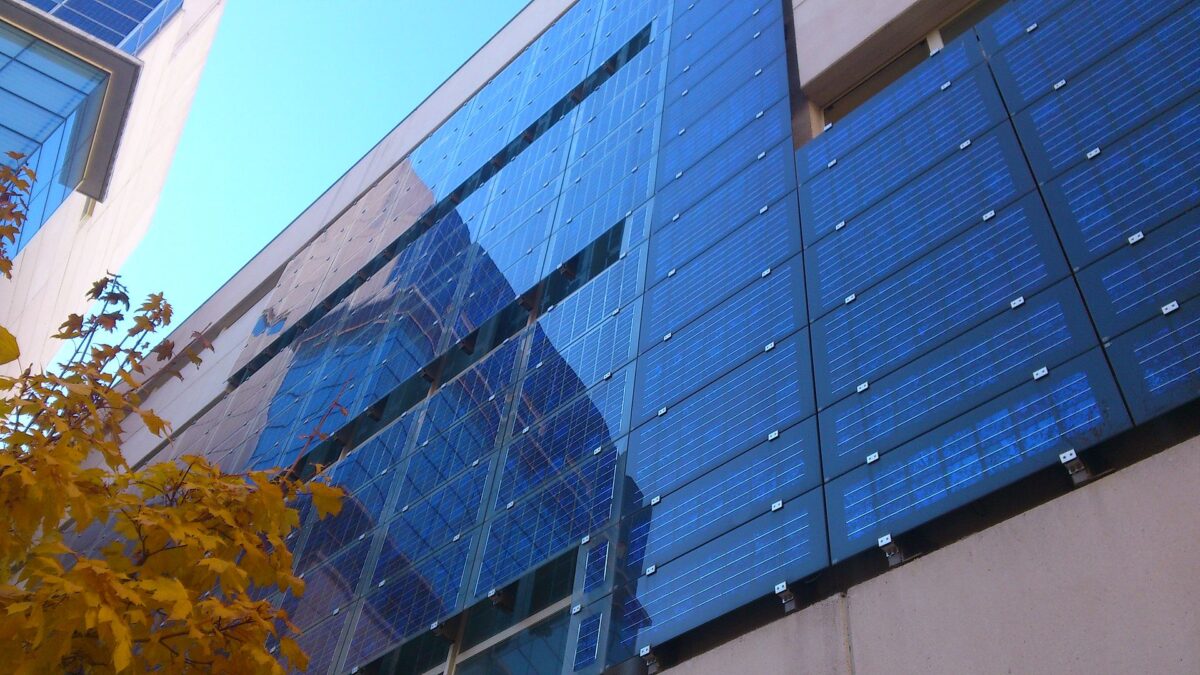
A study conducted by the German Development Agency Deutsche Gesellschaft für Internationale Zusammenarbeit (GIZ) in collaboration with India-featured think tank The Center for Study of Science, Technology and Policy (CTEP), it turned out that India has the potential for more than 300 GW of building-integrated photo-photovoltaic. Moreover, according to a report from the World Bank, 70% of the buildings that India must become a developed nation must still be built by 2047, which still underlines the enormous future potential for BIPV systems in the country.
BIPV could help India to achieve a significant part of the objectives for renewable energy consumption, such as building 500 GW non-fossil fuel capacity by 2030. But the BIPV industry, both in India and worldwide, is a young with few recognized standards. India has included BIPV installations in its residential solar scheme on the roof (PM Surya Ghar: Muft Bijli Yojana), aimed at 10 million installations by 2027, which could lead to an increased demand for BIPV components. But for now, due to the limited knowledge and availability of BIPV components in the country, the inclusion of BIPV in this scheme would not have the expected impact.
CSTEP has also collaborated with New Delhi’s School of Planning and Architecture to develop a series of Guidelines for BIPV, to use by solar installers, architects, construction companies, policy makers and other stakeholders. The guidelines were published in mid -2025, after an assessment by the Indian Ministry of New and Renewable Energy.
“We have the potential in India; we have the guidelines. Now we have to increase the public consciousness and understanding of BIPV,” said Shantanu Roy, sector coordinator, renewable energy sources and energy saving, at CTEP.
The three institutions are now working together to develop a BIPV ladder with which owners of buildings and other important stakeholders (such as architects, designers and policy makers) can calculate the BIPV -Levensateability of a building on the basis of a few parameters and a BIPV design tool that will show detailed system designs. “We want to give a very extensive solution for stakeholders to make it easy for them to decide whether they go for BIPV or not go,” said Roy.
Cross-sector perspective
During the development of the guidelines, Roy discovered that the consciousness of BIPV among architects and the building sector was low. In his opinion, this makes the work even more valuable, so that not only the knowledge is offered that BIPV products exist, but also clear guidelines for the entire process to work with – which regulations are relevant, different ways to integrate PV into the design, and so on.
Giving a clear explanation of the economy is a different goal, so that the sector can understand the benefits. For example, PV glass is more expensive in advance than a normal glass facade, but savings on energy bills, for a high build-up office building with heavy air conditioning, can make it more than worthwhile in the long term. And the earlier BIPV is processed in a plan, the better. “BIPV works best when it is integrated in the design phase and not as a retrofit or a side issue as soon as building designs are completed,” said Roy.
Roy also sees policymakers as the key to growth in BIPV, and notes that its intake in PM Surya Ghar: Muft Bijli Yojana Is encouraging, but larger commercial buildings are where the real potential lies. And in many cases, updates for building codes are needed to also have BIPV components classified as building materials.
To improve BIPV consciousness, it must be included in the architectural and technical curricula. Roy says that he has been involved in workshops and training sessions with students in different disciplines, with the aim of ensuring that when they become professionals, they have knowledge of BIPV and how it can be a useful solution in many contexts.
Possibilities
With BIPV’s recording in PM Surya Ghar: Muft Bijli YojanaRoy sees some options for balcony PV in high -rise apartments where owners have no roof or other places where roofs are shaded or otherwise in use.
But the real chance is in the commercial and industrial sectors, with glass facades in office buildings and integrated roofs at factories, warehouses and other buildings – especially those which have no roofs to wear the load of a PV installation. Roy points to an installation at a train station in Vijayawada, in the southern state of Andhra Pradesh, where throwing above four platforms were replaced by a PV installation that also functioned as a roof.
Most BIPV products on the market were developed today by European companies. Many of these companies are now investigating partnerships to develop production units in India, which makes this a very attractive prospect for India.
For the time being, India has enough land to continue the construction of large-scale solar energy. But the solar ambitions will increasingly rise against land and other limitations. In this scenario, BIPV has the potential to achieve a significant part of the solar target of India, while the energy bills for building owners are reduced and the grid decrease.
This content is protected by copyright and may not be reused. If you want to work with us and reuse part of our content, please contact: editors@pv-magazine.com.
