

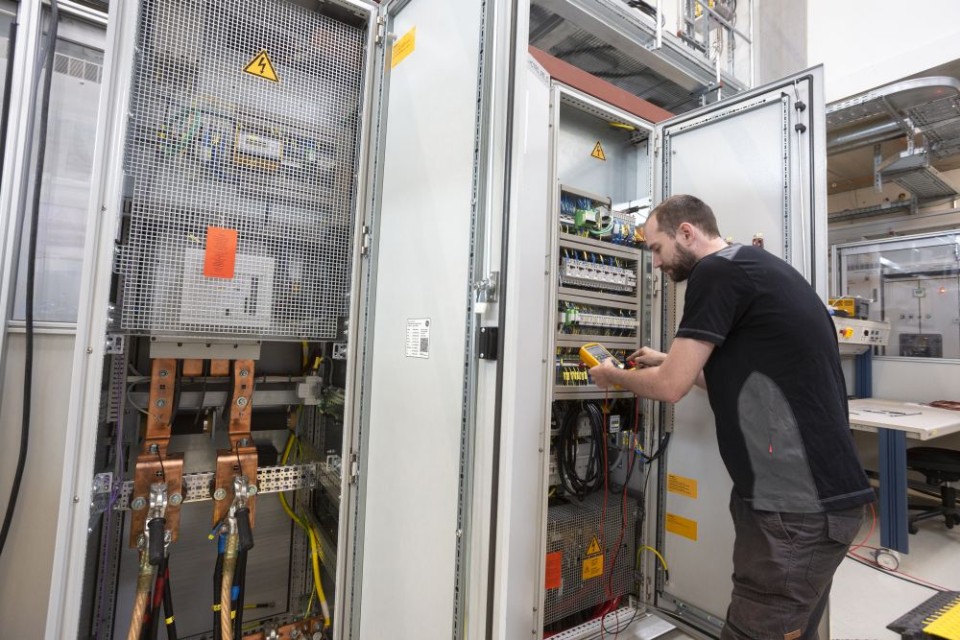
The evaluation process, developed in collaboration with four German transmission system operators, has been carried out on seven European companies whose inverters vary from kW to MW in size.
Researchers from the Fraunhofer Institute for Solar Energy Systems (ISE) have worked on a test procedure for grid-forming inverters.
In the GFM -Benchmark project, Fraunhofer has collaborated with four German grid operators – 50 Hertz Transmission GmbH, TransNet BW GMBH, Amprion GmbH and TenneT TSO GmbH – to develop a measurement and evaluation process for the stabilizing properties of Inverters.
The work consisted of a call for companies that are interested in testing their inverters against the evaluation procedure. In total, seven companies from different countries responded to the call. Their devices varied from a few kW to 5 MW in capacity and were all measured according to the tests. The inverters were at various technological readyness levels, adds Fraunhofer, from pilot to prototype to series production.
The research team used the tests to examine the differences between the devices in terms of grid formation by exposing them to different operating conditions within the laboratory. Simulated schedules situations include rapid frequency changes, short circuits and phase jumps, in addition to observations during normal operation.
Roland singer, project manager of Fraunhofer Ise, said that the devices showed similar behavior under clearly defined requirements. “In other cases, however, there were major differences and we were able to give the manufacturers suggestions for optimization for almost every device,” he explained.
The Fraunhofer Isee added that the willingness and dedication of the manufacturer for the development of grid-forming inverters is high, and notes that The project has given both an extensive overview of the market willingness of grid-forming inverters and a practical control for new national and European test standards.
The team has already used the test results to contribute to the note ‘grace -forming properties’, made by The Grid Technology/Grid Operation Forum of the German Association for Electrical, Electronic and Information Technologies (VDE FNN). The recently published document describes The requirements and verification procedures for scheduling units and form the basis for participating in the future market for immediate reserve, set to start from the beginning of 2026.
The results of the Fraunhofer tests on the participating grid-formers will be published anonymously and presented to the public on 8 October during the 24th wind and solar integration workshop, which takes place in Berlin.
This content is protected by copyright and may not be reused. If you want to work with us and reuse part of our content, please contact: editors@pv-magazine.com.
