

Market managers in the British solar and storage sector not only dominate nationally – they win by being present everywhere.
New analysis of Sunwiz shows that the path to national leadership starts building strongholds in certain regions, expanding the reach throughout the country and coordinating products with local needs.
Too often brands only focus on national market share percentages. But those figures are just the end result. Behind the scenes is the local dynamics – installation approvals, product range and distribution range – that stimulates the process of market share growth or reduction.
The regional intelligence of Sunwiz exposes these levers, so that brands can make smarter strategic decisions about where and how to grow.
A striking illustration of regional differences comes from the use of three -phase inverters.
Our data exhibit a significant variation in the United Kingdom:
-
In some regions, three -phase inverters are less than 20% of the installations.
-
In others they are good for more than 35%.
Regions with a higher percentage of three-phase inverters often have more commercial and industrial installations, larger solar projects or layouts in the countryside where three-phase connections are standard.
Regions with a lower percentage, on the other hand, have typically denser residential markets or older grid infrastructure where single phase dominates, leading to less three -phase installations in general.
This example emphasizes why a regional strategy matters. The technology mix differs per location and forms which products get a grip and where future opportunities are.
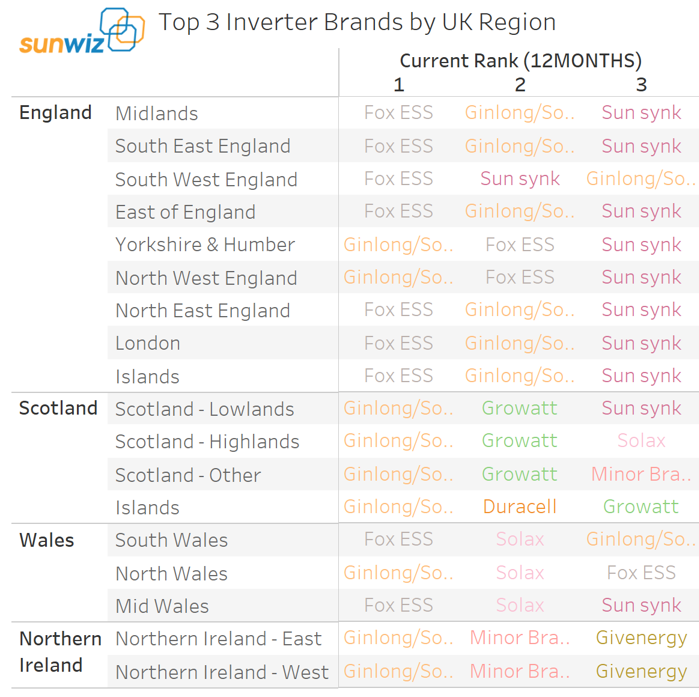
When we break down inverter per region, some clear leaders appear:
-
Fox Ess consistently comes first in most regions in England and Wales.
-
Ginlong/Solis holds top positions in many Scottish regions and parts of North Ireland.
Regional dominance as it can come from many factors:
-
Product market fit-with the right specifications for local project types.
-
Distribution power – Working with wholesalers who have regional reach.
-
Installation relationships – especially where installers specialize in certain technologies.
Another important factor is the association between inverters and batteries, given the high storage confirmation of the UK. This brings us to energy storage systems.
Because batteries are often sold in addition to inverters, it is no surprise that ESS brands show comparable regional patterns.
Reveal our details:
-
Fox Ess leads in many English and Welsh regions and reflects the dominance of the inverter.
-
Dyness is strong in North Ireland; Growatt is doing well in Scotland.
-
Ginlong/Solis is absent in this list.
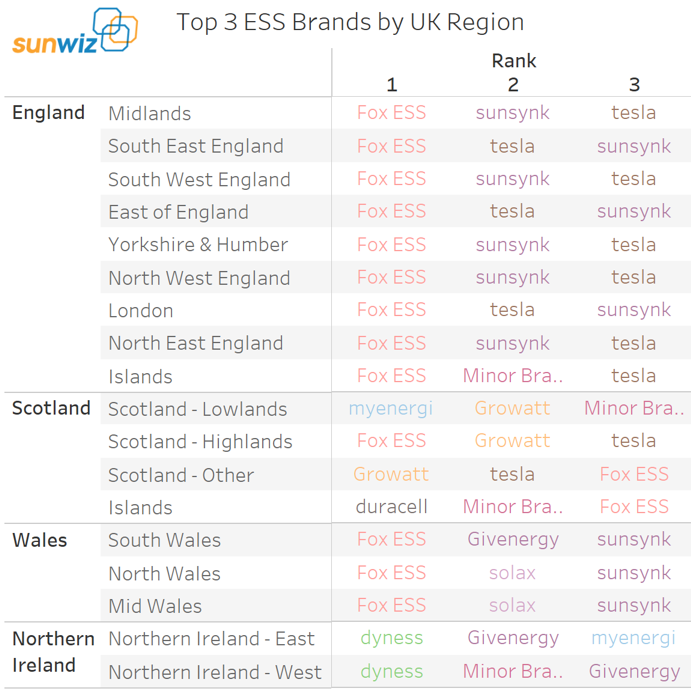
This sleek link between inverters and batteries underlines how success in one product category can strengthen success in another.
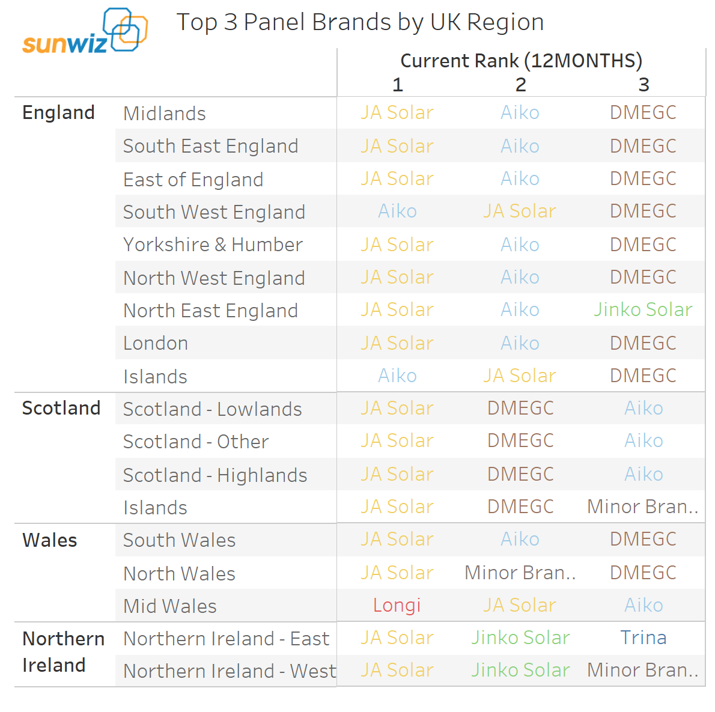
When we look at the top three modula brands per British region, some interesting patterns come to the fore. Yes Solar dominates most regions, which consistently first rank in almost all of England, Scotland, Wales and Noord -IERLAND. This not only indicates the reach of a broad installer, but also a strong distribution network that ensures availability throughout the country.
Other brands show regional strengths that can reflect the fit of the local product market or specific distributors’ relationships.
-
Aiko takes first place in southwestern England and often appears as the second ranked brand elsewhere, which suggests that a growing presence and potential to expand further.
-
DMEGC protects a stable third place in a large part of the UK, which indicates widespread but not dominant adoption.
-
Brands such as Jinko Solar and Longi occasionally appear, hinting at footsteps or holdouts in selected regions such as northeastern England and Mid Wales.
Regional strongholds often serve as launch platforms for national growth. A brand can start by dominating in one area – whether through local product lines, distribution partnerships or early installer relationships – then geographically expand as consciousness and trust.
About panels, inverters and batteries, the data shows that brands win national market share via two important drivers:
-
Installer range – wide geographical coverage through an effective distribution strategy.
-
Installation depth – Offering the right products for the full range of the needs of the installers, which ensures repeated companies.
Brands that reach both not only grow – they support and defend their market share over time.
