

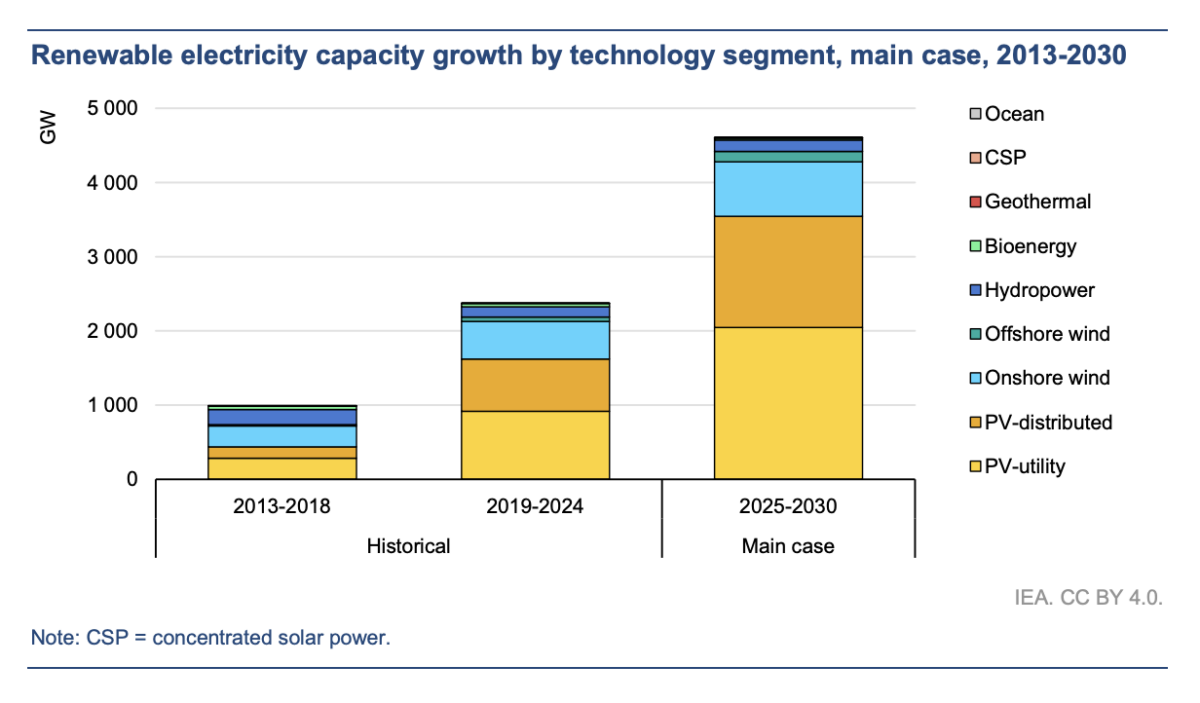
The International Energy Agency (IEA) cut its 2025–30 renewables by 5%, citing lower solar additions, although PV still represents almost 80% of 4.6 TW.
According to the IEA’s latest analysis, approximately 3.6 TW of Solar is expected to be installed worldwide between 2025 and 2030.
The agency’s medium-term forecast report,”Renewable energy sources 2025” predicts that Solar will account for almost 80% of the 4.6 TW of renewable energy that will be added around the world in the second half of the decade.
The report says low costs, faster permitting and broad social acceptance will continue to drive the accelerating adoption of solar energy. Analysis of the year predicts a record year for solar additions in 2025, nearly 600 GW of additional capacity, largely due to an increase in distributed solar applications.
Annual installations are expected to slow slightly between 2026 and 2028, with IEA citing delays in China and the United States linked to evolving policy timelines. The agency then predicts that more than 600 GW of solar will be added in 2029, before getting closer to the 700 GW threshold in 2030.
IEA’s latest report cuts renewable energy growth forecast for 2025-2030 by 5% compared to Last year’s equivalent publicationcorresponding to a loss of 248 GW of renewable capacity.
Solar accounts for more than 70% of this absolute reduction, mainly in utility-scale projects, and is largely due to forecast reductions in China equivalent to 129 GW less solar and the United States.
IEA expects that 140 GW less solar will be installed in the United States by 2030 than last year, due to factors including FEOC restrictions and allowing suspensions on federal lands. The largest relative impact is on distributed solar, and in particular the US residential market, which will be most affected by the planned expiration of solar tax credits at the end of this year.
In contrast, other markets have seen their solar installation forecasts increase. IEA has slightly revised the EU forecast, especially for utility-scale solar capacity in Germany, Spain, Italy and Poland. India’s forecast is up almost 10% across all renewable technologies, while the Middle East and North Africa’s capacity has been revised up by 23%, largely due to faster-than-expected developments in Saudi Arabia.
The report says that 80% of countries will see renewable power capacity grow between 2025 and 2030 than in the past five years. IEA Executive Director Fatih Birol highlighted Saudi Arabia, Pakistan and several Southeast Asian countries as areas to be seen on solar latitudes.
Elsewhere in the report, renewables are expected to become the largest global energy source by the end of the decade, used for 43% of electricity generation by 2030, with solar overtaking hydropower as the largest source of renewable energy source.

IEA’s current projection expects 16,200 TWH of electricity generation from renewable energy sources in 2030, which is almost 850 TWH less than last year’s estimates. It has been reduced due to the revised capacity forecast and increased levels of solar and wind input.
Rising levels of curtailment and negative electricity prices point to the need for urgent investments in grids, storage and flexible generation, the report adds. IEA warns that while several countries are beginning to respond with capacity and storage auctions, much more is needed to ensure that variable renewables are integrated in a cost-efficient and safe manner.
Earlier this year, analysis by London-based data analytics and consulting firm Globaldata forecast that the world will have deployed 4.8 TW of Solar by the end of 2030, 7.6 TW By 2035.
This content is protected by copyright and may not be reused. If you would like to collaborate with us and reuse some of our content, please contact: editors@pv-magazine.com.
Popular content

