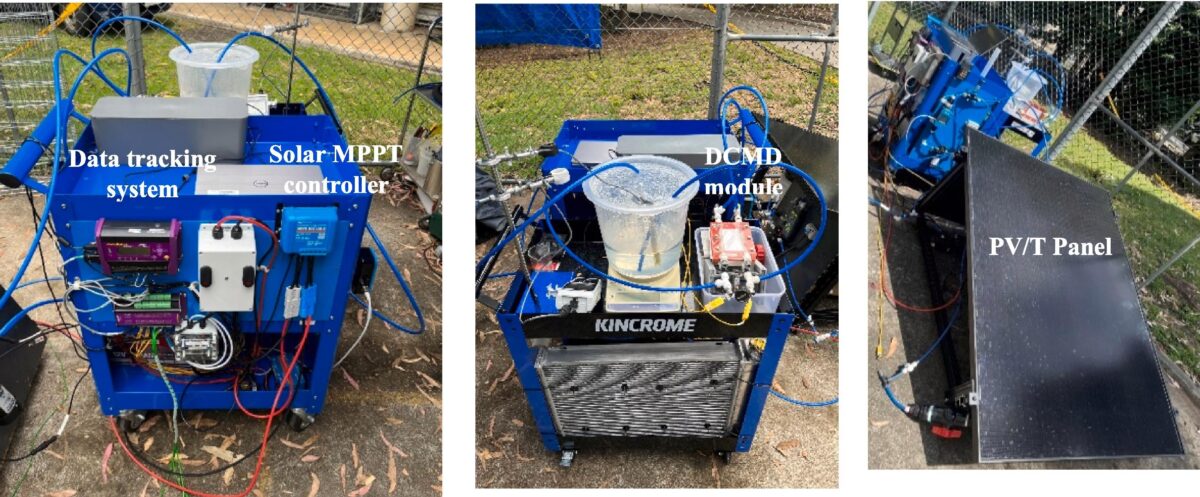
Scientists have designed a PVT-powered direct contact membrane distillation system for off-grid applications. The system is intended for desalination purposes in remote areas.
Researchers from Australia’s Commonwealth Scientific and Industrial Research Organization (CSIRO) Manufacturing have developed a new off-grid direct contact membrane distillation (DCMD) system that operates on photovoltaic/thermal (PV/T) panels.
The proposed system is intended for desalination applications in remote areas.
“The modular and adaptable design aims to provide a practical off-grid solution suitable for regions with limited access to water and energy infrastructure,” the team said. “It can provide an energy-efficient solution for drinking water production in areas where access to freshwater and energy infrastructure is limited.”
DCMD is a type of membrane distillation (MD) process where both sides of the membrane are in direct contact with water. In both DCMD and traditional MD, salt or dirty water is heated, creating vapor that passes through a membrane and traps the impurities in the hot supply side of the system. On the other hand, on the cool, penetrating side, cold conditions cool the vapor and turn it back into liquid water. The “direct contact” portion of the system refers to the fact that both the hot and cold sides are in direct contact with the membrane.
The experimental setup is based on a laboratory-scale DCMD module with an effective membrane area of 0.008 m2, using polytetrafluoroethylene (PTFE) membrane with a pore size of 0.22 μm or 0.45 μm. The PV/T panel has an electrical power of 375 W and a thermal power of 660 W. The electrical power is used to drive a 12 V pump that circulates water through the system, and two DC fans of 100 W each to cool the fresh water. serves as a coolant on the cool side and as a backup 12V battery.
“The feed water was circulated through the heat exchanger (HEX) at the back of the PV/T panel, raising the temperature at the feed inlet of the MD system to a range of 40-70 C,” the researchers said. “The PV/T panel can accommodate 5 liters of circulating heat transfer fluid. To maintain a constant salinity in the feed tank, fresh water is pumped from a 5 liter permeate water tank.”
Photo: CSIRO Production, Solar Energy, CC BY 4.0
In the laboratory experiment with the system, an electric AC heater was used to maintain a constant bath heater temperature of 60 C and a feed tank temperature of 52 C. The outdoor experiment took place over two weeks of the Australian summer. In the first week, the scientists used a membrane with a pore size of 0.22 µm, while in the second week they used 0.45 µm. During the first and second tests, average ambient temperatures of approximately 29°C and 36°C were observed. Solar radiation varied considerably between 100 W/m2 and 1300 W/m2.
“The fluctuating environmental conditions of the outdoor trials led to inconsistent operating temperatures, such as outdoor coolant inlet temperatures ranging from 22°C to 38°C and feed inlet temperatures between 40°C and 50°C, compared to more stable indoor conditions (22°C for permeate inlet temperature and 55°C for feed inlet temperature) ,” said the academics.
The recorded average permeate flux in the outdoor experiment ranged between 8-16 kg/m2h outdoors, compared to 22-30 kg/m2h indoors. Flux refers to the rate at which purified water flows through the membrane. The average output ratio (GOR) gained by the system was calculated to be approximately 0.60 in the first trial and 0.66 in the second trial. GOR measures how effectively thermal energy input is used to produce clean water.
“The energy consumption of the system was measured at 130-140 W, approximately one third of the PV/T power, while the maximum power generation was 280 W in battery charging mode,” they pointed out. “The thermal and electrical efficiencies ranged from 10-18% and 15-20% respectively. The cooling effect of the PV/T panel was measured between 1.5 C and 2 C, resulting in a marginal electrical power improvement of approximately 0.8-1.2%.”
All details about the system can be found in “Sustainable desalination through hybrid photovoltaic/thermal membrane distillation: development of an off-grid prototype”, published in Solar energy.
This content is copyrighted and may not be reused. If you would like to collaborate with us and reuse some of our content, please contact: editors@pv-magazine.com.
Popular content