

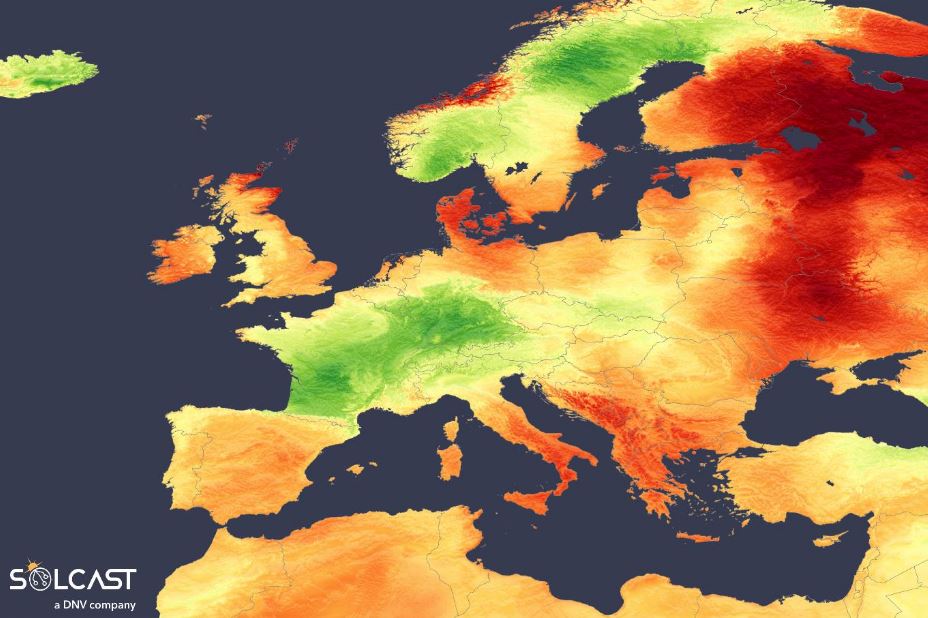
In a new weekly update for pv magazineSolcast, a DNV company, reports that September was dominated by a persistent high-pressure system centered over Eastern Europe. This atmospheric blocking pattern suppressed cloud formation and created ideal conditions for solar radiation over a wide swath of the continent.
Europe’s solar industry saw mixed radiation patterns in September as widespread high-pressure conditions delivered above-average radiation across much of the continent, even as severe floods and storms disrupted solar potential in key regions such as France, Italy and the United Kingdom. This variability is expected to continue, with a clear north-south split in forecast conditions for the remainder of fall, according to analysis using the Solcast API.
September was dominated by a persistent high pressure system over Eastern Europe. This atmospheric blocking pattern suppressed cloud formation and created ideal conditions for solar radiation over a wide swath of the continent. Many regions
recorded radiation levels that were more than 10% above the long-term average. Notably, Finland experienced its third warmest September on record, and from September 19 to 22, a heat dome increased temperatures by as much as 15 degrees Celsius in just 48 hours in central and southern Africa.
Eastern European regions. These conditions allowed solar energy in these regions to take advantage of the exceptional solar radiation in late summer.

However, the same high-pressure system contributed to unstable weather on the western flank. The low pressure over Britain attracted moist Atlantic air, increasing cloud cover and rainfall in France and parts of eastern Germany, where insolation fell about 15% below normal. High surface temperatures in the Mediterranean Sea further increased atmospheric instability, coupled with a southward-shifted jet stream that enhanced thunderstorm development. This led to flash flooding in several regions of France and Italy, with parts of northern Italy receiving up to 100mm of rain in 24 hours. These conditions severely limit solar energy production in the affected areas.
October started with more extreme weather. Storm Amy brought record winds to Britain and Ireland, with gusts of more than 100 miles per hour and causing widespread power outages. The storm system also brought extensive cloud cover and rain, which were already poor
irradiation levels in Northwestern Europe.
Looking ahead, forecasts indicate a significant meteorological gap. In northern Europe, particularly northern Britain and southern Norway, it is expected that there will be up to 25% more rainfall and 10% more cloud cover than average, leading to a 5% reduction in solar radiation in some regions. In contrast, Southern Europe is likely to benefit from continued high-pressure dominance. Spain and Italy are forecast to experience a reduction in cloud cover of up to 10% and 25% less precipitation, supporting stronger solar conditions until late autumn.
Solcast produces these figures by tracking clouds and aerosols worldwide at a resolution of 1-2 km, using proprietary satellite data AI/ML algorithms. This data is used to drive irradiance models, allowing Solcast to calculate high-resolution irradiance, with a typical deviation of less than 2%, as well as cloud tracking predictions. This data is used by more than 350 companies that manage more than 300 GW of solar energy worldwide.
The views and opinions expressed in this article are those of the author and do not necessarily reflect those of the author pv magazine.
This content is copyrighted and may not be reused. If you would like to collaborate with us and reuse some of our content, please contact: editors@pv-magazine.com.
Popular content

