

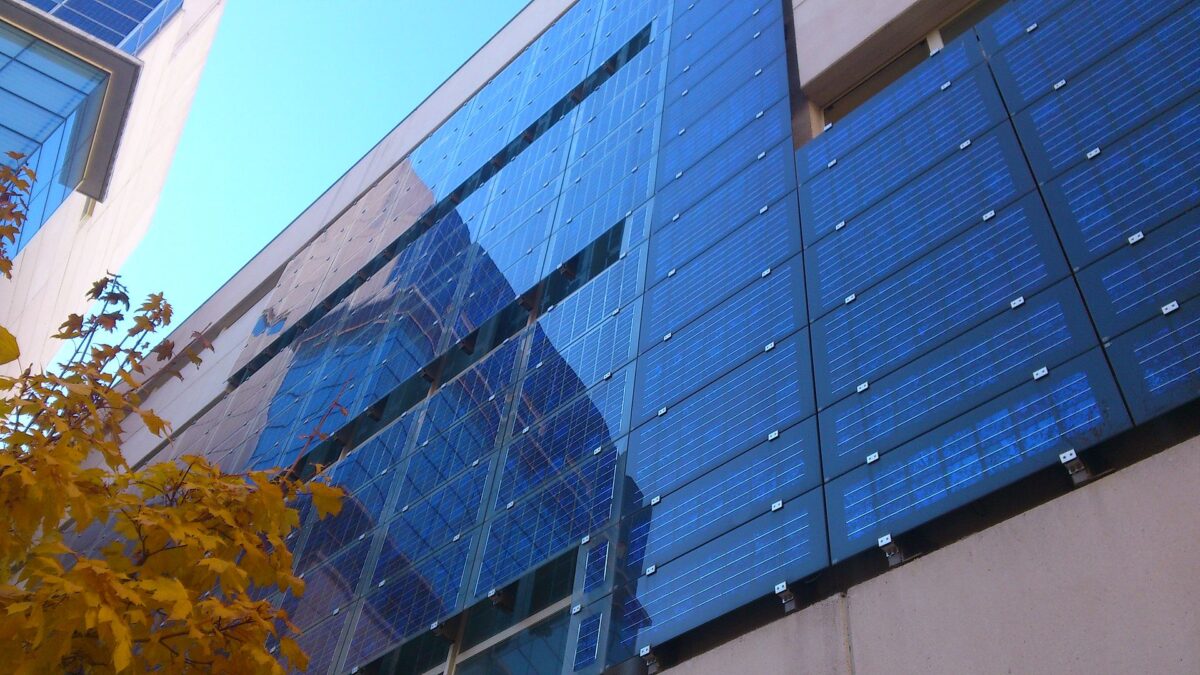
Researchers in Germany have investigated how battery storage could help facade PV systems expand beyond their niche market by 2030. Their findings show that a large majority of south-facing facades in Europe could be equipped with vertical solar panels in combination with batteries.
Scientists from the German Institute for Solar Energy Research Hamelin (ISFH) have investigated how battery storage can improve the performance of south-facing photovoltaic (PV) facades and found that integrating batteries significantly improves the economic feasibility of these vertical solar systems, which are often dismissed as too expensive or insufficiently productive.
“In our research we were able to clearly demonstrate that battery storage is an important driving factor behind the economic viability of PV facades,” said the study’s lead author Dennis Bredemeir. pv magazine. “We were able to demonstrate this by performing our calculations both with and without battery storage in the building’s energy system. Without the battery storage, the share of PV modules on the south facade is very low across Europe. However, adding the battery to the same scenario results in a share of PV modules on the south facade well above 80% for large parts of Europe. This can clearly be linked to the favorable seasonal generation profile of facade PV.”
Bredemeir and his colleagues conducted their techno-economic cost analysis for 2030.
“For PV we assumed capital expenditure (CapEx) of €760 per kW, while for battery storage we assumed €150/kWh. At this low cost, battery storage is being built across Europe, allowing the potential of the south facade to be realized. Interestingly, there is a recent publication indicating that even this low cost assumption may be too pessimistic,” he said, referring to the study.Are we too pessimistic? Cost forecasts for solar photovoltaics, wind energy and batteries overestimate actual costs worldwide”, published in Applied energy by scientists from Finland’s LUT University.
The German researchers did not take public incentives into account in their calculations, with the optimization based on capex, operational expenditure (OpEx), electricity sales prices and income from feeding excess electricity back into the grid.
“We use a value of € 0.02/kWh for the feed-in tariff, because we assume that this will be a realistic value that can be achieved on the electricity spot market in 2030,” Bredemeier explains. “Under these assumptions, facade PV can be economically viable without subsidies. This is in comparison to PV on east or west-facing roofs. However, if a south-facing roof is available, it will be fully utilized before any other surface is used.”
The scientist conducted a sensitivity analysis for the costs of facade modules in relation to standard modules.
“For this we assumed 20% higher costs for the facade modules compared to the standard modules,” he emphasized. “Our findings show that even with these higher costs, solar facades are being built in many places. Of course, the attractiveness of PV on facades would decrease if we were to assume even higher costs for BIPV modules. However, the special advantage of BIPV modules is that, in addition to generating electricity, they also provide functions such as facade and thermal insulation.”
The researchers presented a case study for a single-family home (SFH) with sloping roofs and without shading from PV modules. The 3.5-4.5 kW solar facade is believed to supply excess energy to the grid or store it in the battery, with electricity from the grid only used when solar generation or stored energy is not available.
The analysis showed that without battery storage the ratio of installed PV power on south facades to total installed PV power is approximately 30% in large parts of Europe, while adding batteries appeared to result in a pronounced increase in this share to approximately 80%.
“The south facade becomes the only surface used in many regions, especially between 45°N and 65°N,” the scientists further explained. “Even with the assumption of 20% higher CapEx for PV installations on facades, the share of south facades is still around 50% in the above-mentioned region. This result becomes even more apparent when additional heating and cooling demand is added to the building.”
Their work is presented in the newspaper “Falling battery storage costs make photovoltaic facade systems more attractive to prosumers”, published in Applied energy.
This content is copyrighted and may not be reused. If you would like to collaborate with us and reuse some of our content, please contact: editors@pv-magazine.com.
