

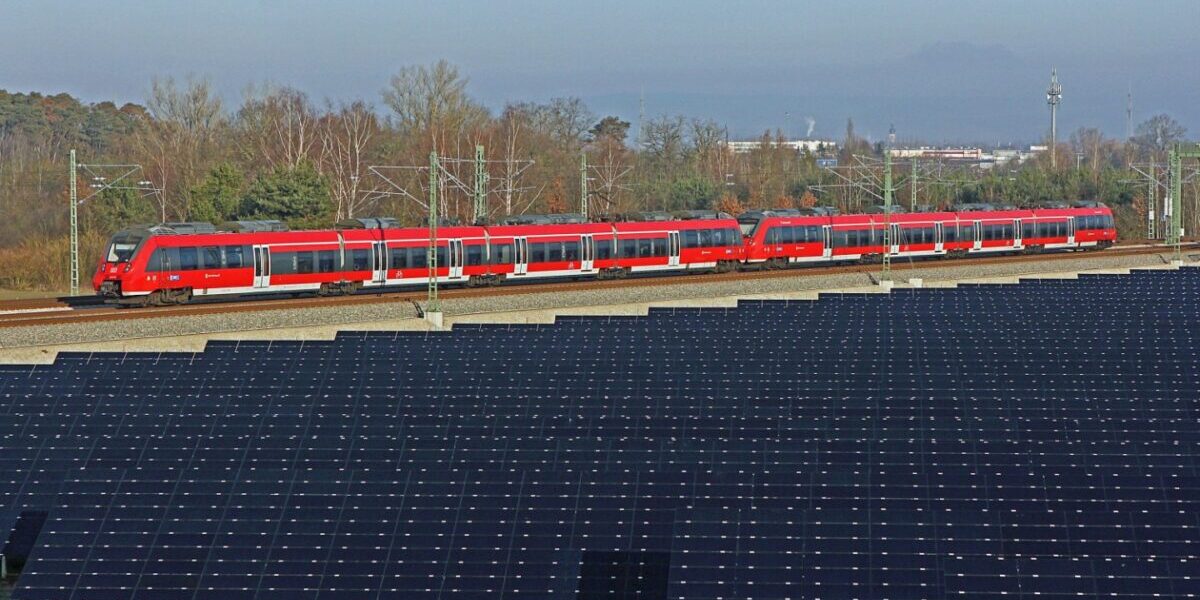
The Fraunhofer Institute for Solar Energy Systems (ISE) says that PV systems within a 2 km radius of German railway stations can generate more than four times the annual power demand of the network.
Germany’s Fraunhofer ISE has identified significant potential for the deployment of solar energy along the German railway network. It found that areas within a 2 km radius of a substation could host up to 37.6 GW of solar capacity.
The institute said converters that enable direct feed back into the rail network will be key to overcoming regulatory and market barriers that have so far limited such installations. The findings emerge from the “PV4Rail” research project, funded by the Federal Ministry of Economic Affairs and Energy, which aims to directly integrate PV into the country’s 16.7-hertz single-phase rail network.
“However, a significant part of the energy demand in the railway network could be covered by solar energy, because the potential for photovoltaic areas along railway lines is many times greater than the amount of energy required in the railway network,” says Andreas Hensel, PV4Rail project manager at Fraunhofer ISE.
Fraunhofer ISE estimated an annual generation potential of 32,920 GWh from solar energy systems near railway stations, compared to around 7,500 GWh of electricity demand for rail transport in 2023. The potential could be even greater given the nearly 8,000 km electricity grid operated by national railway company Deutsche Bahn.
Although Germany has tried several pilot projects, these have been limited by grid compatibility and inverter technology. Vensys Elektrotechnik GmbH, partner in the project, has developed a 2 MW central inverter, divided into two 1 MW sections. One of the units, tested in the Fraunhofer ISE laboratory, achieved an efficiency of 96.6%.
Fraunhofer ISE has also developed control systems for the operation of grid-forming inverters, analyzing connection options based on system size. PV systems up to 5 MW can be powered directly from overhead lines, while systems up to 12 MW must connect via busbars at substations. Larger systems, up to 40 MW, would require special substations with transformers and switchgear to integrate into the 110 kV rail network.
Austria has already demonstrated large-scale integration of solar energy into its rail network, with several systems of more than 10 MW supplying power directly to the network. However, Fraunhofer noted that grid connection standards differ between Austria’s ÖBB and Deutsche Bahn.
Due to the technical and safety requirements of the German railway network, only voltage-boosting inverters can currently be used. Fraunhofer said this behavior has been validated in simulations as part of the PV4Rail project and could progress to real-world implementation in a follow-up phase.
This content is copyrighted and may not be reused. If you would like to collaborate with us and reuse some of our content, please contact: editors@pv-magazine.com.
