

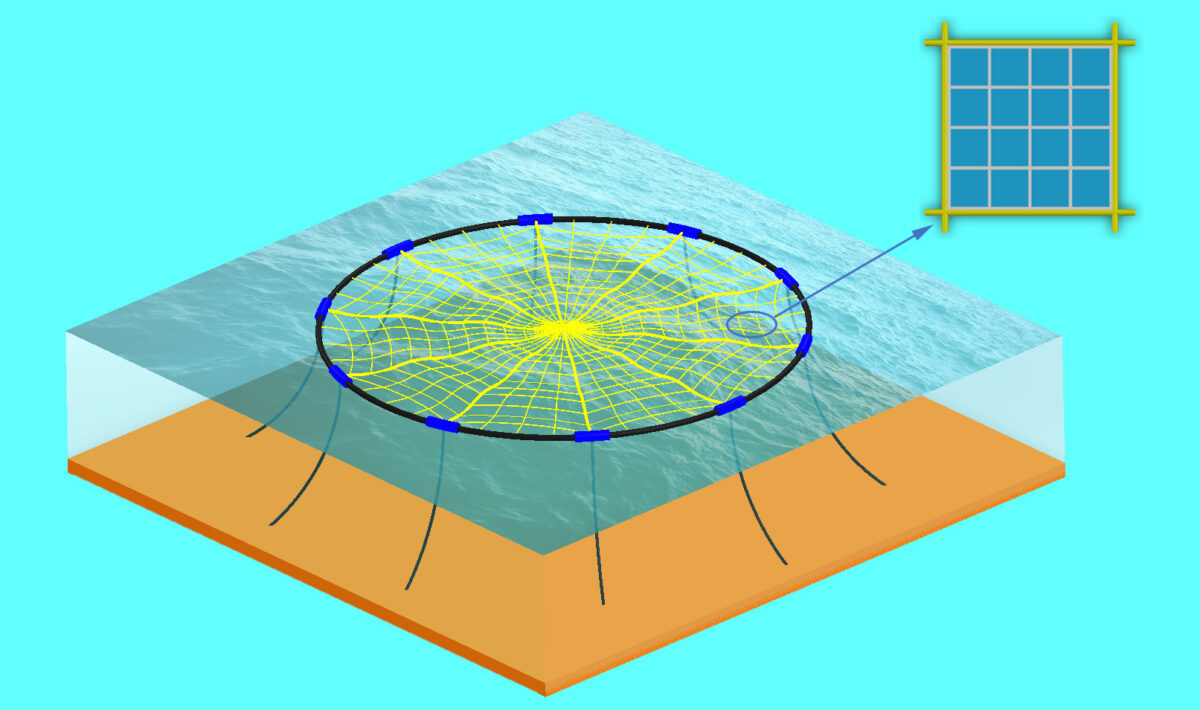
Scientists in the UK have developed a new web-inspired concept for floating PV farms, modeled after spider webs. The system would be particularly suitable for spiral and radial configurations, but also for deployment between offshore wind farms.
A group of researchers from Scotland’s University of Strathclyde have proposed a new web concept of floating PV farms (FPV).
The technical feasibility of the design was analyzed using the Morison model, a method commonly used to assess wave loads in the design of oil platforms and other offshore structures. Various FPV configurations were investigated to evaluate the effects of environmental loads and other parameters.
“The floating concept for FPV proposed in our paper is a nature-based solution inspired by spider webs, which innovatively builds a large elastic web frame on the ocean surface to house modular solar power plants,” first co-author Zhi-Ming Yuan said. pv magazine. “The remarkable characteristics of spider webs, including low material costs, high damage tolerance, resistance to impact loads and good recoverability, are exactly what we desperately need for the next generation of floating offshore solar farms.”
The researchers proposed two design concepts based on the type of web structure. The first uses web frames composed of both spiral and radial lines, allowing the system to deform with waves as a uniform structure. The alternative configuration involves deploying the system between offshore wind turbine towers, which provide structural support for the web. In both designs, the PV array has a square layout.
“As the main force-bearing components, elastic ropes are used to create a flexible web frame, so that the waves on the open sea are absorbed by elastic deformation of the frame,” Yuan said. “The new concept has great potential to be scaled up in size and capacity from several MW to GW to handle different offshore applications.”
To analyze the distribution of the load on the ropes, the researchers used the simulation tool Riflex, that is used for static and dynamic analysis of slender marine structures. The research focused on PV arrays with configurations of 1 × 1, 2 × 1, 3 × 1 and 3 × 3 modules. Each module was 2 meters long and wide, with a height of 0.8 meters and a gap of 1 meter between the modules.
The synthetic ropes used in the simulations had a material density of 1.65 kg·m⁻¹ in water, a diameter of 38 mm and a minimum breaking strength of 219 kN. The wave directions tested were 0°, 22.5°, 45°, 67.5° and 90°, with wavelengths ranging from 50 to 200 meters. A cable break scenario was also simulated.
“The most surprising result is that the motion phase for floating PV modules is more important than the motion amplitude. When the long and large waves arrive, the solar panels installed on the flexible web frame, consisting of both spiral and radial lines, deform with the waves as a uniform structure,” Zhi-Ming explains. “The phase angle of the movements between adjacent modules is very small, indicating negligible relative motion between adjacent modules. This means that the system transfers the loads elegantly – dancing with the waves rather than working against them. This would avoid ‘snap loads’ on ropes and floats, achieving excellent survivability in the open sea.”
For the 1 × 1, 2 × 1, and 3 × 1 module configurations, both the motion and cable tension responses showed similar performance under different wavelengths. However, in the 3 x 3 module array, when the wave propagation direction was aligned parallel to one of the ropes, the resulting stress distribution became highly unbalanced, significantly increasing the risk of failure.
“The design and research of this web-like floating PV farm is still in an early proof-of-concept stage. The Strathclyde team is actively promoting the commercialization of this web-like concept and technology,” Zhi-Ming concluded. “They are working with other academic and industrial partners in Europe, including Seaflex, Sperra and Sunsurf, to form partnerships and consortia to apply for funding from the EU. If successful, we will increase the Technology Readiness Level (TRL) to 4 over the next three years.”
The system was described in “A new web type concept of floating photovoltaic farms in an open sea environment”, published in Engineering.
This content is copyrighted and may not be reused. If you would like to collaborate with us and reuse some of our content, please contact: editors@pv-magazine.com.
