

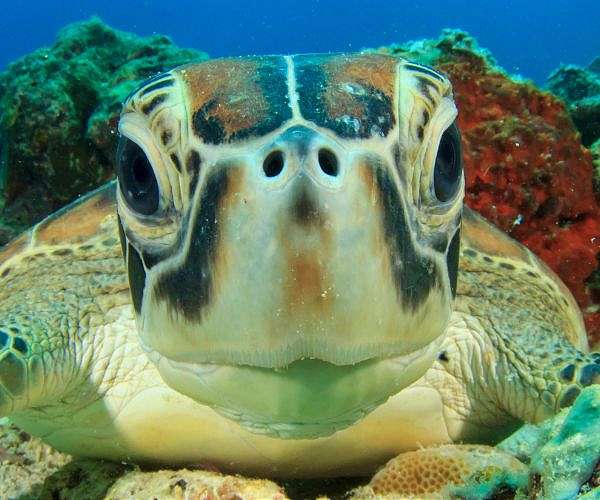
Solar lighting keeps sea turtles out of fishing nets
Studies have shown that lighted nets can reduce bycatch of sea turtles and sharks, but the idea has faced many hurdles to adoption. The batteries have a short lifespan, are expensive to replace and pose disposal problems. The lamps are too heavy and can easily get caught on nets. Fishermen find it difficult to work with it.
To overcome these hurdles, researchers at Arizona State University worked with a team of coastal gillnet fishermen to develop solar-powered lights that function as buoys, just like any other strung on the drift line of a fishing net. The LED lights flash on and off to save energy and can remain active for more than five days without sunlight.
The net-relieving gear is highly effective at preventing sea turtles from becoming entangled in gillnets, ASU marine biologist Jesse Senko and colleagues report in a new study published in Conservation Letters. In controlled experiments in Mexico’s Gulf of California, sea turtle bycatch rates were 63% lower in illuminated solar nets compared to unlit control nets. And the lighted buoys had no effect on the success of the fishing. The researchers recorded higher catch rates of targeted yellowtail fish in the lighted nets, although the difference was not statistically significant.
“The results were quite exciting,” said Senko, an assistant professor at ASU’s School of Ocean Futures. He said the study is the first to demonstrate the effectiveness of harnessing solar energy and flashlight to deter sea turtles from fishing nets. “It’s a win-win in that you get a lamp that lasts significantly longer, and it also appears to reduce bycatch as effectively as lamps that require replaceable batteries.”
Fishing gear entanglement is a primary threat to endangered sea turtles, along with climate change, pollution, habitat loss and emerging diseases. Despite signs of recovery in some species, current population numbers remain a small fraction of the total that once existed.
“Sea turtles are important for maintaining healthy oceans, which are necessary for resilient fisheries,” Senko said. “They have existed for more than a hundred million years and fulfill ecological roles that no other species fulfills.”
Senko has made it a priority in his lab to work with fishermen to develop ways to make fishing gear less harmful to sea turtles, sharks and other endangered species. The goal is to develop practical solutions that can be deployed at scale to reduce wasteful bycatch while maintaining productive fisheries.
In coastal North Carolina, where many forces have threatened fisheries’ way of life, Senko Lab members are working with fishermen to reduce bycatch in pound nets, bottom-anchored net systems that trap fish. The ASU researchers compared the numbers of turtles, sharks and other species caught in nets on days with or without solar lights. They are also collecting observations of never-before-seen sea turtle behavior using custom-designed underwater video cameras and data recorders.
Maintaining a resilient fishery
Small-scale coastal fisheries supply almost half of the world’s seafood fisheries, Senko points out, and are critical to maintaining coastal communities’ food, income and livelihoods.
The idea for integrating solar-powered LED lighting into buoys came from fishermen in Mexico, brothers Juan Pablo Cuevas Amador and Felipe Cuevas Amador, who are co-authors of the new study.
“They took us into account and gave us the freedom to express our opinions and make changes,” said Juan Pablo Cuevas Amador. “For us it’s important that it’s done collaboratively, because with what they know and what we know, we can do some pretty interesting things.”
Senko said fisher-led ideas are “where the real magic happens; that’s the meaningful innovation. Because their ideas are incorporated, they’re more likely to want to use it and share that information with their friends and their community and with neighboring communities.”
After completing the fishing experiments, the Cuevas Amador brothers asked Senko if they could keep the solar-powered lighted buoys. The equipment made fishing easier because they no longer had to waste a lot of time and effort removing turtles from the nets.
“When I heard that, I knew we were on to something,” Senko said. “And they’ve been fishing with these lights ever since. As far as we know, they are the only fishermen in the world fishing with solar-powered illuminated nets.”
Senko and colleagues are now working with a manufacturer, Fishtek Marine, to produce commercially available illuminated solar-powered buoys for fishing nets. Senko said it is possible to make them available for purchase within two to three years. Research into their effectiveness could encourage conservation groups and government agencies to provide subsidies to help fishermen purchase them. Senko has received funding for the research from Schmidt Marine Technology Partners, the Disney Conservation Fund and the National Philanthropic Trust.
The researchers are conducting future studies to understand sea turtles’ behavioral responses to flash lights, and using that knowledge to maximize the deterrent effects of net lighting.
“A 63% reduction in sea turtle bycatch is a great starting point. But there’s no reason why that can’t be improved, right?” says Senko. “My goal is: how do we get that reduction from 63% to a reduction of 95%.”
Research report:Harnessing solar energy to reduce sea turtle bycatch
