

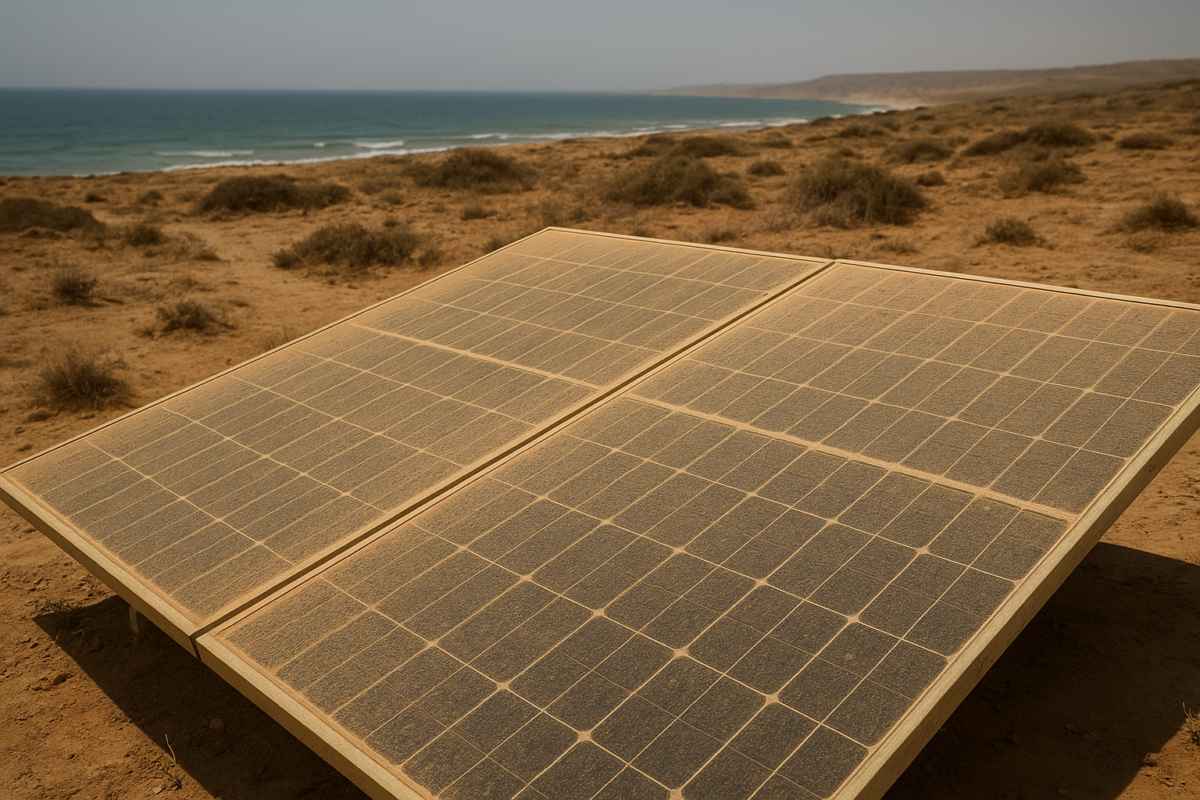
A Saudi-Egyptian research team examined the effects of four types of dust on photovoltaic panels in dry coastal environments and found that energy losses can be up to 48%.
A research team led by Saudi Imam Abdulrahman Bin Faisal University has conducted an experimental study on how different fabric compositions affect photovoltaic performance. The study examined four types of dust – montmorillonite, kaolinite, bentonite and natural dust – on solar panels operating in dry coastal environments.
“The findings of this study have practical implications for optimizing PV maintenance in arid coastal areas,” the group explains. “By linking dust composition to degradation mechanisms, stakeholders can prioritize cleanup schedules or select coatings tailored to dominant minerals. For example, hydrophobic coatings can reduce moisture-induced adhesion in calcium-rich environments, while iron-rich areas can benefit from thermally resistant materials.”
The experiments were conducted in Jubail, a city on the Persian Gulf coast of Saudi Arabia, classified as BWh (hot desert) under the Köppen climate system. A 20W polycrystalline PV panel was used for outdoor performance testing between September 9 and 29, 2025. At maximum power, the panel delivered a current of 1.14 A and a voltage of 17.6 V, with an open-circuit voltage of 21.1 V and a short-circuit current of 1.29 A.
The montmorillonite, kaolinite, and bentonite clays were obtained as commercial mineral powders and sieved to less than 45 μm. Natural dust samples were manually collected from glass surfaces exposed to environmental conditions in Jubail. The dust deposition was carried out in seven stages, starting with a surface density of approximately 1.0 g/m² and gradually increasing to approximately 7.0 g/m². Measurements were taken after each deposition phase.
“Mineralogical analysis via SEM-EDX revealed several compositional profiles that directly correlate with performance degradation patterns,” the academics said. “Natural dust, characterized by a high content of silica (25.37%) and calcium oxide (30.52%), emerged as the most harmful contaminant, causing an energy loss of 48% at a deposition density of 6 g/m2 by combined light scattering and hygroscopic cementation.”
Calcium-rich dust was found to be especially problematic in coastal conditions, where increased humidity (40-65% relative humidity) converts loose particles into adhesive layers that resist natural cleaning mechanisms. In contrast, the increased iron content of montmorillonite (62.67%) contributed to the thermal degradation, increasing the panel surface temperature to 40.4 C and decreasing the open-circuit voltage.
“Humidity emerged as a critical amplification factor rather than an independent stressor, reducing efficiency by 15-30% when relative humidity exceeded 60%. This threshold marks a transition from reversible fouling to cemented adhesion, where capillary forces bind dust particles to the PV surface with sufficient force to resist removal by wind,” the academics further explained. “The daily analysis showed that optimal energy generation occurs during morning hours with low humidity (8:00–11:30 am, efficiency 12–13%), while afternoon periods experience 20–25% efficiency losses.”
The team also found that particulate pollution significantly affected performance degradation, with the Air Quality Index (AQI) showing a stronger negative correlation with efficiency than humidity alone. “At AQI levels above 160, the combined effects of light scattering by airborne aerosols and surface contamination reduced conversion efficiency to below 10%, even at moderate dust deposition densities (3-4 g/m2),” they concluded.
Their findings are available in “Experimental and modeling research on the impact of dust composition on photovoltaic performance in dry coastal environments”, published in the Journal of Materials Research and Technology. Scientists from Saudi Imam Abdulrahman Bin Faisal University, Egypt’s Atomic Energy Authority and Egypt’s Ain Shams University participated in the study.
This content is copyrighted and may not be reused. If you would like to collaborate with us and reuse some of our content, please contact: editors@pv-magazine.com.
