

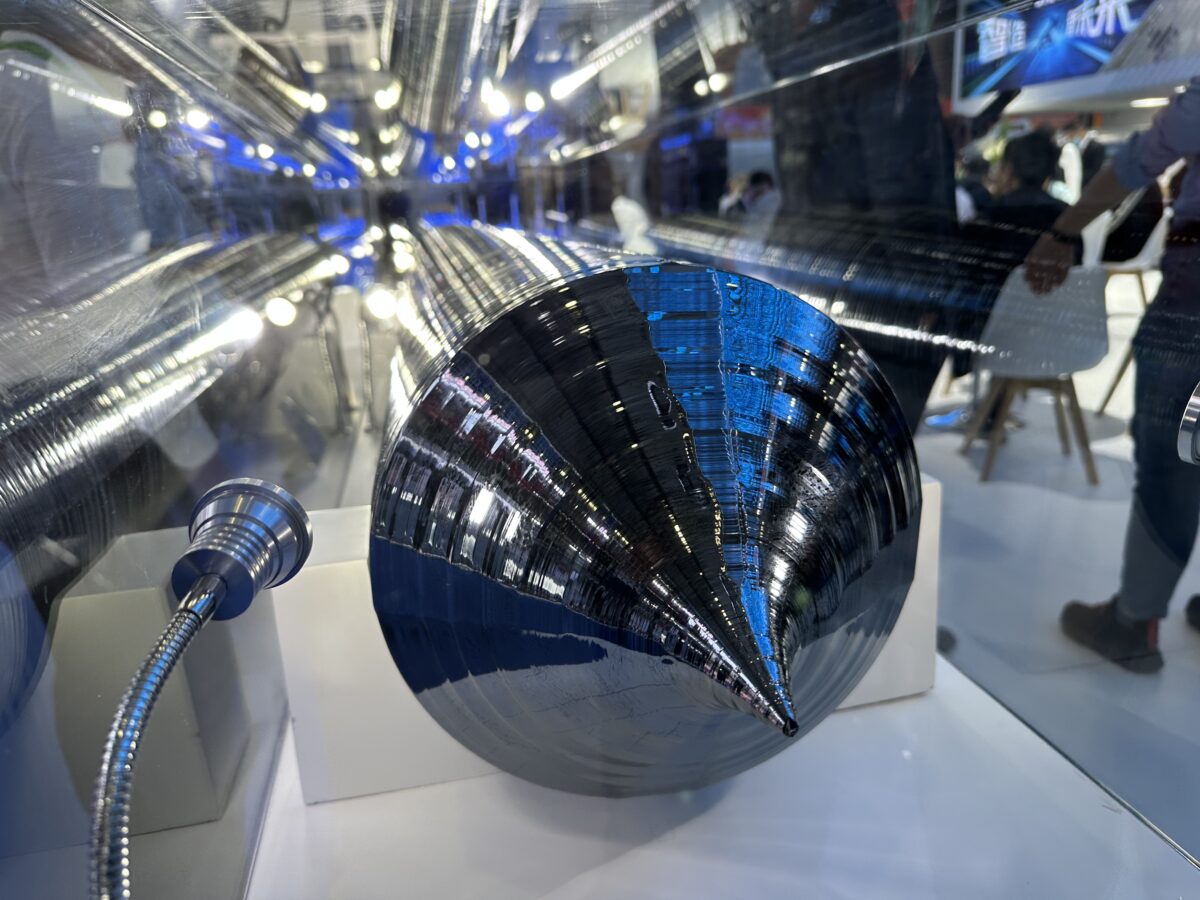
An international team proposes using antimony-doped silicon from Czochralski as an alternative to n-type silicon for photovoltaic applications. Their analysis showed that 140 μm as-cut planar antimony-doped wafers exhibit slightly higher mechanical strength compared to plain wafers doped with phosphorus.
A team led by the Australian National University has investigated antimony (Sb)-doped Czochralski silicon as an alternative n-type substrate for solar PV applications in a study that included characterization of axial resistance distribution, donor properties and mechanical strength.
“This study has clarified why antimony-doped n-type silicon rods can achieve a uniform resistance distribution despite the very low segregation coefficient of antimony. We have shown that the key factor is the controlled evaporation rate of Sb during Czochralski growth, and not co-doping with phosphorus as often speculated,” corresponding author Rabin Basnet told us. pv magazine.
The study, which appears in “Resistance distribution and donor properties of antimony-doped n-type Czochralski silicon rods”, published in Solar energy materials and solar cells, helps “explain how the industry has succeeded in producing uniform Sb-doped blocks and provides a scientific basis for optimizing doping uniformity in next-generation wafers,” Basnet said.
Although the use of Sb for wafer doping in photovoltaic applications is new, Sb is a “well-established n-type dopant” in semiconductor device production, according to the researchers.
In previous work on this topic, “High quality antimony doped n-type silicon wafers for solar cell applications”, published in Solar RLL, the group showed that “switching the donor dopant from phosphorus to antimony does not compromise the bulk lifetime of n-type Czochralski (Cz) wafers, according to Basent.
“Building on this, the current paper shows that antimony doping also enables highly uniform resistivity along the axial direction of the Cz-Si rod. Together, these findings indicate that Sb-doped n-type Cz wafers are considered a strong candidate to become the industry standard for the next generation of n-type wafers,” Basent said.
The researchers used Sb- and phosphorus-doped (P-doped) silicon wafers grown via the Cz rod charging process and supplied by Chinese manufacturer Longi Green Energy Technology. For testing, it relied on electron paramagnetic resonance (EPR) spectroscopy to assess donor and dopant-related characteristics and electrical resistance. The bending strength was tested as standard with a three-point bending setup.
On the modeling side, the team noted that to evaluate the viability of Sb for this application, the conventional model, based on Scheil’s equation, had to be modified to take into account both “segregation and evaporation effects as well as the mechanisms of incorporation.”
“It was initially surprising that Longi achieved such a uniform resistivity distribution with Sb doping alone. Given that antimony has a segregation coefficient almost an order of magnitude lower than that of phosphorus, one would expect significant axial variation. However, our analysis revealed that precise control of Sb evaporation during crystal growth, rather than co-doping (as revealed by EPR analysis), explains the observed uniformity, an unexpected and technically elegant solution,” Basnet explains.
The significance of the findings for manufacturers is that uniform resistance distribution increases the yield of usable blocks, improves wafer production efficiency and reduces material costs, Basnet said. He added that one benefit of the mechanical strength of Sb-doped wafers is reduced breakage during cell processing, improving throughput and yield.
The research team plans to continue investigating Sb doping, including its impact on carrier lifetime, defect formation and recombination behavior of minority carriers. Plans include comparative studies of thermal stability between Sb-doped and P-doped wafers during processing, along with device-level evaluation of Sb-doped wafers in high-efficiency solar cells to assess electrical and reliability performance, Basnet said.
The research team included participants from Longi Green Energy Technology, Colorado School of Mines and the U.S. Department of Energy’s National Renewable Energy Laboratory.
Last year, a research team from ANU and Longi reported the results of a study on gettering for improvements in the quality of n-type wafers, as reported by pv magazine.
This content is copyrighted and may not be reused. If you would like to collaborate with us and reuse some of our content, please contact: editors@pv-magazine.com.
