

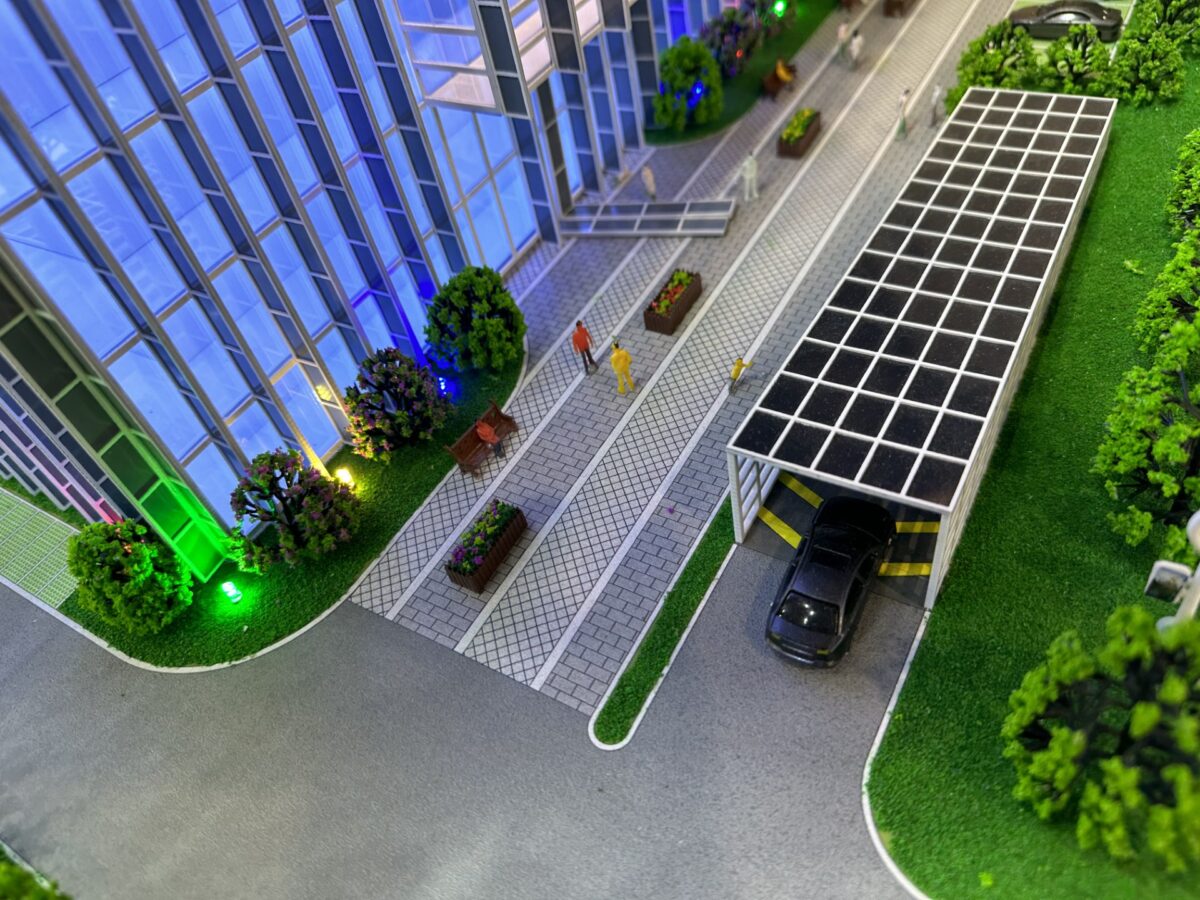
The South Korean government says all public parking lots larger than 1,000 square meters will be required to install solar energy systems from the end of this month, as part of a nationwide policy to accelerate the adoption of renewable energy in urban areas.
South Korea’s Ministry of Climate, Energy and Environment (MCEE) has revealed that it will enforce a new rule requiring solar installations in all public parking lots over 1,000 square meters from November 28, 2025, following Cabinet approval of an amendment to the country’s renewable energy law.
The decree stipulates that all public parking facilities managed by national, regional or municipal authorities must install renewable energy systems, such as solar panels, from the end of November.
Facilities with a total area of at least 1,000 square meters will be required to install systems capable of generating at least 1 kW per 10 square meters – which, according to the MCEE, is a minimum of 100 kW in total.
The ministry said the measure aims to accelerate the deployment of renewable energy in urban areas with available grid access and to improve land use efficiency by using public parking lots for solar energy generation. It has already expanded renewable energy adoption through the Renewable Portfolio Standard for energy producers and a mandate requiring installations in public buildings.
Consultations will take place with local governments and public agencies to finalize implementation plans and align renewable energy policy objectives. Starting in December, regional briefings will take place in 11 metropolitan areas, including Seoul, supported by new information materials to help with the rollout, the MCEE said.
“Requiring renewable energy installations in public parking lots is a way to improve the efficient use of national land through public sector leadership in renewable energy deployment,” the MCEE said in an online statement. “We will continue to expand the adoption of renewable energy in various ways to contribute to a low-carbon green transition.”
The new public parking mandate complements a broader range of recently introduced initiatives as South Korea looks to expand solar energy deployment across multiple sectors. For example, in October the central government announced a draft law to establish a legal framework for agrivoltaic energy, allowing the deployment of solar energy on agricultural land while ensuring food security.
In addition, the Korea Technology and Standards Agency (KATS) recently introduced national standards for photovoltaic thermal (PVT) modules. It noted the active presence of ten domestic manufacturers and said it is committed to international standardization to support eventual global expansion.
South Korea installed approximately 2.5 GW of new solar capacity in 2024, bringing its cumulative PV capacity to approximately 29.5 GW at the beginning of this year.
This content is copyrighted and may not be reused. If you would like to collaborate with us and reuse some of our content, please contact: editors@pv-magazine.com.
