

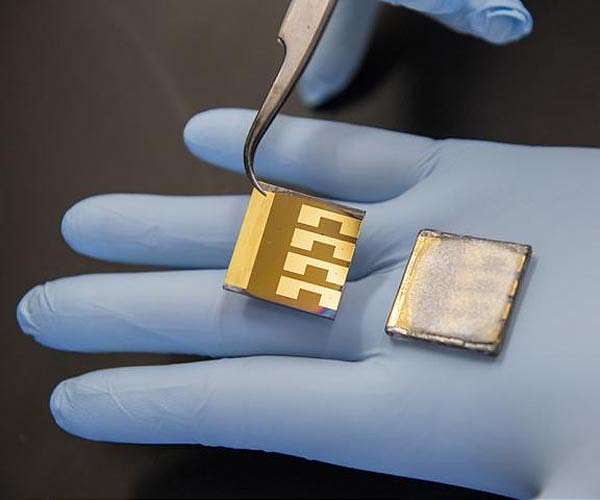
Researchers from Zhejiang University have identified critical parameters governing crystallization in sheet-coated perovskite films, clarifying routes for producing high-efficiency solar cells and optoelectronics on a commercial scale. The review focuses on barriers caused by uneven crystallization, defects and instability that arise when perovskite deposition exceeds laboratory dimensions.
Blade coating combines simplicity with continuous production capabilities and efficient use of materials, making it a leader in the field of mass production. However, the method introduces variability in film thickness, crystallinity and defect concentration. The complex nucleation and growth dynamics during coating cause inconsistencies that reduce device efficiency and compromise long-term stability.
The team investigated how solution chemistry, coating dynamics, environmental conditions and post-treatments determine crystal nucleation, grain evolution and defect distribution. Their findings integrate recent developments into a systematic framework for optimizing film formation in reproducible, scalable processes.
The polarity of the solvent and the rate of evaporation determine the timing of supersaturation and nucleation. Mixed solvent systems balance solubility against controlled crystal growth. The concentration and viscosity of the solution control film thickness and uniformity. A high concentration slows evaporation and promotes defects, while a low concentration limits grain expansion.
Additives such as ammonium salts, surfactants and coordination agents adjust nucleation density, passivate surfaces and improve interface quality. These chemicals improve grain organization and stability. Coating parameters, especially sheet velocity, determine whether deposition occurs in evaporation-dominated or Landau-Levich regimes, directly affecting crystal domain formation.
The wettability of the substrate controls the distribution of liquids and prevents dehumidification. Gas quenching accelerates the removal of solvents, causing uniform crystallization. Environmental humidity and oxygen exposure alter the reaction pathways, affecting phase purity and film stability.
“The performance and stability of perovskite devices are highly dependent on how the film crystallizes during deposition,” the authors said. “Understanding the interplay between solution chemistry, coating process and environment allows us to systematically tune nucleation and grain growth. This is essential for producing uniform, defect-minimized films, especially when scaling up from laboratory cells to large-area photovoltaic modules.”
The framework extends beyond solar cells to include perovskite light-emitting diodes, photodetectors and tandem configurations where film quality determines device output. Future developments could include automated coating with real-time crystallization monitoring, alternative solvent chemistry with reduced environmental impact, and advanced passivation strategies.
These advances could accelerate the commercial deployment of perovskite technologies in clean energy generation and optoelectronic devices. Coordinated control of chemical composition, fluid dynamics and atmospheric conditions during drying proves to be the basis for producing uniform, dense films with minimal defects over large areas.
Research report: Key factors affecting the crystallization of perovskite films in blade coating processes
