

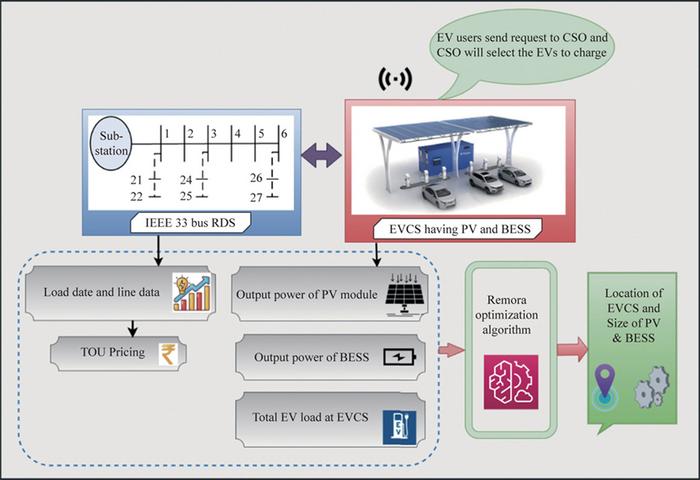
Scientists in India have developed a new method to optimize the placement of an EV charging station on the grid, along with the size of PV generation and battery storage. They have also created a framework for an innovative slot offering.
A group of scientists from India have developed a new method for scheduling electric vehicle (EV) charging at charging stations that include PV generation and battery energy storage systems (BESS).
The proposed method consists of two components: optimization and hierarchization. The first component optimizes the placement of EV charging stations (EVCS) within a standard IEEE 33-bus radial distribution system, along with the sizing of the PV system and the BESS. The second component determines the order in which EVs are charged.
“This research tackles the chaos by optimizing the placement and operation of stations in distribution networks, ensuring efficient energy flow while reducing emissions and costs,” the team said in a statement. “Tackling these barriers will pave the way for sustainable transportation that doesn’t overload our aging networks, making electric vehicles a practical choice for everyone from city commuters to long-haul drivers.”
The optimization part of the method is based on the multi-objective remora optimization algorithm (MOROA), which takes inspiration from the way the remora fish move and attach to larger marine animals. To determine the optimal size of the PV and the BESS, the model first initiates ‘free travel’, which represents a global search with significant hops. Then, like the animal, it performs small attacks, which allows the area of the response to be better localized. Finally, the model enters the state of ‘exploitation’, where the best answer is refined.
As for the hierarchy part of the method, the system uses the Analytical Hierarchy Process (AHP) to see if it can provide an EV charging spot. An application must initially be made via a mobile phone app. The system then takes into account several parameters to determine the allocation, including the arrival time at the EVCS, the departure time assuming a five-hour rate, the charging status, the desired charging status, the EV distance to the EVCS and the availability of slots. An algorithm assigns a normalized score to each parameter, based on which a decision is made for the driver.
“The weight ranking mechanism means less stress on the electricity grid, which translates into fewer power outages and lower electricity rates for communities,” the team explains. “EV owners benefit from faster and cheaper fares, while station operators increase profits through optimized PV-BESS integration. Environmentally, minimized emissions support global carbon neutrality goals, potentially avoiding tons of CO2 annually in areas with high EV usage.”
To test their method, the researchers ran a MATLAB simulation of an IEEE 33 bus system. They placed two EVCSs (EVCS 1 and EVCS 2) on the network, each with optimally sized BESS and PV systems. EVCS 1 is designed for 40 EVs and EVCS 2 for 80 EVs. However, they received simultaneous charging requests from 80 and 150 EVs respectively. The simulation considered three types of vehicles: an MG Comet with a 17.3 kWh battery, a Tata Tiago with a 19.2 kWh battery and a Citroën eC3 with a 29.2 kWh battery.
The scientists tested four scenarios on the IEEE 33 bus: a base scenario where nothing was added to the bus (case 1); the IEEE 33 bus with the two EVCS (case 2); the IEEE 33 bus with the two EVCS and PV (case 3); and finally the IEEE 33 bus with the two EVCS and PV and BESS (case 4). In all cases requiring EVCSs, MOROA placed EVCS on bus 29 and EVCS 2 on bus 11. In all cases where PV was required, the size consisted of 514 modules of 5 kW each on the first station and 318 modules of the same capacity on the second station. EVCS 1 required 90 BESSs with a capacity of 18 kWh each, and EVCS 2 required 92 of the same BESSs.
In case 1, the total power loss was 2,206.88 kW. In the remaining cases, this changed to 2,417.97 kW, 1,604.01 kW and 1,591.52 kW for cases 2, 3 and 4, respectively. The emissions from the upstream network were 34,055.24 kg, 35,543.88 kg, 24,926.55 kg and 25,056.24 kg, respectively. The corresponding costs for each configuration were INR 92,629,901.34 ($1,045,566.50), INR 96,952,067.57, INR 161,078,952.90 and INR 164,542,048.50 respectively.
“This MOROA-powered approach could revolutionize urban planning, integrating smart EVCS into smart cities where PV-BESS combos can handle real-time demand from massive EV fleets,” the scientists concluded. “Further research could include AI for predictive EV traffic modeling or hybrid renewables such as wind, increasing resilience to weather variability. By refining uncertainties in EV behavior, such as random arrivals, future iterations could optimize larger networks, such as IEEE 69 bus systems, further reducing costs and emissions for a seamless transition to electrified transportation worldwide.”
Their findings are published in “Multi-objective electric vehicle charging planning for photovoltaic charging stations and battery energy storage in distribution networks,” in Green energy and intelligent transport. Scientists from India’s Siksha ‘O’ Anusandhan University and Biju Patnaik University of Technology participated in the study.
This content is copyrighted and may not be reused. If you would like to collaborate with us and reuse some of our content, please contact: editors@pv-magazine.com.
