

In a new weekly update for pv magazineOPIS, a Dow Jones company, provides a brief overview of the major price trends in the global PV industry.
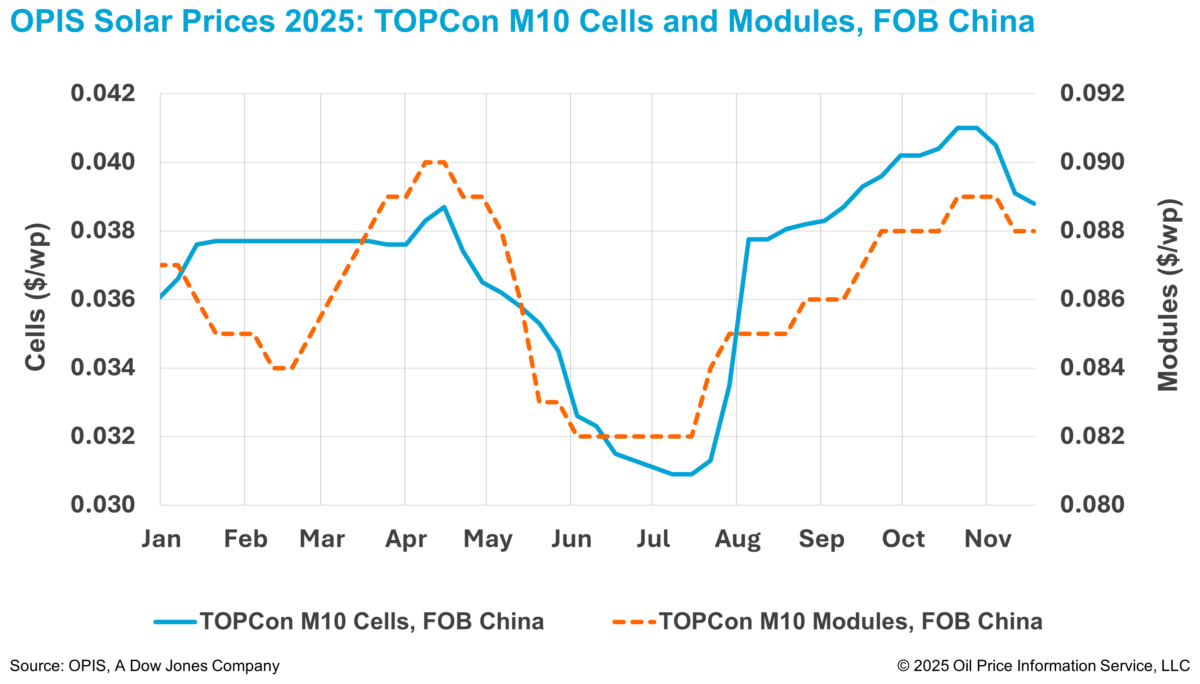
The Chinese Module Marker (CMM), the OPIS benchmark rating for TOPCon modules above 600W, remained stable at $0.088/W Free-On-Board (FOB) China, according to the OPIS Solar Weekly Report released on November 18.
In contrast, upstream cell prices continued to decline. According to the same report, FOB China TOPCon M10 cell prices fell 0.77% to $0.0388/W. TOPCon cell prices have now fallen for four weeks in a row, down 2.7% since early October, while module prices have remained unchanged over the same period.
The continued weakness in Chinese TOPCon cell prices stems from weak demand and weak trade activity in export markets. Market sources said buyers had already stockpiled Chinese cells earlier this year on expectations that a cut in export tax credits could lead to price increases in the second half of 2025, leading to a rush to secure cargoes in the third quarter.
However, some market sources no longer expect the discount change to materialize this year, citing the industry body’s focus on reducing domestic supply through production and sales quota controls.
A downstream manufacturer told OPIS that the trade association has allocated specific quotas to leading manufacturers, threatening financial penalties for companies that exceed their allocations.
Another producer noted that even if the rebate is abolished or reduced, the change would not necessarily improve manufacturers’ profitability as sales prices already take into account the tax component. If buyers don’t accept the price increase, sellers may still have to bear the costs, which doesn’t make sense, the producer added.
While the timing remains uncertain, several sources say a policy adjustment could be made before the end of the year, although confidence in this outcome has waned. Market views also remain divided: some expect a complete abolition of the discount, while others think the rate could be reduced from 9% to 5%.
Meanwhile, the long-awaited consolidation initiative in polysilicon appears to be facing headwinds, despite earlier indications of progress. In an interview with China Central Television’s Economic Channel on October 28, GCL Technology Chairman Zhu Gongshan stated that 17 companies have reached a preliminary agreement to establish a consortium and the plan has actually reached the signing confirmation stage. He further noted that the consortium is already taking shape and is expected to be completed within the year.
Despite this development, one market analyst noted that the initiative now faces regulatory hurdles. The plan, which was originally intended for implementation in the third quarter of 2025, is now expected to be postponed until the second quarter of 2026, with one trading source describing the current status as a “standstill”.
Still, industry sources noted that consolidation efforts have had minimal impact on downstream cell and module prices so far. However, they expect that the initiative, once it comes into effect, could alleviate supply and demand imbalances in the upstream sector, stabilizing prices in the longer term.
OPIS, a Dow Jones company, provides energy prices, news, data and analysis on gasoline, diesel, jet fuel, LPG/NGL, coal, metals and chemicals, as well as renewable fuels and environmentally friendly feedstocks. It acquired assets with pricing data from Singapore Solar Exchange in 2022 and now publishes the OPIS APAC Solar Weekly Report.
The views and opinions expressed in this article are those of the author and do not necessarily reflect those of the author pv magazine.
This content is copyrighted and may not be reused. If you would like to collaborate with us and reuse some of our content, please contact: editors@pv-magazine.com.
