

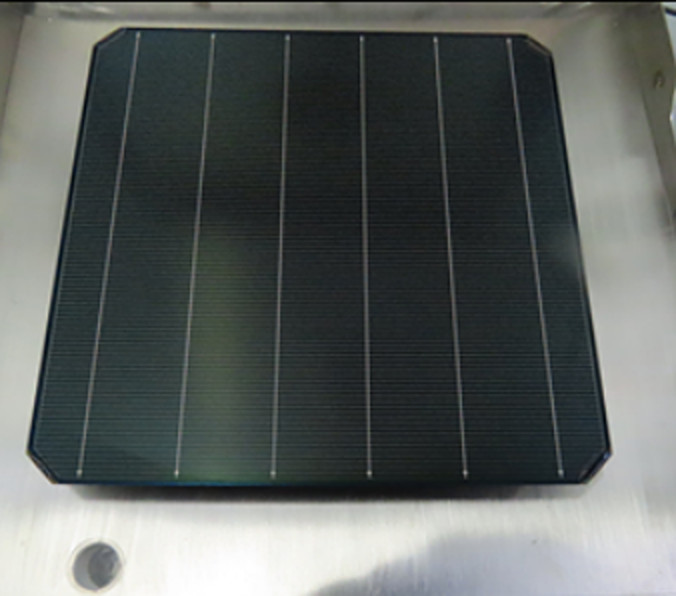
The Chinese manufacturer said the tandem device was developed via a double buffer layer strategy that improves interfacial adhesion while maintaining efficient charge extraction. The efficiency result was certified by the US Department of Energy’s National Renewable Energy Laboratory (NREL).
Chinese PV module manufacturer Longi has announced that it has achieved an energy conversion efficiency of 33.35% for a flexible 1 cm2 perovskite-silicon tandem solar cell.
The result was certified by the US Department of Energy’s National Renewable Energy Laboratory (NREL).
“The cell is fabricated on a 60 μm thick silicon wafer and can be folded in half with a bend radius of up to 15 mm,” a company spokesperson said. pv magazine. “It weighs only 4.38 grams.”
The top tandem device is constructed using a double buffer layer strategy, which Longi says improves interfacial adhesion while maintaining efficient charge extraction. Interfacial adhesion is especially critical in flexible tandem devices, which undergo greater mechanical stress from bending compared to rigid cells.
To address this, the team applied an initial tin oxide (SnOx) buffer layer to protect the perovskite and transport layers during the transparent conductive oxide sputtering process, performed via atomic layer deposition (ALD). A second SnOx layer was then deposited by chemical vapor deposition (CVD) to improve charge extraction and reduce resistivity losses at the interface with the buckminsterfullerene (C60) layer, which is prone to delamination under environmental stress.
The resulting top cell has a SnOx bilayer contact structure, the C60 layer, a transparent back contact made of indium zinc oxide (IZO), a silver (Ag) metal contact, a perovskite absorber, a lithium fluoride (LiF) layer, and a self-assembled monolayer hole transport layer composed of ethylene diammonium diiodide (EDAI).
Longi did not reveal whether the bottom silicon cell uses a heterojunction (HJT) or TOPCon design.
Tested under standard lighting conditions, the 1 cm2 tandem cell achieved an efficiency of 33.35%, an open-circuit voltage of 1.996 V, a short-circuit current density of 19.77 mA/cm2 and a fill factor of 84.5%.
Using the same cell design, the company’s scientists also built a 260 cm2 cell based on M6 wafers with an efficiency of 29.8%, this result being verified by The German Fraunhofer ISE CalLab.
“The modified tandem solar cells exhibit good durability and retain more than 97% of their initial energy conversion efficiency after 43,000 bending cycles under a maximum radius of curvature of approximately 40 mm in air, and approximately 97% after thermal cycling tests for 250 cycles,” the manufacturer said.
The cell design was described in “Flexible perovskite/silicon tandem solar cell with double buffer layer”, published in nature.
This content is copyrighted and may not be reused. If you would like to collaborate with us and reuse some of our content, please contact: editors@pv-magazine.com.
