

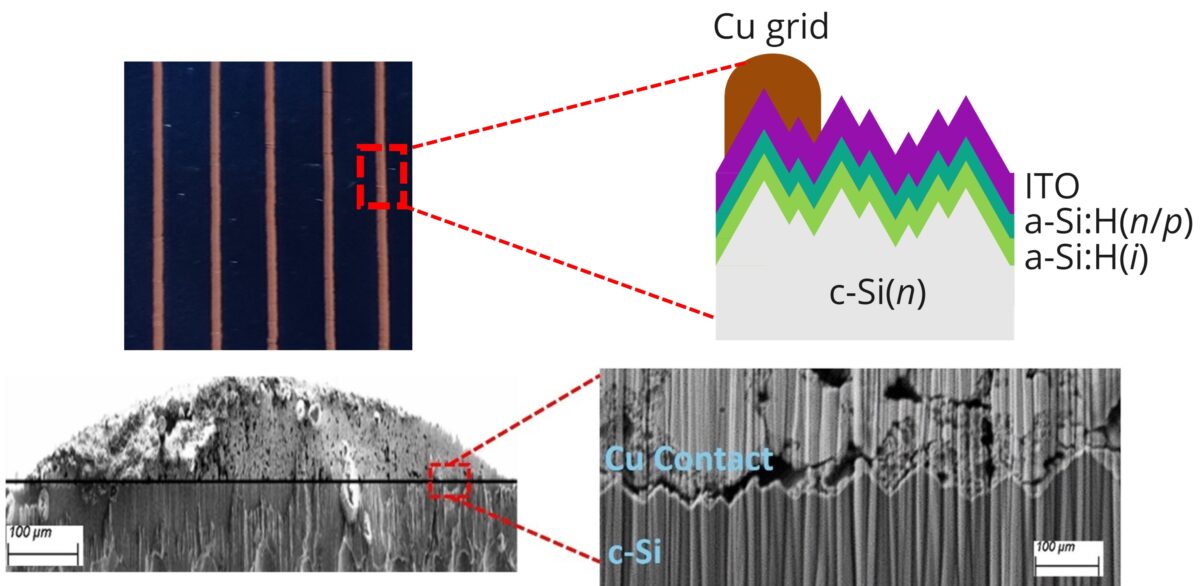
Researchers in the United States have developed a photonic curing technique that uses laser sintering to quickly heat and harden copper pastes on temperature-sensitive solar cell substrates without causing thermal stress. The process reportedly produces dense, low-porosity copper layers with strong adhesion to indium tin oxide, achieving low bulk and contact resistance.
Researchers at the University of Central Florida in the United States have developed a photonic curing technique that reportedly improves the copper (Cu) metallization of solar cells by reducing Cu oxidation.
“We have We have already made great progress in achieving cell efficiencies approaching 20% with copper metallization, and we are actively addressing oxidation and other integration challenges to move closer to industry acceptance,” said the corresponding author of the study. Prasanth Kumartold pv magazine. “Our work was funded by the U.S. Department of Energy (DOE).”
Photonic curineG is a high-temperature technique that uses intense bursts of light from flash lamps to quickly heat the surface of a material. This approach can ‘cure’ metals or inks without overheating or damaging the underlying layers, making it particularly useful in the production of electronics and solar cells to improve conductivity and material quality.
In their work, the scientists treated Cu micro and nanoparticles with laser sintering to generate rapid, localized heating via a high-intensity laser beam. This method reportedly allows Cu pastes to be hardened on temperature-sensitive substrates without inducing thermal stress.
“The laser sintering technique enables selective energy absorption, reducing damage to the substrate and improving adhesion between the Cu and indium tin oxide (ITO) layers compared to conventional sintering methods,” the scientists explain. “In addition, the photonic curing process is scalable and compatible with large-scale photovoltaic production.”
For the experiments, Cu micro- and nanoparticles were deposited on 140-μm-thick ITO-coated Czochralski (Cz) wafers using a microdosing system, while sintering was performed with a CO₂ laser. For high-resolution printing, a commercial copper paste was used, supplied by US-based printed electronics manufacturer Novacentrix.
Image: Image: University of Central Florida
Using scanning electron microscopy (SEM), energy dispersive X-ray spectroscopy (EDAX) and profilometry, the team analyzed the Cu line resistance, bulk resistance and contact resistance at the ITO/Cu interface. They found that the process produced a dense, compact Cu layer with reduced porosity and strong bonding of Cu contacts.
Under “optimized” conditions, the process achieved a bulk resistance of approximately 19 μΩ·cm and a contact resistance of approximately 35 mΩ·cm². The researchers noted that these values are low enough to allow significant reductions in Cu consumption, providing a viable path to cost-effective and reliable metallization processes.
“Contacts formed with linewidths of 150-200 μm in this work achieve high aspect ratios in the range of 0.1 to 0.15,” the team said. “Future efforts will focus on reducing contact finger linewidths and increasing aspect ratio, which is especially important for minimizing optical shadow losses.”
Looking ahead, the researchers plan to investigate the thermal interactions that occur during the laser sintering of Cu paste, with the aim of further optimizing the process for the production of next-generation solar cells.
The new technique was presented in the article “Photonic curing of copper inks: a path to scalable copper metallization for solar cells”, published in physics status solidi (PSS). The research team included academics from the University of Delaware.
This content is copyrighted and may not be reused. If you would like to collaborate with us and reuse some of our content, please contact: editors@pv-magazine.com.
Popular content

