

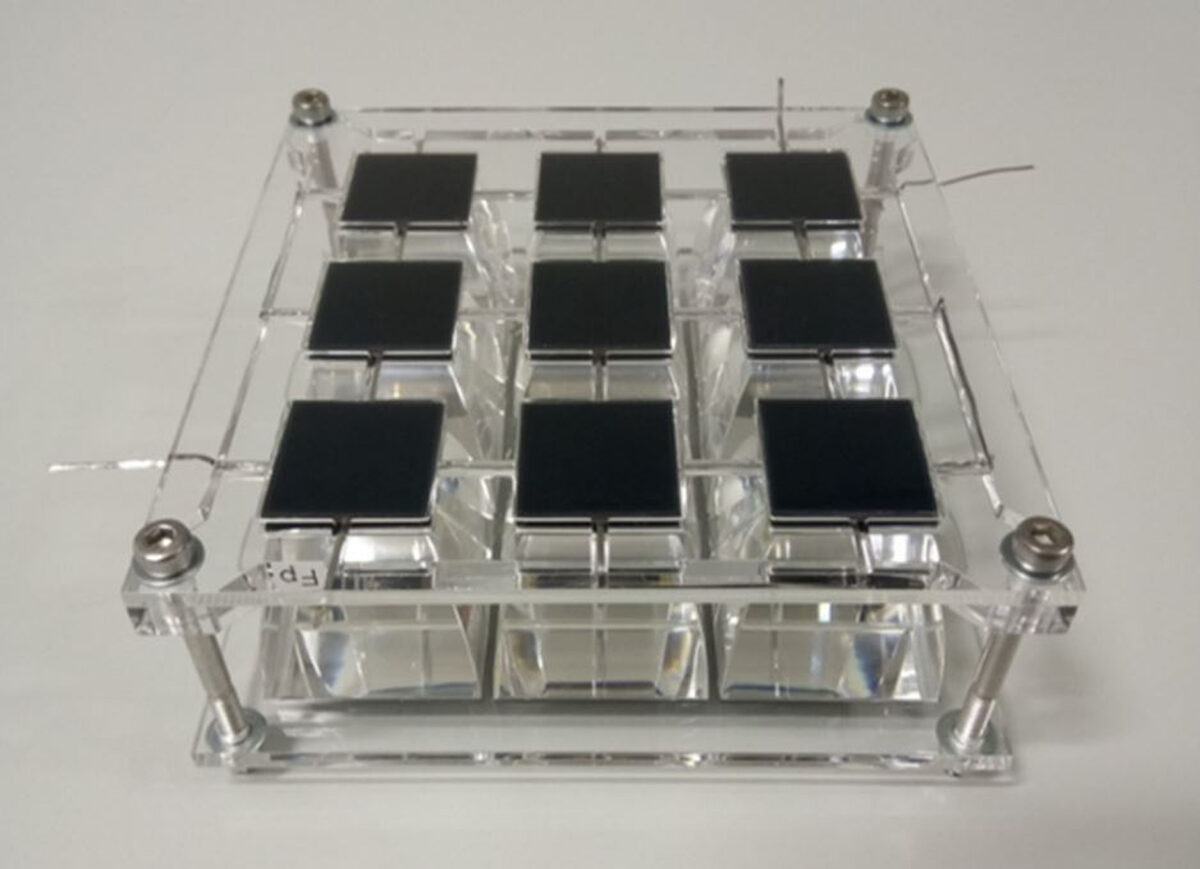
Researchers from the University of Jaén in Spain have demonstrated a semi-transparent crystalline silicon photovoltaic solar module with rear-mounted optical concentrators for agricultural voltaic applications.
A research team from Spain’s University of Jaén demonstrated a new agrivoltaic concentrator PV module, with back-crossed composite parabolic concentrators (CCPC) and crystalline silicon solar cells emulating a bifacial configuration. For agricultural applications it is designed to balance high efficiency and optical transparency with minimal panel shading.
“Our research presents the first semi-transparent photovoltaic (STPV) module using rear-mounted optical concentrators specifically to enhance the contribution of reflected radiation, a resource traditionally underutilized in both agricultural voltaic systems and building-integrated photovoltaic systems,” said co-corresponding author of the study, Álvaro Valera-Albacete. pv magazine.
Unlike previous STPV designs, the prototype, RearCPVbif, focuses and directs albedo light to the back of bifacial cells for a “substantial increase” in energy generation without compromising optical transparency, Valera-Albacete said.
“The main motivation was the growing need to reconcile solar energy production with the limited availability of land,” explains Valera-Albacete, noting that in the agrivoltaic sector, increasing electrical output “usually comes at the expense of reducing the quality and quantity of light” that reaches crops due to shading by the PV modules.
The researchers fabricated a prototype module and developed a modeling framework for testing. The proposed design integrates low-concentration optical components at the back, aligned and connected to small, spaced crystalline silicon solar cells. The geometric concentration had a targeted transparency factor (TRF) of 60%, which the researchers say is “sufficient for most horticultural crops.”
To emulate the bifacial cells needed for the design, the scientists used two electrically independent monofacial crystalline silicon solar cells. These were placed in 3 x 3 arrays and mounted on an 8 mm thick transparent polymethyl methacrylate (PMMA) substrate. The module was 42.8 mm thick and weighed 0.4767 kg, or 34.15 kg/m2.
Tests of the optical performance of the CCPC power amplification, light quality, average photosynthetic transmittance (APT), average visible transmittance (AVT) and thermal performance have been completed. The results showed a bifacial response, with the “posterior generating more than twice as much force as the anterior, showing clear advantages over monofacial and bifacial references,” according to the study.
The system also provided “good transmission of diffuse light” and a visible transmission of almost 60%. Thermal performance remained stable, with “predicted cell temperatures below 70 C,” while insulation performance was “comparable to double glazing systems,” the researchers reported.
They said the experimental and numerical results were in “good agreement in terms of light transmission and uniformity,” but they also noted discrepancies in non-uniformity, indicating the need to further refine the model and conduct outdoor testing.
The work is described in “Investigating the potential of a new semi-transparent photovoltaic system with rear concentrator for agrivoltaic energy”, published in Results in technology.
Currently, the researchers are in discussions with private sector organizations to accelerate development and commercialize the technology, said Eduardo F. Fernández, co-corresponding author of the study.
“This also includes a detailed assessment of the benefits that the technology offers for crop growth, based on an experimental campaign examining different types of crops,” said Fernández.
In addition, the research team is building on its experience with optics and solar cells by investigating applications for wireless energy transfer with high-power photovoltaic receivers and monochromatic laser light sources.

This content is copyrighted and may not be reused. If you would like to collaborate with us and reuse some of our content, please contact: editors@pv-magazine.com.
Popular content

