

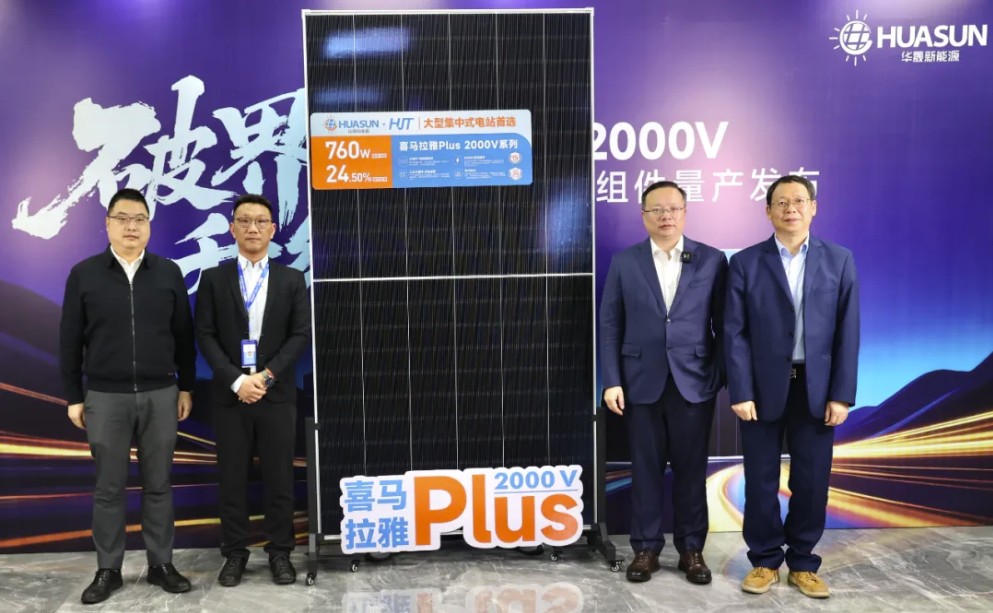
The Chinese manufacturer said the new module’s higher voltage design reduces cable, combiner, pile foundation and land use requirements, delivering system balance savings of up to CNY0.15 ($0.012)/W in western China. The module offers an output power of 730 W to 770 W and a conversion efficiency of up to 24.8%.
Chinese solar module manufacturer Huasun has launched a new heterojunction (HJT) solar module with a system voltage of 2,000 V and a power of up to 770 W.
The Himalaya HSN-212-B132 has a bifacial double-glazed configuration with 132 cells, measures 2,384 mm x 1,303 mm x 33 mm and weighs 36.5 kg.
The new product is available in eight versions with output power ranging from 730 W to 770 W and power conversion efficiency from 23.5% to 24.8%. It has an open-circuit voltage of 49.66 V to 50.46 V and a short-circuit current of 18.62 A to 19.33 A.
The manufacturer said efficiency gains were achieved through the high screen-to-body ratio, negative aperture and large format G12 wafers. These design changes reportedly increased the effective cell area by 2.1%, increasing power by approximately 20 W over comparable configurations.
Huasun’s patented edge sealing process, using butyl rubber without perforation, is integrated to improve moisture resistance while allowing high system voltages without compromising the aperture ratio. The split-cell architecture is said to reduce mismatch losses in partial shade and extend effective generation during the early morning and late afternoon periods.
The thermal profile of the module matches typical HJT performance, with a temperature coefficient of -0.24%/°C for maximum power, reflecting the inherently low thermal sensitivity of this cell technology.
The module is compatible with 2,000 V DC system architectures, an upgrade from the prevailing 1,500 V standard. Huasun says the higher voltage reduces requirements for cables, combiners, pile foundations and land use, delivering balance of system (BOS) savings as high as CNY0.15 ($0.012)/W in western China. The company also reports that the design can improve project internal rates of return (IRR) by up to 0.86 percentage points compared to 1,500 V TOPCon system configurations.
The new product has a first year degradation rate of 1%, followed by an annual degradation limit of 0.3%. After 30 years, the module is guaranteed to retain at least 90.3% of its nominal power. The product meets the performance and safety standards of IEC 61215/61730, along with additional certification under IEC 62941 for manufacturing quality and IEC/TS 62994 for life cycle environmental assessment.
Founded in 2020, Anhui-based Huasun Energy is now the world’s largest manufacturer of HJT modules, with an annual production capacity of 20 GW of modules and cells.
As utility-scale developers face increasing cost pressures, Huasun expects the 2,000 V HJT series to gain traction in projects in desert areas, where labor, foundation and land costs dominate total expenditures.
This content is copyrighted and may not be reused. If you would like to collaborate with us and reuse some of our content, please contact: editors@pv-magazine.com.
