

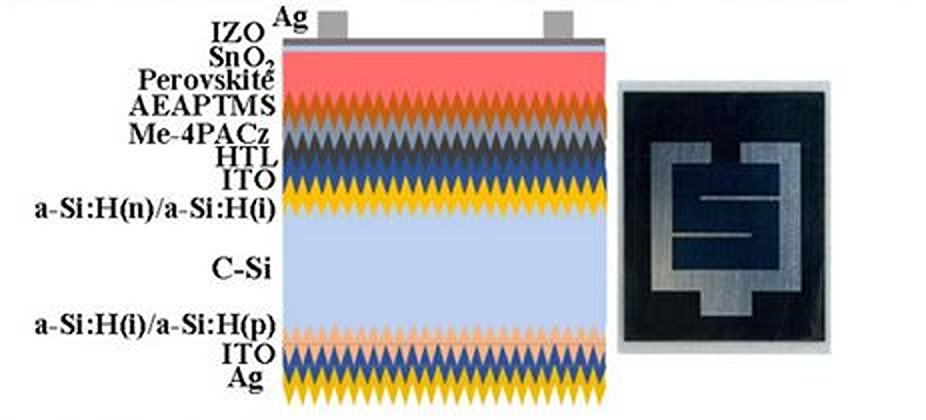
The two-terminal perovskite-silicon tandem solar cell was fabricated via a chemical polishing method that selectively removes residual lead(II) iodide from the perovskite film in the top cell. This focused interface engineering improved uniformity and stability, enabling a certified efficiency of 31.71% and improved long-term performance.
A group of researchers led by China’s Northwestern Polytechnical University has developed a two-terminal (2T) perovskite-silicon tandem solar cell via an interface engineering strategy that removes residual lead(II) iodide (PbI2) from the wide bandgap perovskite cell without damaging its lattice.
PbI2 formation in wide band gap perovskite solar cells arises from incomplete precursor conversion during crystallization and often leads to a reduction in device performance. Although small amounts of PbI₂ can provide localized passivation of defects, excessive accumulation at the surface and grain boundaries creates nonradiative recombination pathways, promotes ion migration, causes phase instability, and induces hysteresis.
“A monolithic tandem architecture with two terminals was realized by integrating the optimized perovskite upper subcell with a passivated crystalline silicon lower subcell,” said the study’s lead author Tao Ye. pv magazine. “This strategy not only reduces non-radiative recombination losses, but also enables superior interfacial uniformity and compositional homogeneity. In addition to achieving high efficiency, this targeted PbI2 removal method provides a scalable and robust route to advance perovskite-silicon tandem photovoltaics, paving the way for reliable, high-performance next-generation solar technologies.”
A chemical polishing method using a mixed solvent of dimethyl sulfoxide (DMSO) and chlorobenzene (CB) was developed to selectively remove residual PbI2 from the wide bandgap perovskite top subcell. This approach reportedly reduced trap state density, promoted grain boundary fusion, increased photoluminescence intensity, and extended carrier lifetime.
The research group treated the perovskite films with various mixed DMSO-CB solvents prepared at varying volume ratios and found that the optimal ratio was 1.6:100, which effectively removed PbI2 while maintaining surface integrity and grain compactness. Through X-ray photoelectron spectroscopy (XPS) measurements, the scientists were able to verify that the Pb content in the perovskite film decreased after polishing. They also observed a slight shift in the binding energy from 138.2 eV to 138.4 eV.
“Remarkably, the process did not cause structural damage to the perovskite lattice, highlighting its controllability and broad applicability in multilayer stacked architectures,” they explained. “This improvement in uniformity further confirmed the improved optoelectronic quality of the polished film.”
The tandem cell was built with a bottom heterojunction cell (HJT) measuring 2.5 cm x 2.5 cm and a perovskite device at the top that relied on a substrate made of indium tin oxide (ITO), a hole transport layer (HTL) made of a phosphonic acid called methyl substmodified carbazole (Me-4PACz)a perovskite absorber, A tin oxide (SnO2) buffer layer, a transparent contact made of indium zinc oxide (IZO) and a silver (Ag) metal contact.
Tested under standard lighting conditions, the tandem cell achieved a certified energy conversion efficiency of 31.71%, with an open-circuit voltage of 1.839 V, short-circuit current density of 21.04 mA cm-2 and a fill factor of 81.95%. The device further exhibited suppressed hysteresis and improved operational stability, retaining more than 90% of its initial output power after 700 hours of continuous simulated sunlight illumination.
“All measurements indicated that eliminating residual PbI2 effectively improved the interfacial properties and device reliability, and underlined the efficacy of the DMSO-CB solvent system in chemical polishing,” said Ye.
The new cell design was presented in “Targeted PbI2 Removal unlocks 31.71% efficiency perovskite-silicon 2T tandem solar cells”, published in RRL solar energy.
This content is copyrighted and may not be reused. If you would like to collaborate with us and reuse some of our content, please contact: editors@pv-magazine.com.
