

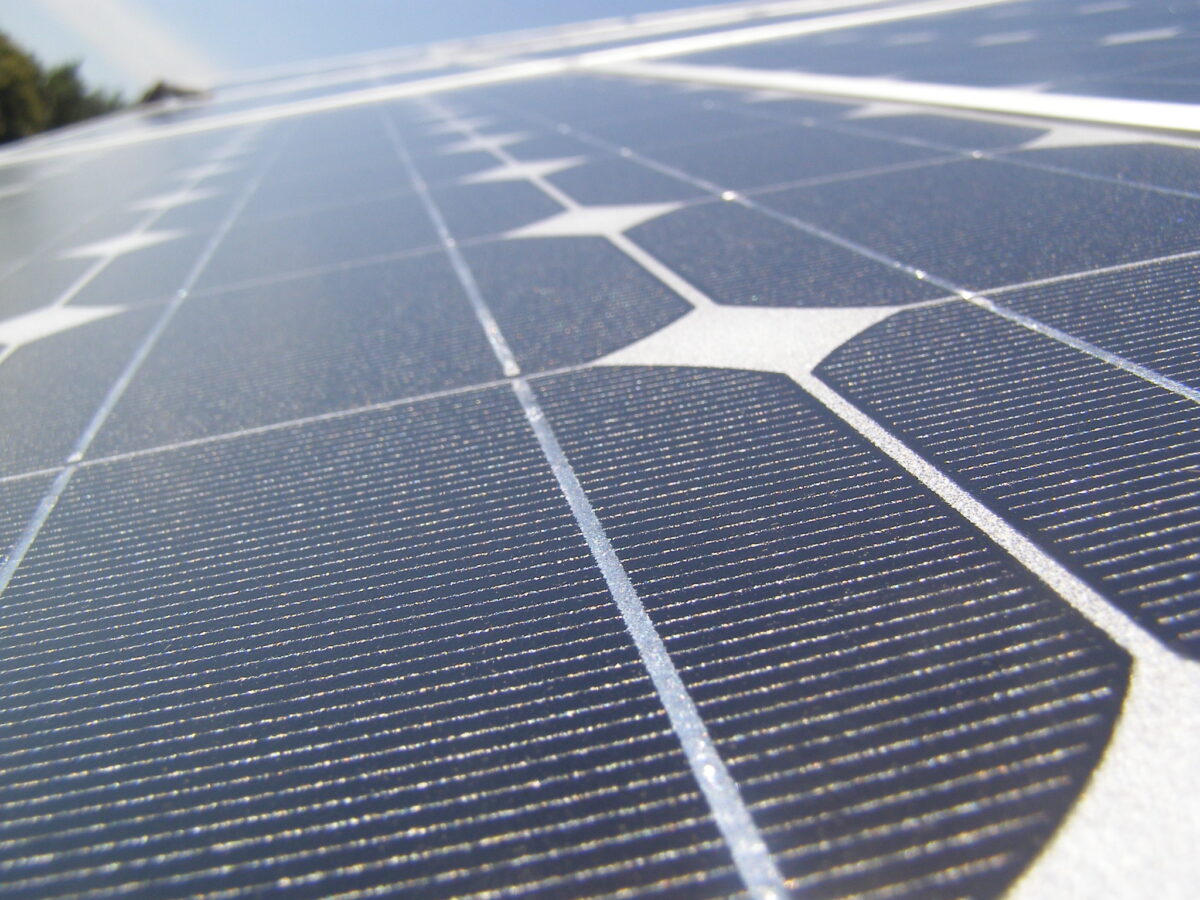
Slovak scientists have developed a new hydrophobic, anti-reflective coating for solar glass with a thin film of silica-titanium oxide as the bottom layer and an inorganic-organic top layer made of silica modified with triethoxy(octyl)silane. This new coating increases glass permeability by 7% compared to uncoated glass.
A European group of scientists has developed a new hydrophobic anti-reflective (AR) coating for the cover glass of PV modules.
The double-layer coating uses a thin film of silica-titanium oxide (SiO2-TiO2) as the bottom layer and an inorganic-organic top layer of silica modified with triethoxy(octyl)silane (OTES) as the top layer.
“In this study, a bilayer hydrophobic AR was successfully fabricated via the sol-gel process,” the researchers said. “The Sol-gel process has emerged as a promising film deposition technique due to its several advantages such as low cost, wide range of available precursors, low synthesis temperature and excellent control over the structural and morphological characteristics of the films .”
First, the academics prepared the SiO2-TiO2 sol and the OTES-modified SiO2 sol with different molar ratios to check their refractive index. They then started the coating process by first dipping cleaned microscope slide substrates into a dip coater containing SiO2-TiO2, then allowing them to dry and undergo heat treatment. To control the refractive index and film thickness, the extraction rates were varied. A similar second dipping process was then performed in the OTES-modified SiO2.
“The refractive index and thickness of the bilayer coatings were measured by ellipsometry using a bilayer model,” the academics said. “The refractive index of the bottom layer (SiO2-TiO2 coating) and the top layer (OTES-modified SiO2 coating) were 1.74 and 1.39, respectively, and thicknesses of 77.0 nm and 95.9 nm, respectively” , they said after optimization.
The group then measured the coated glass for transmission and reflection spectra in the 350 to 800 nm range and the close-up of the 500 to 600 nm range to obtain its optical properties. The best results for the double coating were achieved at 550 nm, where it showed a transmittance of 99%, compared to 91% of an uncoated reference glass. It also had a reflectivity of 0.15%, compared to 8% for the uncoated glass substrate.
In the next step, the researchers obtained images of the water contact angle (WCA) to analyze the wetting properties of the new coating. While the uncoated reference glass has a WCA of 56.8 degrees, the coated reference glass had a higher value of 102 degrees. The uncoated glass substrate had a surface free energy of 48.5 mN/m, while the coated substrate had 25.48 mN/m.
“The bilayer AR coating showed higher WCA and lower surface free energy, indicating a less wettable surface,” they explained. “This was attributed to the presence of hydrolytically stable O Si octyl nonpolar functional groups on the surface, which can reduce surface energy and hinder wetting.”
Additionally, the researchers measured the durability of the double-coated glass, exposing it to two years of environmental conditions. According to the results, it showed minimal changes in transmission after that period compared to the original values. The adhesion of the new coating was also tested and found to be “excellent”.
“The results show that the double-layer coating is a promising solution for reducing reflection and improving the optical properties of glass substrates,” the scientists concluded. “This coating has potential value in several areas, especially in the solar cell industry, where it can increase the efficiency and stability of solar cells.”
Their findings were presented in “High-performance double-layer hydrophobic anti-reflective coatings on glass, prepared by the sol-gel method,” published in Open ceramics. The research was conducted by scientists from Slovakia’s Alexander Dubček University of Trenčín and the Joint Glass Center, as well as the Spanish Institute of Ceramics and Glass.
This content is copyrighted and may not be reused. If you would like to collaborate with us and reuse some of our content, please contact: editors@pv-magazine.com.
