
Close Menu
  • News
  • Industry
  • Solar Panels
  • Commercial
  • Residential
  • Finance
  • Technology
  • Carbon Credit
  • More
    • Policy
    • Energy Storage
    • Utility
    • Cummunity
What's Hot

Vistra adds Enphase batteries to the Texas VPP program

March 6, 2026

ACME Solar signs 450 MW PPA in India, commissions new 38 MW/82 MWh BESS – SPE

March 6, 2026

Freight costs are rising due to military attacks in the Middle East

March 6, 2026
Facebook X (Twitter) Instagram
Solar Energy News
Friday, March 6
  • News
  • Industry
  • Solar Panels
  • Commercial
  • Residential
  • Finance
  • Technology
  • Carbon Credit
  • More
    • Policy
    • Energy Storage
    • Utility
    • Cummunity
Solar Energy News
Home - News - Vacuum annealing increases the efficiency and durability of organic solar cells
News

Vacuum annealing increases the efficiency and durability of organic solar cells

solarenergyBy solarenergyDecember 7, 2025No Comments2 Mins Read
Facebook Twitter Pinterest LinkedIn Tumblr Email
Share
Facebook Twitter LinkedIn Pinterest Email


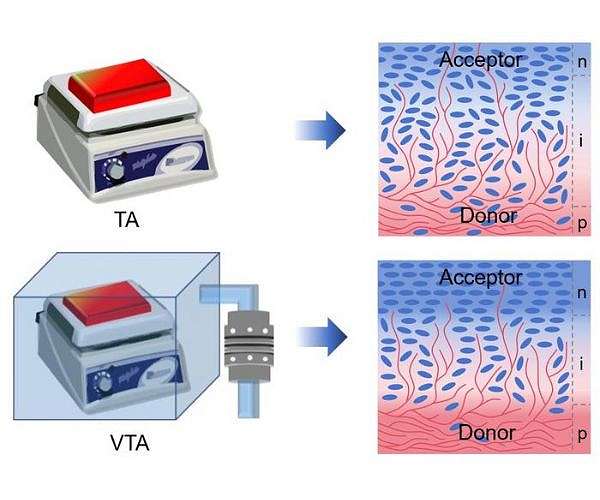
A research team from Wuhan University of Technology led by Professor Tao Wang has developed a vacuum-assisted thermal annealing (VTA) process that addresses the associated challenges of efficiency and stability in organic solar cells. The method designs the internal structure of the photovoltaic active layer so that devices maintain strong performance over long operating times.

The work focuses on controlling the arrangement of nanoscale donor and acceptor materials in the active film. The research team stated that “the VTA process accelerates solvent evaporation while promoting favorable molecular organization.” Under VTA, donor components accumulate toward the bottom of the film and acceptor components toward the top, creating a stratified but connected pseudo-bulk heterojunction with a pin-type profile that supports charge transport and extraction.

Using characterization tools including X-ray photoelectron spectroscopy, depth profiling and wide-angle X-ray scattering with grazing incidence, the team found that VTA-treated films exhibit higher molecular order and tighter pp stacking than films produced via standard processing routes. This improved packaging immediately led to higher device performance, with Champion cells achieving an energy conversion efficiency of 20.5 percent.

Stability tests under continuous illumination showed that conventional devices maintained 80 percent of their initial output (T80) for more than 3,900 hours. In device architectures optimized for stability, the extrapolated lifetime of the T80 has increased to approximately 54,000 hours, which is one of the longest lifetimes reported to date for organic solar cells that combine high efficiency with extended operational stability.

The researchers noted that “the enhanced crystallinity and suppressed phase separation created by the VTA treatment create a robust morphological structure that resists degradation.” Additional measurements indicated that VTA-treated films undergo less structural relaxation and domain coarsening when exposed to thermal stress, explaining the improved resistance to performance degradation.

See also  Fraunhofer ISE develops Inp-on-Gaas Substraten for III-V solar cell-pv Magazine International

The VTA approach was validated for several material systems, including PM6/L8-BO, D18/L8-BO and the all-polymer combination PM6/PY-IT, indicating that the process can be widely applied in the manufacture of organic solar cells. The study shows that relatively simple post-processing can address the trade-off between high efficiency and long-term stability, supporting the future development of flexible, lightweight organic photovoltaic modules for practical use.

Research report:Vacuum-assisted vertical component distribution in pseudo-bulk heterojunctions: a path to powerful and stable organic solar cells


Source link

annealing cells durability efficiency increases organic solar vacuum
Share. Facebook Twitter Pinterest LinkedIn Tumblr Email
solarenergy
  • Website

Related Posts

Vistra adds Enphase batteries to the Texas VPP program

March 6, 2026

ACME Solar signs 450 MW PPA in India, commissions new 38 MW/82 MWh BESS – SPE

March 6, 2026

A deep learning model tracks the status of the EV battery with high precision

March 6, 2026
Leave A Reply Cancel Reply

Don't Miss
Technology

Falling costs Stimulate battery storage profits – PV Magazine International

By solarenergyJanuary 29, 20250

The 500 pages report offers a complete picture of the battery industry, including a deep…

Pahal Solar expands module production capacity to 3 GW

February 11, 2026

Identifying important organic-an organic interactions sites for improved emissions in hybrid perovskites through printing technology

March 15, 2025

Hidden mounting mounting requires no holes in the outer roof layer

February 7, 2025
Stay In Touch
  • Facebook
  • Twitter
  • Pinterest
  • Instagram
  • YouTube
  • Vimeo
Our Picks

Vistra adds Enphase batteries to the Texas VPP program

March 6, 2026

ACME Solar signs 450 MW PPA in India, commissions new 38 MW/82 MWh BESS – SPE

March 6, 2026

Freight costs are rising due to military attacks in the Middle East

March 6, 2026

Solis launches new portfolio of residential storage systems – SPE

March 6, 2026
Our Picks

Vistra adds Enphase batteries to the Texas VPP program

March 6, 2026

ACME Solar signs 450 MW PPA in India, commissions new 38 MW/82 MWh BESS – SPE

March 6, 2026

Freight costs are rising due to military attacks in the Middle East

March 6, 2026
About
About

Stay updated with the latest in solar energy. Discover innovations, trends, policies, and market insights driving the future of sustainable power worldwide.

Subscribe to Updates

Get the latest creative news and updates about Solar industry directly in your inbox!

Facebook X (Twitter) Instagram Pinterest
  • Contact
  • Privacy Policy
  • Terms & Conditions
© 2026 Tsolarenergynews.co - All rights reserved.

Type above and press Enter to search. Press Esc to cancel.