

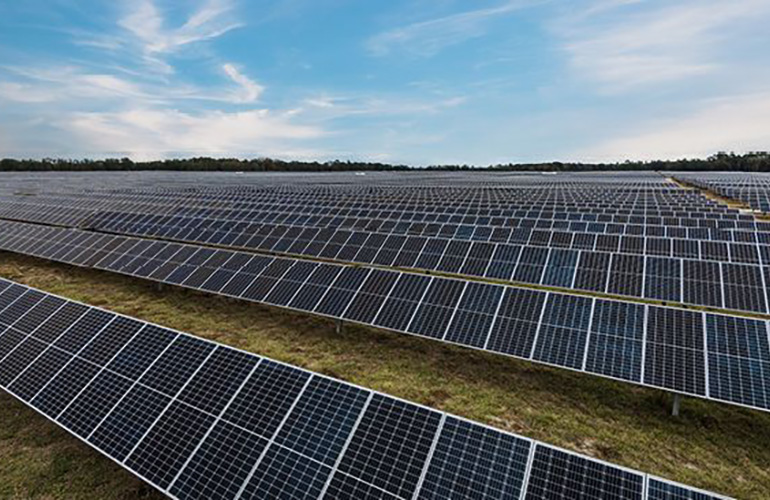
The U.S. solar industry installed 11.7 GW of new capacity in the third quarter of 2025, which was the industry’s third largest quarter ever and pushed total installations past 30 GW this year. Despite actions in Washington aimed at clean energy, solar and storage are responsible for 85% of all new energy added to the grid in the first nine months of the Trump administration.
Credit: Duke Energy
According to the Insight into the US solar market Q4 2025 According to the report released today from the Solar Energy Industries Association (SEIA) and Wood Mackenzie, 73% of all solar capacity installed this year was built in states won by President Donald Trump, including eight of the top 10 states for new installations: Texas, Indiana, Florida, Arizona, Ohio, Utah, Kentucky and Arkansas. Utah rose into the top 10 solar states this quarter with two large-scale projects coming online with a total capacity of more than 1 GW.
The July memo from the U.S. Department of the Interior (DOI) and other federal actions to hinder large-scale solar and storage projects in the pipeline have created significant uncertainty in the business community. Lacking clarity from DOI on timelines for permitting or project approval, the report’s forecasts for utility-scale solar deployment through 2030 remain virtually unchanged from last quarter.
“This record-breaking quarter for solar deployment shows that the market continues to turn to solar energy to meet rising demand,” said Abigail Ross Hopper, president and CEO of SEIA. “The remarkable growth in Texas, Indiana, Utah and other states that President Trump won shows how decisively the market is moving toward solar. But unless this administration changes course, the future of clean, affordable and reliable solar and storage will be frozen by uncertainty and Americans will continue to see their energy bills rise. America’s manufacturing boom, our global competitiveness and billions of dollars in private investment are at stake.”
With the opening of two new solar panel manufacturing facilities in Louisiana and South Carolina, totaling 4.7 GW, the United States has now added 17.7 GW of new module manufacturing capacity by 2025. Corning opened its silicon rod and wafer plant in Michigan in the third quarter, meaning the United States can now produce every major part of the solar panel supply chain.
“We expect 250 GW of solar to be installed between 2025 and 2030. But the U.S. solar industry has more potential,” said Michelle Davis, head of solar research at Wood Mackenzie and lead author of the report. “Wood Mackenzie is tracking substantial increases in energy demand across the country. The solar industry would be well positioned to meet more of this new demand if existing restrictions were eased, which would have a positive impact on our forecast.”
Last month, SEIA published an analysis of EIA data showing that more than 73 GW of solar projects have permits pending and are vulnerable to politically motivated delays or cancellations.
News item from SEIA
