

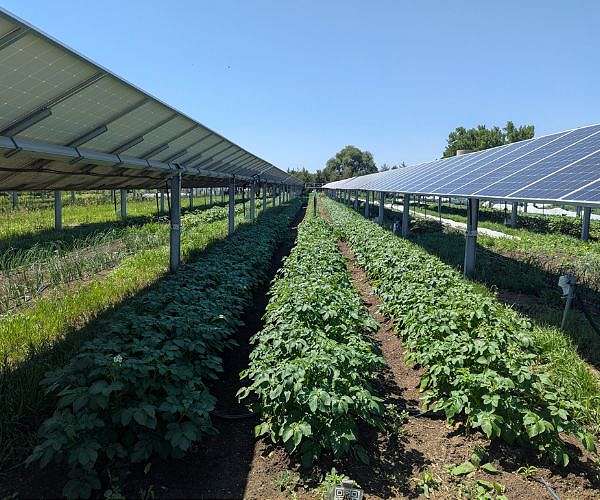
Mounting solar panels over fields can improve working conditions for farm workers and produce food and electricity on the same land, according to research to be presented at the AGU 2025 Annual Meeting in New Orleans. Interviews with workers and field measurements show that agricultural voltaic systems provide shade, reduce exposure to extreme heat, and help farms avoid conditions associated with dangerous heat stress.
The research focuses on agrivoltaic systems, in which solar panels are installed over or next to crops, so that energy and agriculture share the same area. Farmworkers reported that the panel structures give them access to shade during harvesting and other tasks, reducing the amount of time they have to work in direct sun. They described feeling less tired at the end of the day if they could alternate tasks under the panels and rest in shaded areas.
Lead researcher Talitha Neesham-McTiernan of the University of Arizona drew from four years of fieldwork on agrivoltaic farms, much of it during Arizona’s hot summers. She noted that both scientists and workers routinely scheduled the most strenuous tasks at times when they could work under the solar panels. “It just seemed to be something that people were doing in these systems, but no one in the study area was talking about it,” she said.
Heat is a major occupational hazard in agriculture, where workers are estimated to be 35 times more likely to die from heat-related illnesses than those in non-farm jobs. Neesham-McTiernan noted that climate change is expected to increase this risk, increasing the value of practical strategies that can mitigate heat stress in the field. “[Agrivoltaics] is not a one-size-fits-all solution,” she said. “It cannot be used everywhere. But with the threat of heat, we need a catalog of ways we can protect farmworkers. Without them we cannot feed ourselves. Protecting them and their bodies should be of paramount importance to everyone.”
Farm workers pointed out some specific benefits of working under the panels. They reported that the shade provided by the awnings reduced sun exposure during peak afternoon hours and that being able to step in and out of shaded rows helped them manage the heat during the day. Neesham-McTiernan shared one employee’s description of how the scheme made them feel less exhausted at the end of a shift, which in turn affected their energy levels outside of work.
The shaded structures also help keep drinking water cooler, which is critical for preventing heat illness. “They can put their bottles under the panels and they stay cool all day,” Neesham-McTiernan said, “instead of, as one of the farm workers put it, it’s like drinking tea.” Employees emphasized that access to cool water during the workday supported their ability to continue working safely in high temperatures.
In addition to shade and water, the panel supports themselves provide a physical aid during long hours in the field. “Every farm worker said it was an advantage to be able to lean against the beams that held the panels up, just to reduce the weight,” Neesham-McTiernan noted. She said these small ergonomic benefits would not only show up in sensor data, but would clearly impact everyday comfort.
To quantify the thermal environment, the research team installed sensors that recorded air temperature, humidity, wind speed and solar radiation on agrivoltaic farms and on similar open fields. They used this data to calculate wet bulb temperature, a composite heat stress index often used to identify hazardous outdoor working conditions. By comparing the two situations, the team was able to link employee experiences to objective changes in environmental stress.
Measurements showed that agrivoltaic fields can reduce the Earth’s wet bulb temperature by as much as 5.5 degrees Celsius, or about 10 degrees Fahrenheit, compared to open fields. Neesham-McTiernan estimated that this decline could mark the difference between circumstances in which work must stop and circumstances in which workers can continue with mandatory rest breaks, such as taking breaks every hour. She emphasized that when these marginal gains accumulate over a full workday, a growing season and a career, their impact on health and productivity becomes significant.
The study also compared worker perceptions with sensor readings in different parts of the farms and at different times of the day. In some cases, participants and instruments did not fully agree on which areas felt warmest or most comfortable. Neesham-McTiernan argued that assessing heat stress at work requires both physiological and experiential information, because metrics alone cannot capture how people actually feel and function during long-term outdoor work.
Neesham-McTiernan plans to extend the research to farms in other climate zones to determine whether the benefits of agrivoltaic heat reduction hold up under different environmental conditions. Future work could include more precise monitoring of physiological indicators and health outcomes, with the aim of directly linking observed changes in the microclimate under solar panels to worker health data. The project emphasizes thermal comfort and safety as central factors in evaluating agrivoltaic energy deployment, in addition to energy yield and crop performance.
Research report:Experiences of farm workers reveal the benefits of agrivoltaic energy in heat mitigation
