

In a new weekly update for pv magazineOPIS, a Dow Jones company, provides a brief overview of the major price trends in the global PV industry.
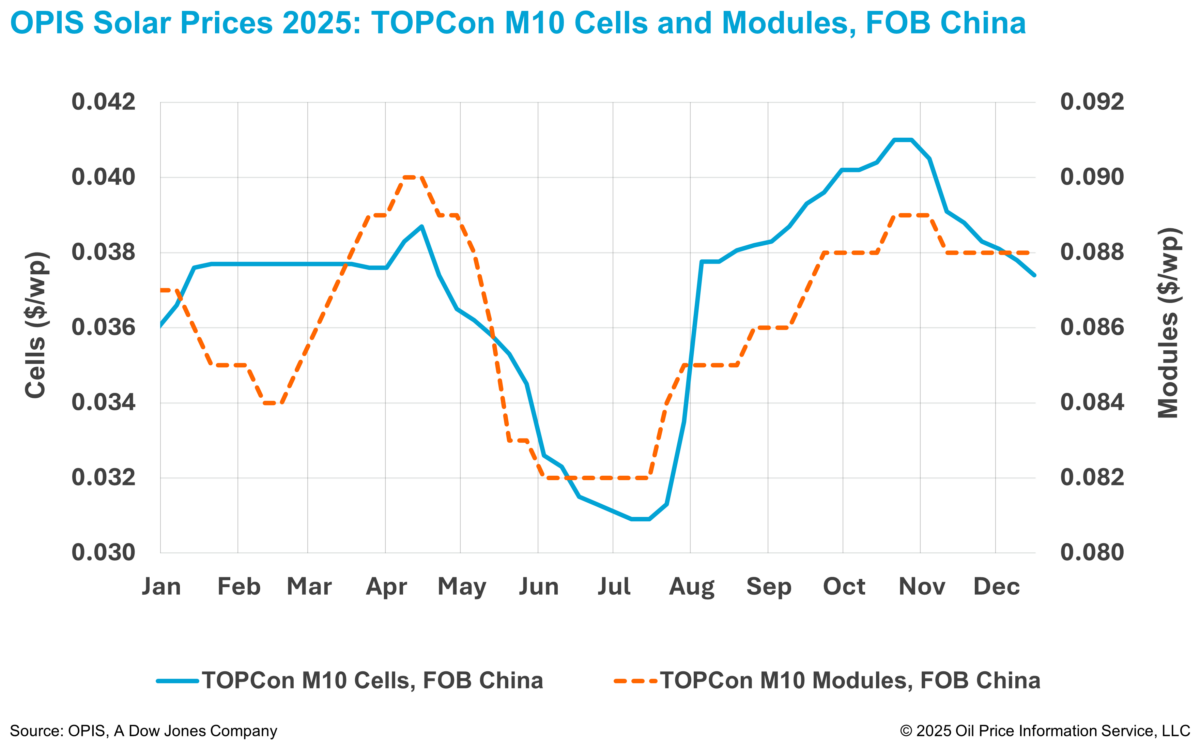
Chinese TOPCon cell prices fell this week, despite increasingly positive sentiment among market sources who expect prices to find support in the coming weeks.
According to the OPIS Solar Weekly Report published on December 16, FOB China TOPCon M10 cell prices were assessed 1.06% lower at $0.0374/W, with price guidance between $0.0364-0.0387/W.
Several market sources expect Chinese cell prices to rise, mainly driven by rising production costs. Silver, a key input in the cell manufacturing process, could become a major upside cost driver after prices rose last month.
Market participants said silver prices could remain supported as China moves to tighten export controls. New rules from 2026 to 2027 would introduce a quota-based export system, requiring exporters to obtain permits to ship silver abroad, according to trade sources.
A Chinese cell maker told OPIS that its headquarters sees higher silver prices as the main driver behind rising cost pressures in the cell segment. The producer added that stronger demand for silver could increase silver paste prices, which would in turn put upward pressure on cell prices.
Another leading cell manufacturer noted that cell prices are also affected by upstream supply discipline, especially in the wafer and polysilicon segments. The source said waffle prices could face upward pressure as producers are hit by poor margins and are likely to make more aggressive production cuts.
In the polysilicon market, discussions continued about the potential downstream impact of the recently established polysilicon platform company, which was announced last week. However, most sources believe that the consolidation plan has had only limited direct impact so far as policy details remain vague.
Meanwhile, a major sticking point for India’s expansion of cell production — securing visas for Chinese technicians — will disappear. On December 17, the Indian government announced streamlined business visa procedures for foreign engineers and technicians, including Chinese nationals
After a border dispute in 2020, India had sharply tightened visas for Chinese citizens, with issuances plummeting from 200,000 in 2019 to an estimated 2,000 in 2024, according to the Institute for Energy Economics and Financial Analysis.
Market participants expect the visa relaxation to significantly help manufacturers scale up domestic cell production before June 2026, when the ALMM (Approved List of Models and Manufacturers) framework will extend to cells. From then on, ALMM-compliant modules used in the covered projects must be manufactured with cells appearing on the ALMM List-II.
In a related development, the ALMM List-II saw a significant expansion this week. The Ministry of New and Renewable Energy has added 5,251 MW of Waaree solar cell capacity to the December 15 update of the Approved List of Models and Manufacturers (ALMM) List-II, bringing the total listed cell capacity to 23.7 GW.
Waaree’s newly named capacity includes 3.92 GW of TOPCon cells and 1.33 GW of PERC cells. Waaree now has the largest recruited TOPCon capacity.
OPIS, a Dow Jones company, provides energy prices, news, data and analysis on gasoline, diesel, jet fuel, LPG/NGL, coal, metals and chemicals, as well as renewable fuels and environmentally friendly feedstocks. It acquired assets with pricing data from Singapore Solar Exchange in 2022 and now publishes the OPIS APAC Solar Weekly Report.
The views and opinions expressed in this article are those of the author and do not necessarily reflect those of the author pv magazine.
This content is copyrighted and may not be reused. If you would like to collaborate with us and reuse some of our content, please contact: editors@pv-magazine.com.
