

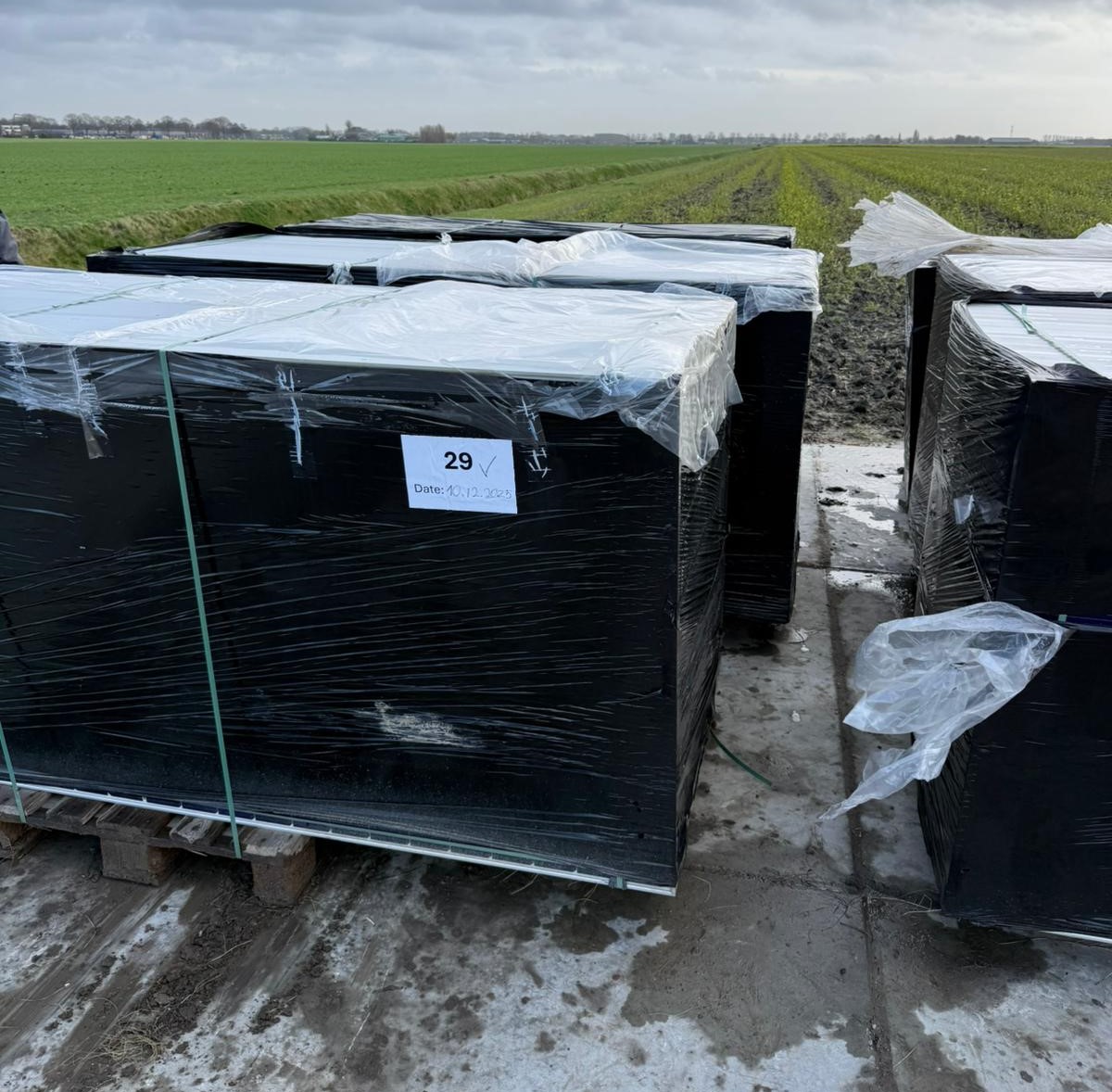
Glare from a nearby solar farm temporarily closed the runways at Amsterdam Airport Schiphol, prompting Dutch authorities to order the removal of around 78,000 PV modules and the application of other anti-reflective films. The removed, almost new modules have now been taken over by BM Energy and are expected to be used again in projects where glare is not a problem.
At the beginning of March, the Polderbaan at Amsterdam Airport Schiphol was closed to incoming traffic during sunny conditions between 10 a.m. and 12 p.m. due to glare caused by nearby solar panels. Although outside the landing area, the PV installations reportedly obstructed the pilots’ vision when the sun was shining.
After the first operational measures and temporary runway closures, Schiphol Airport, solar park operator The Green Energy Corridor (DGEC), the municipality of Haarlemmermeer and the Ministry of Infrastructure and Water Management announced in August that a solution had been found. The plan involved removing some of the panels and covering the remaining panels with a film intended to prevent reflection.
The Dutch government has set September 2026 as the deadline for the implementation of both measures. “Removing, adapting and replacing the solar panels entails costs,” the ministry said in a statement. All parties involved make a financial contribution to the measures, with the ministry contributing €6.8 million ($8.0 million).
The solar park covers approximately 100 hectares and consists of four fields. Dutch authorities have ruled that DGEC must remove the panels from two of these fields, affecting approximately 78,000 of the 230,000 modules at the site.
Following the removal, Dutch solar energy company BM Energy acquired the modules as part of an organized asset transition.
“The panels are n-type bifacial double-glazed modules originally installed in a large-scale ground-mounted PV system located beneath an aircraft approach path,” says Leen van Bellen, trading and development manager at BM Energy. pv magazine. “The removal was initiated for reasons of aviation safety and is not related to any technical or performance deficiency of the modules themselves.”
“The original project investment was tens of millions of euros, and removing, handling, storing and remarketing the affected modules adds a significant additional layer of costs,” Van Bellen added. “Schiphol offered to pre-finance the temporary relocation and storage as a proportionate safety measure, but the financial impact for the project owner remains significant.”
Despite the replacement of the modules, the total installed capacity of the project remained the same, while the system continued to operate with the same technology and power classes.
The removed modules are expected to be reintroduced to the market for alternative applications including repowering projects, utility-scale developments and large commercial or industrial installations where glare is not a limiting factor.
“We expect that these modules will find new applications without any problems,” says Van Bellen. “They are virtually new utility-scale Tier 1 modules suitable for strengthening projects, new ground-mounted installations, commercial and industrial sites and other locations where glare reductions are not an issue. From our experience, there is strong demand for these types of assets when released in a structured and transparent manner.”
This content is copyrighted and may not be reused. If you would like to collaborate with us and reuse some of our content, please contact: editors@pv-magazine.com.
