

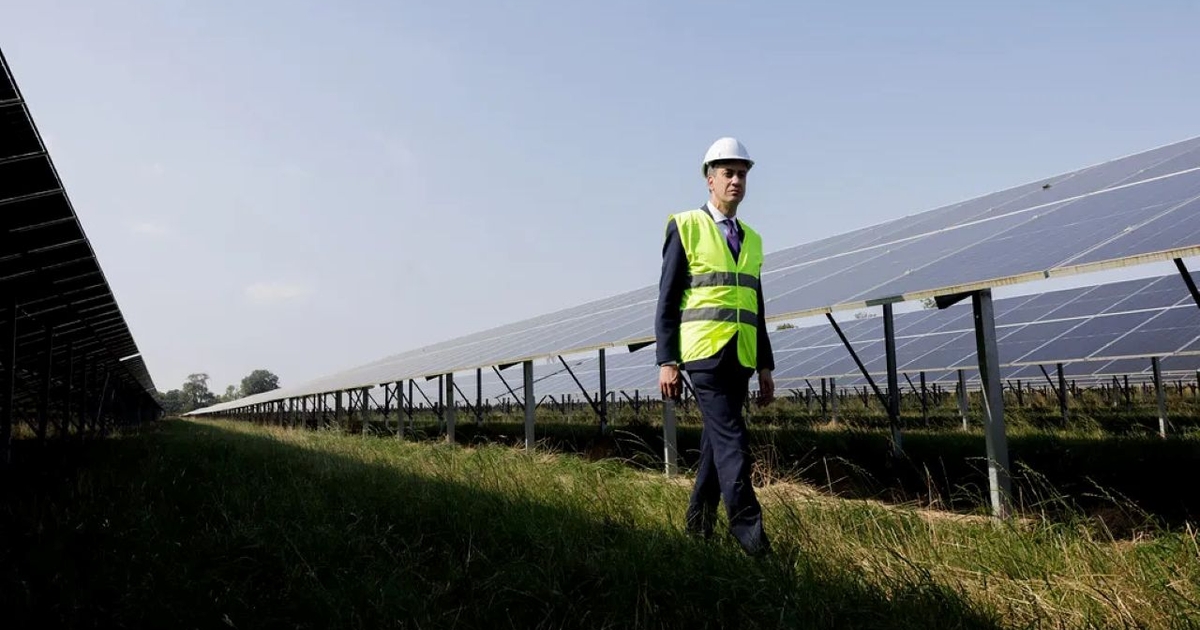
In 2025, the UK government moved quickly with legislation and reforms to support the country’s renewable energy efforts.
“With the Clean Power 2030 Action Plan as the impetus,” said Shraiya Thapa, senior clean energy thought leader at law firm Freeths, “the government has picked up the pace this year.”
Thapa emphasized both Roadmaps for solar energy and clean flexibility as markers of progress, alongside changes to grid connections and the Planning and Infrastructure Act.
This included changes to the UK planning system to make it harder for local authorities to reject solar projects on false grounds. In December, the government introduced a revised NPPF, which stated that when assessing applications, planning authorities must “give significant weight to the benefits associated with renewable and low-carbon energy generation and the proposal’s contribution to a net zero future”.
This was stated by a spokesperson for the British solar energy supplier Segen Solar energy portal that “meaningful progress” has been made this year in both the solar and energy storage sectors, citing, like Thapa, the publication of the Solar Roadmap.
“By outlining concrete steps to scale deployment and target 45-47 GW of installed solar by 2030, the roadmap gives developers, installers and investors more confidence to plan and invest,” the spokesperson said. “The government is going beyond early commitments and laying the foundation for sustainable growth.”
Chris Hewett, Chief Executive of solar and energy storage industry body Solar Energy UK, noted the further importance of the Department for Energy Security and Net Zero (DESNZ) establishing a Solar Council to continue the work of the Solar Taskforce, which developed the UK Solar Roadmap.
“Every business thrives on government support and a solid policy foundation. With CP2030, the Solar Roadmap, Connection Reform and the Solar Council we clearly have that, although of course there is always room for improvement,” he said.
Pranav Menon, senior research associate at Aurora Energy, stated that this year’s construction figures remain “well below” what would be needed to meet Clean Power 2030, implying that solar deployment closer to 6GW per year will be needed in the second half of the decade.
Menon saw that the main constraint is still delays in grid connections, “stretching project timelines and limiting how quickly capacity can be brought forward, even when project economics are strong.”
Net connection issues resolved (or not)
This despite the recent publication of nominal timelines for grid connection for renewable technologies, culminating in this year’s rescheduling of grid connection queues.
In April 2025, the UK energy market regulator Ofgem approved a plan to revolutionize the way the National Energy System Operator (NESO) handles applications for grid connections from renewable energy developers.
A total of 283 GW of projects received Gate 2 allocations, with 132 GW ‘Phase 1’ projects to be connected before 2030 and 151 GW of Phase 2 allocations with dates up to 2035.
Projects totaling 216 GW received Gate 1 offers, which means they remain in the system with a provisional offer for deferred connections and are allowed to reapply for Gate 2 status through semi-annual application windows.
One developer characterized Gate 1 as projects that are “essentially non-existent as far as the system administrator is concerned.”
For Thapa, “On the grid connection front, for solar projects to be connected in the coming years, the ultimate amplification costs and effective delivery from both project and grid supply chains will prove critical to meeting government targets.”
Hewett similarly said that “while there was, to say the least, room for improvement in its management and the results were painful for many of our members, we all knew that the grid connection queue was in urgent need of reform”.
“Many details still need to be worked out,” he added, noting that the announced offers are in line with government and industry objectives. “Now that grid connection offers have been accepted and planning permission has been obtained, a huge number of ground-mounting projects will be completed in the coming years.”
Britain’s biggest solar moments of 2025
That said, 2025 marked important milestones for the UK solar sector. Segen called Britain’s achievement of an installed capacity of more than 20 GW “a pivotal moment that demonstrated solar’s transition from a complementary technology to a core pillar of the UK energy system.”
The company spokesperson added that large-scale solar PV projects increasingly reflect “a more mature and considered approach to development, with a stronger emphasis on net benefits for biodiversity, community engagement and co-location with agriculture”.
Segen also said advances in panel efficiency, inverter performance and energy management software have significantly improved system productivity and reliability.
These things strengthen the business case for on-site generation, the spokesperson said, “while for homeowners, simpler installation processes and smarter technologies make solar energy more accessible and attractive.”
Menon agreed, saying: “Implementation has been particularly strong behind the meter, with 2025 a record year for accredited rooftop installations, reflecting accelerated adoption across both domestic and C&I sites.”
Britain’s largest solar power station, 373MW Cleve Hill, came online this yearHewett’s “standout project” of 2025.
He also points to the growth in the housing sector, which he attributes to an increase in new construction projects.
“The Future Homes Standard and Future Buildings Standard will undoubtedly stimulate the market further.”
However, he noted that “on reflection” measures to stimulate the residential and commercial retrofit market have been “slightly slower than those for ground-mounting”, noting that investment from the government’s Great British Energy Company for solar on school and hospital roofs was “extremely welcome”.
“We are still waiting for the fine details of the Future Homes Standard and the Future Buildings Standard, which should put PV on the vast majority of new builds.”
Solar energy prospects for 2026
Menon said the shape of the market is moving towards private wire and onsite generation for C&I customers, “where companies are highly motivated to reduce energy costs and manage price volatility, while also potentially avoiding grid connection delays”.
Looking to 2026, Thapa said she expects “increasing interest in co-located projects, especially solar and storage, in an era of limited grid connection capacity and more hours of negative prices per year.”
“However, coordinated projects still face numerous barriers, and we must prioritize these projects to better reflect the value and efficiencies they can bring to the network.
“The hope was that this would be done through the Strategic Spatial Energy Plan (SSEP)with the SSEP potentially also reviewing connectivity capabilities for all technologies 2031-2035, but recently announced delays to the SSEP publication have made near-term changes uncertain.”
Like Thapa, Menon also projected an increased focus on co-located solar and storage projects, “although the lack of headroom in the queue for new battery energy storage systems (BESS) remains a challenge”.
For Hewett, the “real challenges” in 2026 are skills and the supply chain. Segen’s spokesperson similarly said that as homes and businesses increasingly look to combined systems for home installations, “investing in training and certification programs will be essential to creating a workforce capable of supporting the UK’s transition to a truly integrated, carbon-free energy ecosystem”.
The company also sees “one of the most urgent needs” of the UK solar industry in 2026 as the development of “robust, well-funded recycling infrastructure”.
Hewett’s final conclusion was that “we can also expect more evidence-free rhetoric against renewables from political opponents and those with a vested interest in preventing the energy transition.”
To mitigate this, he said: “Solar Energy UK will step up its communications efforts to counter these messages and continue to deliver more clean, safe and cheap energy to the UK.”
