Scientists have developed a floating digital PV twin system, trained on data from 155 physical experiments, using a dual artificial neural network (ANN) with a high-fidelity model and a lower-order model. The predictive performance achieved R2 values of 0.9996 for PV surface temperature and 0.9189 for output power.
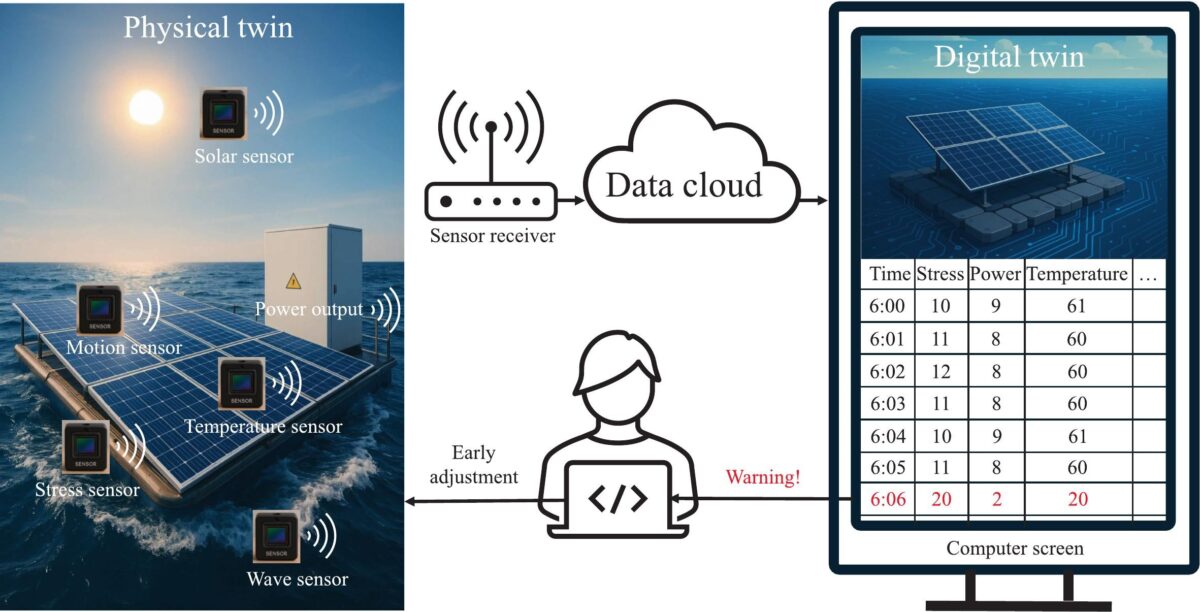
A research team led by scientists from Britain’s Cranfield University has developed an AI-powered digital twin framework for FPV systems. The system uses a physical FPV twin deployed on a water surface, with sensors transmitting data to the cloud and ultimately to the digital version of the installation.
“The digital twin operates in the cloud environment, where AI models are used to simulate system behavior and predict performance under varying environmental conditions,” the scientists explain. “Crucially, the system does not simply react to anomalies after they have occurred. Instead, it enables predictive alerting capabilities, identifying potential risks in advance based on trend analysis and learned patterns.”
The digital twin framework was developed using 155 physical experiments in Cranfield University’s wave tank, which is 30 meters long, 1.5 meters wide and 1.5 meters deep. A catamaran-type floating structure was placed centrally in the tank, with a 50 W solar panel on top, powered by a solar simulator mounted 40 cm above it.
Sensors collected time series data on hydrodynamic motion (swell, wave, pitch), mooring line forces, PV surface temperature and power. The dataset, sampled at 10 Hz, provided the empirical basis for training and validating the digital twin models. The experiments included five angles of incidence (90°, 75°, 60°, 45°, 30°), two wave amplitudes (0.025 m and 0.0375 m) and 15 wavelengths from 1.5 m to 5.0 m in 0.25 m steps.
The resulting data was transferred to a two-level ANN: a high-fidelity (strong) model and a reduced-order (light) model.
“In the initial phase, a high-fidelity (strong) neural network model is trained using experimental data as input. This model captures the complex physical behavior of the FPV system,” the team explained. “To meet the computational demands of the high-fidelity model, a reduced (light) model is developed in the second phase. This model is trained on a composite data set composed of selected results from the high-fidelity model, together with additional experimental data, allowing the core system behavior to be replicated with significantly lower computational overhead. In the final phase, the trained reduced-order model is integrated into a user-facing digital twin application.”
The high-fidelity model achieved R2 values of 0.9996 for PV surface temperature and 0.9189 for power. It accurately recorded the oscillatory behavior in bump and pitch motions, reproducing rapid variations in mooring forces and transient power fluctuations, with root mean square errors (RMSEs) as low as 0.1986 W for power and 0.1526° for PV temperature. The lower order model maintained strong performance with R² values of 0.9073 for power and 0.9660 for temperature.
“Three-dimensional performance maps generated by the trained models revealed strong nonlinear interactions between environmental inputs and system behavior,” the group concluded. “For example, the swell motion peaked under wavelengths of 2.5-3.5 m and higher amplitudes (~0.0375 m), indicating resonant conditions. Power was maximized when solar irradiance exceeded 340 W/m² at an incident angle of 90°, and the PV temperature exceeded 75°C under the same conditions. These insights enable predictive optimization and improve the understanding of FPV performance under variable sea states.”
The researchers presented the system in “Digital twins for a floating photovoltaic system with experimental data mining and artificial intelligence modeling”, which was recently published in Solar energy. Scientists from Cranfield University and Beijing University of Posts and Telecommunications participated in the study.
This content is copyrighted and may not be reused. If you would like to collaborate with us and reuse some of our content, please contact: editors@pv-magazine.com.
Popular content