

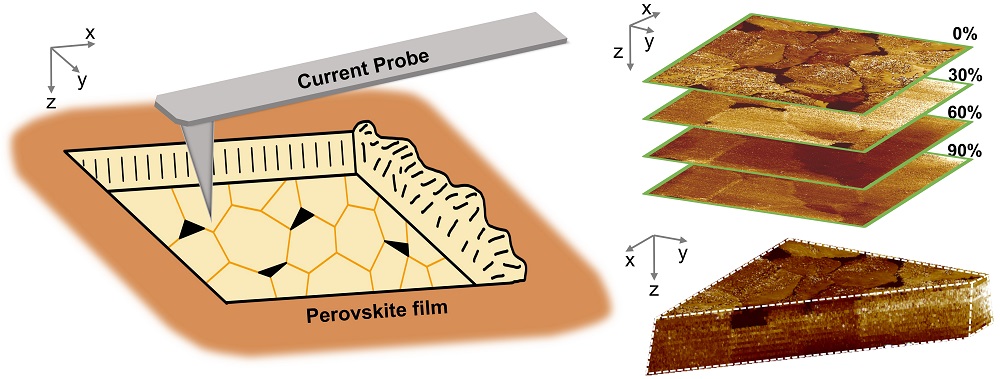
A Chinese research group has demonstrated an electrical imaging technique using 3D tomographic conductive atomic force microscopy to investigate passivation strategies of perovskite films to improve the stability and efficiency of perovskite solar cells.
Researchers in China have developed an electrical imaging technique using three-dimensional (3D) tomographic conductive atomic force microscopy (TC-AFM) to go beyond the indirect characterization of perovskite film and to investigate the effects of passivation treatments intended to improve the performance of perovskite solar cells.
“The main novelty is the use of three-dimensional tomographic conductive atomic force microscopy to directly visualize how electrical conductivity and carrier transport are distributed within perovskite films, rather than being limited to area measurements or a single average value for the entire film,” the study’s corresponding author Chuanxiao Xiao told us. pv magazine.
“This approach allows us to map current paths and defect areas across the entire film thickness at nanometer resolution, which has been a challenge for conventional characterization techniques,” says Xiao.
The 3D nature of TC-AFM provides detailed electrical analysis, both lateral and vertical, providing a comprehensive view of current performance at different depths, according to the study. The approach enables visualization of the current distribution across perovskite films by sequentially measuring the local electrical conductivity.
In a demonstration of the TC-AFM method, FAPbI3 perovskite solar films were characterized after treatment as follows: untreated, passivation with guanidinium iodide (GAI), surface passivation with phenylethylammonium iodide (PEAI), and combined bulk and surface passivation (GAI+PEAI).
An analysis found that the untreated films showed “extensive areas of low conductivity that hindered charge transport,” while bulk passivation mainly “improved conductivity within the film and along grain boundaries.” The surface passivation mainly suppressed defects near the top surface. The combined passivation treatment provided “better suppression of high-resistance areas and improved film conductivity compared to individual passivation treatments,” the study said.
To confirm the passivation effect on the device’s performance, the scientists fabricated corresponding devices. For pin devices, which have the electron transport layer on the top, energy conversion efficiency increased from about 23.3% in the untreated device to 24.5%, 24.7% and 25.1% after bulk, surface and combined passivation treatments, respectively, according to the article.
“Importantly, we show that combining bulk and surface passivation produces a much more uniform and conductive film, almost completely eliminating areas of high resistance. When combined with ultrafast spectroscopy, these results help explain the observed improvements in device efficiency and stability,” said Xiao.
The research is described in detail in “Three-dimensional mapping of electrical behavior in perovskite films using tomographic conductive atomic force microscopy”, published in Newton. The research team included members from the Ningbo Institute of Materials Technology and Engineering (NIMTE) of the Chinese Academy of Sciences (CAS), Ningbo University, Tianjin University, PetroChina Company Limited, Hunan Normal University, Soochow University and Ningbo New Materials Testing and Evaluation Center.
The researchers are now expanding the use of the three-dimensional electrical imaging technology to other perovskite compositions, interfaces and degradation processes, with a particular emphasis on long-term reliability and stability. “For example, we study light-induced phase segregation and degradation in wide bandgap perovskite materials for tandem applications,” says Xiao.
More broadly, the team is developing advanced nanoscale characterization tools to directly link microscopic material behavior to actual device performance in next-generation solar cells.
This content is copyrighted and may not be reused. If you would like to collaborate with us and reuse some of our content, please contact: editors@pv-magazine.com.
