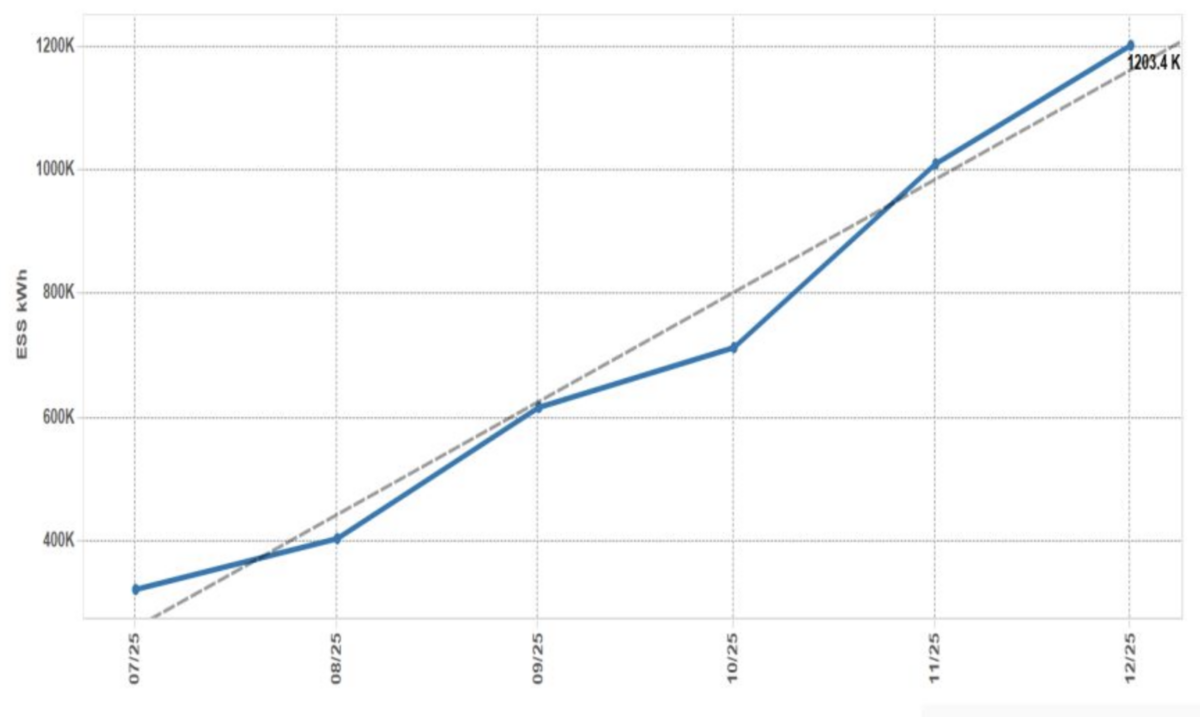
More than 1.2 GWh of new behind-the-meter energy storage capacity was installed across Australia in December 2025, as households and businesses sought to take advantage of the federal government’s revised AUD7.2 billion ($4.9 billion) Cheaper Home Batteries Program.
This is evident from the latest figures from energy sector data analyst SunWiz Australia registered 1,203 MWh of behind-the-meter battery energy storage capacity through the Small-scale Renewable Energy Scheme (SRES) in December 2025, exceeding 1 GWh for the second consecutive month.
The national market grew by 19% in December 2025, slowing from 42% growth the month before, when 1,024 MWh of new capacity was registered. Despite the slowdown, SunWiz director Warwick Johnston said the market continued to show a consistent upward trend.
“Since the introduction of STCs for batteries, volumes have increased consistently month-on-month, without reaching a plateau to date,” he said.
Not only are more batteries being installed, but capacity continues to increase, with the national average system size growing to 32.86 kWh, up from 32.74 kWh in November 2025.
“The most significant change in the market is the shift to larger batteries,” said Johnston. “The volume of smaller batteries declined as people tried to take advantage of the substantial subsidy on larger batteries while it persisted.”
The federal government’s battery subsidy scheme has proven to be a great success. Figures show that between July 1 and December 31, 2025, Australians installed 184,672 home batteries with a combined storage capacity of 4.27 GWh under the initiative.
The plan’s success prompted the government to make changes last month, including scaling back rebates for larger systems, amid fears the budget would be depleted well before the expected 2030 end date.
Under the scheme, eligible households and small businesses have been able to get a 30% discount on a home battery when installed alongside new or existing rooftop solar panels. Subsidies were available for batteries with a capacity between 5 kWh and 100 kWh, with the discount applied to the first 50 kWh.
Below changes announced in December, the first 50 kWh of a system would still be eligible for support, but for medium and larger batteries the discount per kWh would not be as generous.
From May 1, 2026, systems up to 14 kWh will receive the full discount of 30% per kilowatt hour. The rebates would then be phased out for systems from 14 to 28 kWh, and again for systems over 28 kWh.
Systems in the 30 kWh to 100 kWh range continued to show the strongest performance in December, led by the 40 kWh to 50 kWh segment, which recorded 61% month-over-month growth. Although overall volume was lower, the 50 kWh to 100 kWh segment more than doubled its volume compared to the previous month.
In contrast, all other segments experienced volume declines, with the residential segment up to 15 kWh showing the largest decline.
All states recorded growth, ranging from 4% in Western Australia to 62% in the Northern Territory. The remaining states recorded double-digit growth between 14% and 24%.
This content is copyrighted and may not be reused. If you would like to collaborate with us and reuse some of our content, please contact: editors@pv-magazine.com.
Popular content