France-based DOTSun has developed an on-site repair solution for solar panels with affected backplates, compatible with PA, PVDF and PET types. The system uses a compact laminator to apply a protective film to the back of the module, reportedly restoring insulation and extending the life of up to 2,000 panels per location.
French startup DOTSun has unveiled an on-site repair solution for solar panels suffering from backsheet degradation.
The new system, called DOTSun Extended Life, is compatible with all major types of backsheets, including polyamide (PA), polyvinylidene fluoride (PVDF) and polyethylene terephthalate (PET).
“The on-site repair solution will be released this quarter and is designed to extend the life of existing panels while minimizing operational downtime,” said Stephan Padlewski, founder of DOTSun. pv magazine. “Our initial focus is on greenhouses, roofs and small ground-mounted systems, with up to 1,000 to 2,000 panels that can be repaired directly on site.”
The repair process involves applying a hydrolysis and UV resistant adhesive film to the back of the module, restoring electrical insulation and long-term durability. The protective film is 125 µm thick and uses a pressure-sensitive adhesive to ensure strong adhesion to affected PA, PVDF and PET surfaces, according to DOTSun. It is manufactured in France by the high-quality materials supplier Addev Materials.
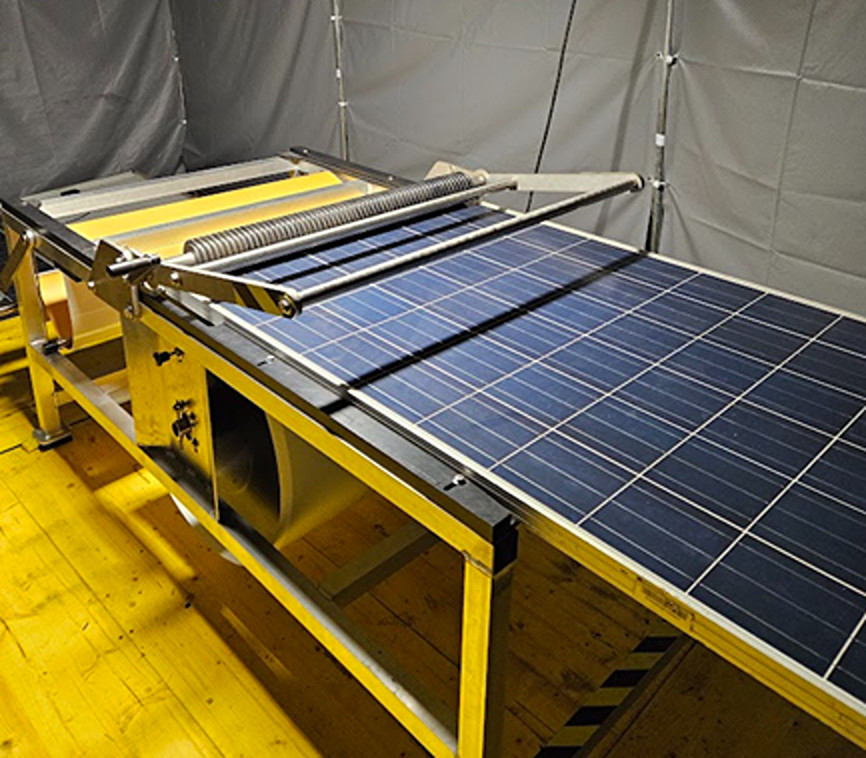
The film is also fully compatible with DOTSun’s proprietary laminating equipment, which operates manually without the need for external power. The laminating machine is suitable for panels up to 1,100 mm x 2,100 mm and achieves a throughput of up to 10 panels per hour per device.
“For larger volumes, DOTSun has developed an industrial-scale laminating machine that can repair and test approximately 100 panels per hour, allowing for significantly larger quantities of modules to be processed that can be repaired, overhauled and reused,” said company co-founder Denis Duyrat. “This industrial repair solution is expected to be deployed by the end of 2027, subject to the successful completion of a financing round targeting the first half of 2026.”
Before proceeding with repairs, the French company carries out an extensive technical audit to assess the performance of the PV installation at module level. The audit identifies early signs of backplate degradation and determines whether panels are repairable based on the severity of damage and overall electrical performance. Panels that exhibit reversible degradation can be repaired and reinstalled in the same location. Modules with irreversible degradation must be replaced.
The repair workflow starts with disassembling the affected modules and transporting them to a mobile repair unit on site. Up to 80 panels per day can be cleaned and laminated per line, with multiple lines available to increase throughput and capacity.
A dedicated workshop shelter has been set up on site to facilitate the repair process and ensure that all work is carried out in a controlled environment. This shelter is specifically designed to accommodate four main phases of the procedure.
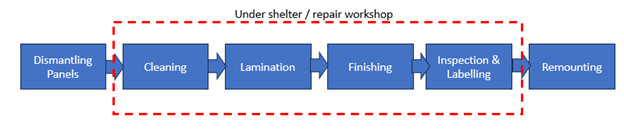
The preparation phase includes a thorough visual inspection and cleaning of the panels using methods such as vacuuming, brushing and wiping. Then, during the lamination phase, DOTSun’s proprietary protective film is applied evenly over the entire backplate, increasing the panel’s durability. This is followed by the finishing phase, during which the edges of the panel and the junction box are sealed with a UV and moisture-resistant insulation layer, which provides additional protection against environmental factors. Finally, the inspection phase provides quality control through a final visual check and the application of a new label to the repaired module.
Throughout the process, disassembled panels are carefully stacked in accordance with their original string layout, ensuring good organization and easy reassembly. After inspection and labeling, panels can be immediately reinstalled on site.
In early 2024, DOTSun completed a proof-of-concept project in France, monitoring the repaired modules both visually and electrically. The company partnered with French industrial conglomerate Sicame Group to deploy a string-level monitoring system, improving the granularity of performance tracking.
“Audit fees for customers, as well as for state-of-the-art performance analysis of PV installations, are charged per day. For utility-scale power plants, an audit typically ranges between €1,500 ($1,750) and €2,000 per MW,” explains Padlewsky. “Our on-site repair benchmark is €15-20 cents per W, which represents a saving of 40-60% compared to purchasing new panels with similar historical characteristics. It is also becoming increasingly difficult to find new 180W or 245W modules, as current mass production focuses on panels above 500W, with completely different sizes and weights.”
“Remote repair is obviously more cost-effective, and our benchmark is to remain 25 to 40% cheaper than new Chinese panels – without even comparing with European-made modules, which are significantly more expensive,” he continued. “To date, all audits are carried out by DOTSun, although we may consider outsourcing some of this activity in the future. However, it remains highly unlikely that we would outsource an audit if it serves as a preparatory step towards a repair campaign.”
DOTSun was founded in 2022 and is located in Bagnols-en-Forêtin the southern Var department of France. It recently received the Green Fund for Industrial Areas in 2025 from the French environmental agency Ademe and the Prefecture of the South PACA region.
This content is copyrighted and may not be reused. If you would like to collaborate with us and reuse some of our content, please contact: editors@pv-magazine.com.
Popular content