

Physicists at Trinity College Dublin have developed a new theoretical framework that links photon condensation in optical microstructures to the fundamental limitations of heat engines, potentially offering new routes to harvest more useful energy from sunlight and other light sources. The work suggests that devices that trap light in small cavities could concentrate diffuse radiation into laser-like beams without the need for an incoming laser, opening a path to convert disorganized heat into ordered optical work.
In their analysis, the team looked at photons trapped in microscopic optical devices, where the light particles can behave collectively rather than as independent quanta. Under the right conditions, this collective behavior leads to a form of condensation, where light energy is funneled into a small, intense beam of a single pure color that closely resembles laser output.
Previous experiments had shown such photon condensation, but only when the input energy already arrived in a highly concentrated, coherent form, delivered by a laser. The new theory indicates that similar condensation should be achievable when the input is diffuse, such as the broad-spectrum radiation from sunlight, conventional lamps or LEDs, provided the optical cavity and its environment are appropriately designed.
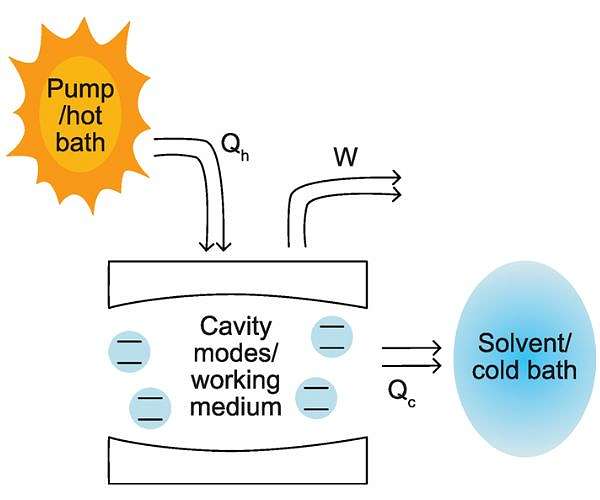
Senior author Paul Eastham, Naughton Associate Professor at Trinity’s School of Physics, explains that the behavior of these light-trapping devices can be understood using the same thermodynamic principles that apply to classical heat engines. Treating the captured photons and their environment as a heat engine, the researchers show that the onset of photon condensation is governed by laws that also limit the performance of steam engines and power plants, linking optical condensation thresholds to fundamental limitations in converting heat into work.
This conceptual bridge means that design rules for efficient heat engines can inform the design of optical structures that channel light energy at the quantum level. According to the researchers, such insight could guide the development of micro- and nanoscale devices that control the flow of energy in photonic circuits, solar energy technologies and microscopic engines powered directly by radiation rather than mechanical fuel.
First author Luisa Toledo Tude, also from Trinity’s School of Physics, notes that the primary purpose of these optical devices is to convert incoming radiation into a more useful form of energy production. In the scenarios considered, that useful output appears as laser-like light that, depending on the application, can be converted relatively easily into electricity, mechanical motion, or other forms of work.
One potential application highlighted by the team is the integration of photon condensation cavities with conventional solar cells. In such a hybrid system, a device that concentrates diffuse sunlight into a narrow-band, high-intensity beam could power a photovoltaic element more effectively than direct lighting, increasing the proportion of incident solar energy captured as electrical energy.
In addition to solar photovoltaics, the same principles could enable miniature radiation-controlled motors in which ordered optical fields drive mechanical or electronic processes on a microscopic scale. These devices can capture ambient light from indoor sources, such as lamps and LEDs, and reuse it to do useful work in low-power sensor networks or quantum technologies.
The research, supported by funding from Research Ireland, appears in the journal Physical Review A. The authors emphasize that the current work is theoretical and that the next step is to experimentally test the predictions in the laboratory, where real optical materials, cavity imperfections and environmental noise will determine how closely practical devices can approximate the idealized behavior described in their models.
While the scientists caution against overspeculation, they acknowledge that validating this theory could broaden the toolbox for managing light as an energy source. In the longer term, advances in controlling photon condensation using heat engine concepts could contribute to technologies that extract more useful work from sunlight and artificial lighting, helping to power the vast number of devices and processes that rely on reliable energy flows.
Research report:Photon condensation from thermal sources and the limits of heat engines
