

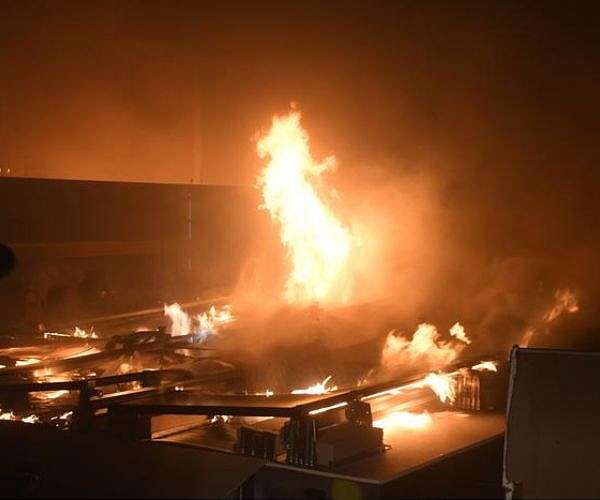
Southwest Research Institute conducted a series of large-scale fire tests to investigate how flames spread under photovoltaic panel installations on flat commercial and industrial roofs. The program is intended to give fire safety organizations the data they need to refine standards and improve mitigation strategies for rooftop solar systems.
Engineers built full-scale test decks designed to replicate typical low-slope roofing used on large buildings, then mounted photovoltaic solar panels on these structures. They subjected the leading edge of the deck to flames and crosswinds to study how fires can start and spread under and around the panel arrays, while also assessing how various design features affect resulting hazards to structures and first responders.
SwRI first conducted baseline testing using three common types of rack orientations for photovoltaic panels to determine which configuration supported the fastest flame spread among the modules. Once the most critical scaffold orientations were identified, the team evaluated two mitigation approaches for those layouts, integrating exposed walkways and vertical barriers to see how these features changed fire growth behavior and pathways across the roof.
To provide a reference situation, the researchers also conducted a comparison test on a bare deck where no photovoltaic panels were installed. This allowed them to compare the fire performance of typical roofing materials only with the more complex geometry and ventilation paths introduced by solar panels and their mounting materials on similar roof structures.
According to project lead engineer Alexandra Schluneker, SwRI’s large indoor fire testing facilities and tailor-made pollution control system made it possible to carry out what she described as the largest evaluations of photovoltaic panels to date under controlled conditions. “SwRI’s large indoor fire testing facilities and customized pollution control system allowed us to safely conduct the largest PV panel evaluations to date with better exposure control while protecting the environment,” said Schluneker. She noted that previous work in this area relied on smaller-scale setups or testing in the open air, where exposure is more difficult to control.
The work was sponsored by the National Fire Protection Association’s Fire Protection Research Foundation and the Property Insurance Research Group, reflecting strong interest from both code developers and insurers. The resulting datasets are expected to support updates to building codes and fire suppression protocols that specifically address the behavior of commercial and industrial rooftop solar panels during fire events.
Karen C. Carpenter, director of SwRI’s Fire Technology Division, emphasized the broader goals of the program in the context of renewable energy deployment and community safety. “Large-scale fire testing of PV panels to evaluate performance, flame spread and potential prevention and suppression strategies is not just a technical necessity – it is a cornerstone of advancing fire safety to ensure that renewable energy solutions remain both sustainable and safe for the communities they power,” Carpenter said.
Schluneker has already shared the preliminary findings from the test series with the fire protection community. She presented initial results at the 2025 NFPA Conference in Las Vegas, Nevada, on June 18, 2025, giving stakeholders a first look at how different racking arrangements and mitigation details can impact fire dynamics at the roof level.
A second round of large-scale fire testing is planned for early 2026 to explore additional mitigation concepts and refine understanding of design features that can slow or redirect flame spread under photovoltaic panels. These follow-up experiments are expected to expand the range of configurations evaluated and provide further guidance for builders, property owners and first responders as the penetration of rooftop solar continues to increase in commercial and industrial facilities.
For more technical information about SwRI’s fire research and engineering activities, including fire testing for photovoltaic systems, visit the Institute’s fire technology pages. here.
