

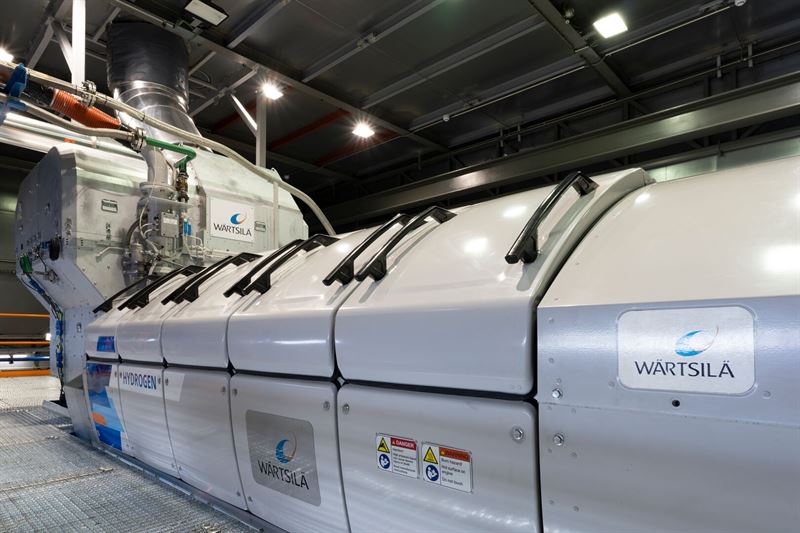
Wärtsila has successfully commissioned a new 100% hydrogen engine that supplies electricity to the Spanish national grid in Bermeo, Northern Spain. This marks what it describes as the world’s first demonstration of a large-scale engine running solely on pure hydrogen. The test represents a step beyond hydrogen-ready systems, demonstrating that engine-based power generation can operate on 100% hydrogen under real grid conditions. The Wärtsilä 31H2 engine, part of the company’s Wärtsilä 31 platform, is currently undergoing performance validation at the site. “This is a test for the future of renewable energy,” says Rasmus Teir, Director of Technology Strategy & Decarbonisation at Wärtsilä. “Today, our Wärtsilä 31H2 hydrogen engine runs on 100% hydrogen and supplies power to the Spanish national grid.” The company says the demonstration supports the case for the flexible, dispatchable generation needed to balance the growing shares of wind and solar power. Green hydrogen, which produces no CO2 emissions at the time of use, can also provide long-term energy storage and grid stability during periods of low renewable production. Wärtsilä adds that the hydrogen engine platform could serve energy-intensive sectors such as data centers and industrial facilities, as well as off-grid applications in the future. The Bermeo trial builds on previous work with hydrogen-ready power plants and comes as Spain continues to expand its renewable energy system and reduce dependence on fossil fuel imports.
Based in Washington Twelve has opened AirPlant One, which it claims is the first commercial-scale plant in the United States to produce sustainable aviation fuel (SAF) from CO₂ and renewable electricity. The plant also produces e-naphtha. “The ribbon cutting, held jointly with Alaska Airlines and Microsoft at the Moses Lake, Washington facility, marks the beginning of commercial-scale production and sets the stage for commercial flights in the U.S. powered by jet fuel from the air,” the company said Wednesday.
Alaska Airlines will operate regular domestic flights using e-SAF, produced by AirPlant One. Microsoft supported the scale-up through an investment from the Climate Innovation Fund and an agreement for the purchase of sustainable aviation fuel. “Using a book-and-claims accounting model co-developed with Alaska Airlines, this agreement will enable Microsoft to reduce reported emissions associated with business travel. This partnership underscores Microsoft’s commitment to advancing clean energy solutions with transformative impacts on aviation and global industry.”
A European consortium has launched HyCavern, a three-year project to develop and validate underground hydrogen storage based on mined, lined rock caverns for regions where conventional storage is not feasible. “A key ambition of HyCavern is to make underground hydrogen storage more scalable and replicable by adapting cave designs to diverse geological conditions,” the consortium said. Partners include the Clean Hydrogen Partnership and organizations such as SINTEF, Fundación Hidrógeno Aragón, the University of Edinburgh, Hive Ventures, Delft University of Technology, Fraunhofer ILT, the University of Oxford, AGH University of Krakow, Comec Innovative, swisstopo, Baker Hughes, Deloitte, Planck Technologies and Picum.
EWE And Salzgitter FlachstahI have signed a seven-year agreement for the supply of 10,000 tons of green hydrogen per year from 2030. “This is the first major hydrogen purchase agreement of the 320 MW production plant that EWE is building in Emden and also Salzgitter AG’s first major contract with a hydrogen supplier,” Salzgitter said after the signing in Berlin.
A research team from the University of Perugia has shown that large-scale integration of excess PV electricity with industrial alkaline water electrolysis (AWE) is technically feasible under the expected electricity system constraints in Italy in 2030. The study, published in Focus on renewable energyfinds that a modular AWE configuration with up to nine parallel trains, each rated at 20 tons of H₂/h, enables load-following operation while maintaining stable electrochemical performance, thermal management and efficiency over a wide operating range. The modeled system achieves electrolyser load factors ranging from approximately 3% in winter to 97% in peak summer periods.
