

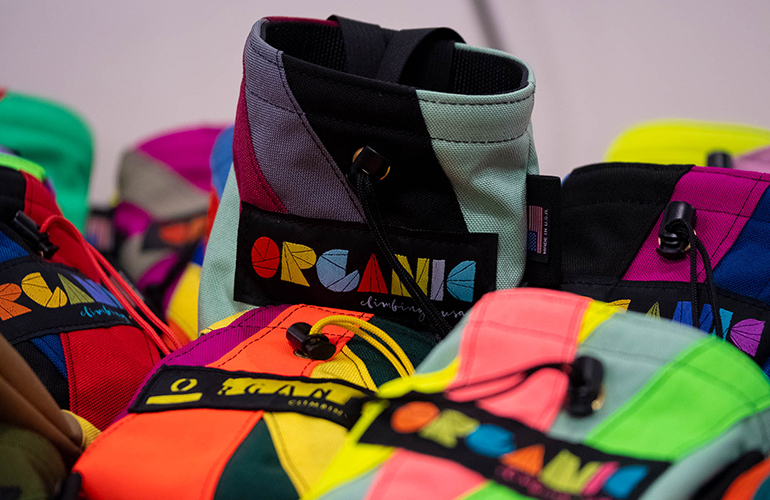
Josh Helke started rock climbing at the age of five. Throughout his life in a sport that relies on steady, purposeful movement, he has also built a business based on these principles. Helke started the company Organic climbing in his garage in Laramie, Wyoming, in the early 2000s, sewing together crash pads used to cushion climbers as they fall from a cliff face.

Organic Climbing is known for producing brightly colored chalk bags and crash pads used for rock climbing. Organic climbing
Today, Organic Climbing and its sister brand Nittany Mountain Works operate from a factory in Philipsburg, Pennsylvania, employing more than 20 people. The Organic Climbing brand is known for using bright fabric swatches, and each chalk bag and crash pad comes with a small card that says ‘Solar Sewn’. The modest textile factory has a rooftop solar project that generates twice as much energy as the operation needs.
“We produce all the energy we currently use,” says Helke. “It was one of the best choices we ever made.”
Organic Climbing has practiced sustainability from the beginning by recycling packaging and using leftover materials in its other sewing projects. These environmentally friendly production methods are even listed in the company’s job descriptions. As the larger climbing accessories market was homogenizing its products, Helke said he made crash pads with brighter colored fabrics and used leftover swatches to make bags with multiple colorways.
His method kept fabric out of the landfill and helped him make more products, but it also provided free advertising. The bright organic bags and pads were easy to spot in photos in major climbing magazines.
The next step – or rather, hand-holding – in Organic’s sustainability journey was bringing solar energy to the factory.
“In retrospect, I think Josh always had the slogan ‘Solar Sewn’ in his head,” said Jason Grottini, president of renewable energy services at Environment. “He had a vision.”
Envinity is a solar and energy efficiency contractor based in the nearby city of State College. The company installs solar energy, strengthens the building envelope and builds energy-efficient homes.
In the region, Organic’s business had grown alongside Envinity, and the contractor had previously completed an energy audit of Helke’s home. When it was time to add solar to the factory in 2018, Envinity was the first choice for an installer.
With financial support from the federal investment tax credit, a solar rebate from regional utilities, and a low-interest loan through the Small Business Administration, Organic was able to afford to install a 60.5 kW solar project on the factory’s roof.

Local installer Envinity built the 60.5 kW solar project at Organic Climbing’s factory in 2018. The array was so large that it could produce double the energy used by the factory. Environment
The PV project was composed in three sub-arrays that together form one three-phase flow SMA Sunny Tripower Core1 string inverter. Helke requested U.S.-made components that make up the system DefinitelyTeed panels attached to the metal roof with S-5! standing seam clamps. Building the project was as easy as it gets.
“I wish solar was more complicated, but sometimes it’s really just putting small rectangles on top of large rectangles, and his roof was the epitome of that,” Grottini said.
The irony of having a solar project on Organic’s roof is that there is a coal vein beneath the factory. Helke’s neighbors told him to use the coal to cover the cost of the PV installation, but “you can’t sell coal to pay for solar, that just doesn’t work,” he said.
Organic paid for the series seven years after it was completed, and without coal money. Since coming online, the factory’s energy consumption has been more than covered. Organic is a minor shareholder in a rock climbing school in State College, and the additional production also subsidizes that facility’s energy costs.
Having rooftop solar has given the company greater economic predictability at a time when energy costs are increasing exponentially. Central Pennsylvania was a region that once had a thriving textile industry, and Organic hopes to keep the trade alive and people employed for the long term. Solar energy helps in part.
“I love making things. It’s a lot of hard work, but I can’t imagine how nice it feels to have containers of things in plastic bags that you bring from abroad and sell,” says Helke. “The feeling of family that we have because we work together and make a product is something you don’t often encounter. That’s something people probably regret about the loss of production. That’s special.”
Organic’s website leads with messages indicating that the factory runs on solar energy. The company produced a two and a half minute duration video about the solar project, in which Helke reads prose about rock climbing and solar photovoltaics. When people tour the factory, he shows guests how much the array produces via SMA’s Sunny Portal. As the label states, solar energy is sewn into Organic Climbing’s fabric.
“This is a case where Josh really wanted to sell the marketing side of solar and you don’t see a lot of that anymore: people making decisions based solely on the impact of public perception,” Grottini said. “But this is 100% a case where I think he almost had to put solar on the building for his business.”
