

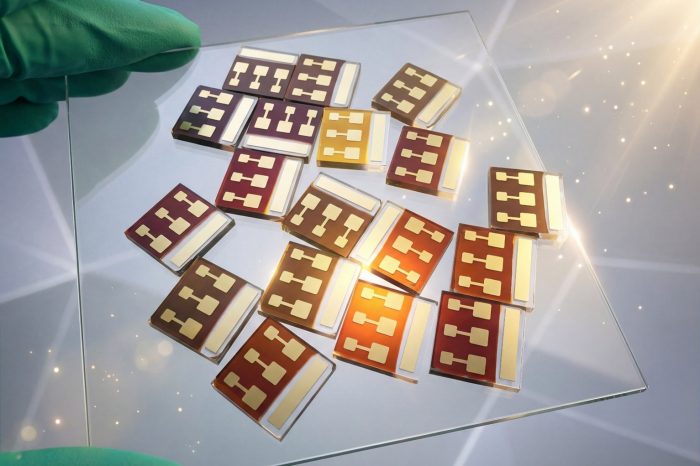
The Australian scientists designed the cell with a sodium sulfide additive to achieve a uniform distribution of sulfur and selenium, improving charge transport.
This controlled elemental layering reduces energy barriers and defects, enabling a certified efficiency of 10.7%.
University of New South Wales (UNSW) engineers have improved the performance of solar cells made from antimony chalcogenide (Sb2(S,Se)3), achieving a champion power conversion efficiency of 11.02% in the laboratory and a certified efficiency of 10.7%.
Due to its optoelectronic properties, high absorption coefficient, material availability, and ability to be deposited at low temperatures, which supports large-scale, low-cost production, Sb2(S,Se)3 has emerged as a promising alternative for next-generation PV materials, especially in the pursuit of ultrathin and tandem solar technologies.
Despite its benefits, antimony chalcogenide efficiency has not gone beyond 10% since 2020. But during this latest study, the UNSW team discovered that the main problem was caused by the elements that make up the material – sulfur and selenium – not being distributed evenly during production.
Chen Qian, the first author of the research paper, said this uneven distribution created an “energy barrier” that made it more difficult for the electrical charge generated by sunlight to move through the solar cell.
“It was like driving a car up a steep slope. When you do that, you need more fuel to get to the end, while it’s more efficient to get there if the road is flat,” he said. “If the distribution of elements in the cell is more even, the charge can move more easily through the absorber instead of getting stuck before being collected, meaning more sunlight is converted into electricity.”
To address this problem, the researchers introduced a small amount of sodium sulfide as an additive into the precursor solution to control the reaction kinetics. The UNSW team said this strategy enables a more uniform depth-dependent elemental distribution, flattens the unfavorable maximum valence band gradient across depth and suppresses the formation of deep-level defects.
The improved antimony chalcogenide solar cells achieved an energy conversion efficiency of 11.02% in the UNSW laboratory with a certified value of 10.7%, independently verified by the CSIRO. The researchers acknowledge that further work is needed to reduce defects in the material, but say they are confident this can be achieved through chemical treatments known as passivation.
“In the coming years, we will continue to work on reducing the defects in this material through that passivation process,” Qian said. “We believe it is an achievable goal to increase efficiency by 12% in the near future by tackling the challenges that still exist step by step.”
UNSW School of Photovoltaic and Renewable Energy Engineering Scientia professor Xiaojing Haowho led this research, said the progress represents a major step forward in the development of antimony chalcogenide as a solar cell candidate. “The next generation of solar panel technology is tandem cells, where two or more solar cells are stacked on top of each other,” she says.
“Each layer absorbs different parts of sunlight to make more electricity. What researchers around the world are trying to figure out is which material would best be used as the top cell, working in conjunction with a traditional silicon cell,” she further explained. “Each material has its own advantages and disadvantages, and I don’t think there is an ideal top cell candidate yet. We need more top cell candidates that can work together with silicon cells. Antimony chalcogenide is one of them and very positive, especially given its distinctive properties.”
The details of the study appear in “Regulation of the hydrothermal reaction kinetics with sodium sulfide for certified Sb2(S,Se)3 solar cells with an efficiency of 10.7%”, published in nature energy.
This content is copyrighted and may not be reused. If you would like to collaborate with us and reuse some of our content, please contact: editors@pv-magazine.com.
