

Demand for electricity is increasing and solar energy generation is being put under pressure like never before for reliability and affordability. Developers are looking pragmatically at opportunities and investing in generation to meet demand using the most cost-effective solution for the location. Solar shows that it can still perform on its own.
In addition to the availability of fuel sources, there is the issue of interconnection and grid availability. Large-scale solar energy projects that maintain energy costs at the same level over the life of the installation encounter planning problems related to the electricity grid. interconnection queues that could take years. Delays are not due to renewable energy. Developers looking to build gas-fired combined-cycle facilities report similar wait times for the delivery of suitable turbines.
Kevin Pratt, the developer’s Chief Operation Officer Pacifico Energytold pv magazine USA that the combination of increasing demand, network interconnection queues and equipment supply chains ensures that generation behind the meter more attractive on a larger scale. All this cannot be the cause of the increasing demand from data centers.
“The reason we’re bullish on private grids, and microgrids in general, is because of the response we’ve seen in the market,” said Pratt. “Even before the advent of the big data center, we had customers who needed reliable power in a number of different scenarios. We decided we had to think ahead about this. So you’re talking chicken and egg. The demand wasn’t there yet, but we thought it would come.”
Pratt cited customer needs from about three years ago, when modest operations were relatively unable to secure utility access to higher capacity. These include a business park in Southern California, a residential complex in Hawaii and an aerospace company in Los Angeles looking to expand its existing operations.
Technologies have advanced to the point where a variety of generation sources such as solar energy, hydrogen fuel cells and linear generators – such as those produced by Mainspring – are available for urban environments and non-attainment areas where environmental regulations and codes are very strict. Combined with storage, Pratt said, these options allow customers to bypass many permitting and interconnection queues by getting as much of their generation behind the meter as they can handle.
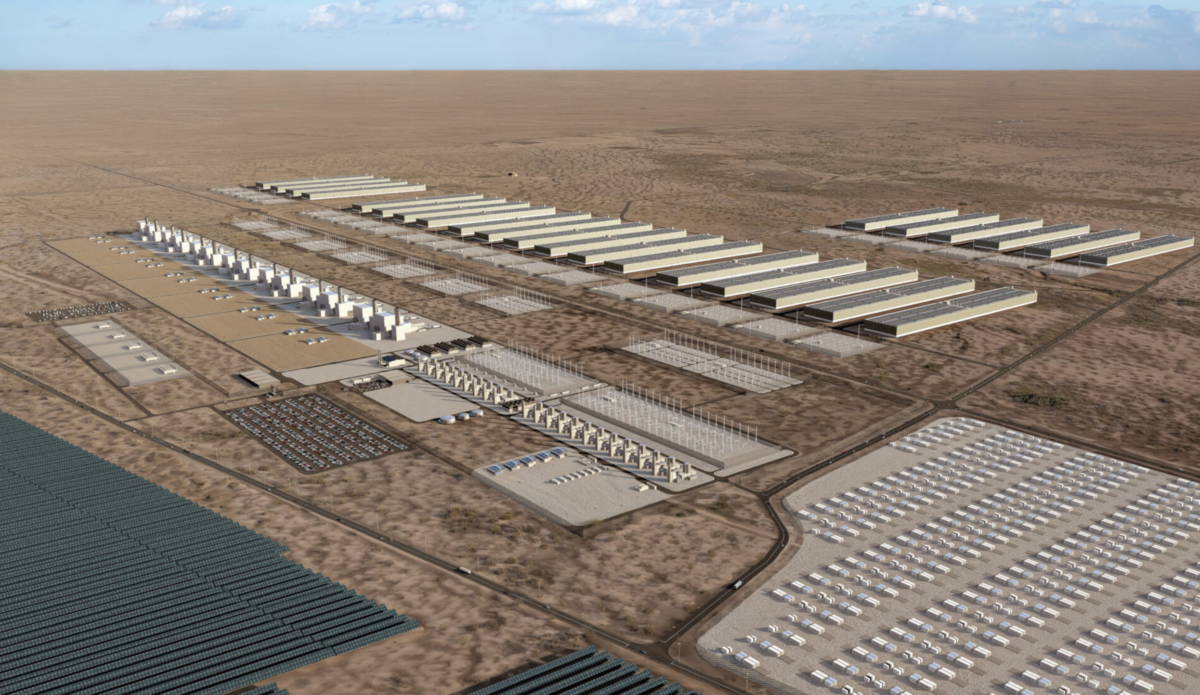
Microgrids no longer imply modest size; new projects can amount to hundreds of megawatts and even gigawatts. Pacifico is building its GW Ranch project in Pecos County, Texas, as a behind-the-meter manufacturing facility for data centers specializing in artificial intelligence development. This project is being built in phases, with 1 GW expected to be operational by 2028 and the entire facility online by 2030.
The primary generation sources for the GW farm will be simple cycle gas turbines, which are not as efficient as combined cycle turbines, but access to natural gas is not an issue in that part of West Texas. Combined cycle generators, which produce steam, also require more water, and the GW Ranch project does not require access to water elsewhere. Additionally, as previously noted, combined cycle turbines are currently in high demand, with long wait times, and Pratt said Pacifico was fortunate to have secured the generators destined for GW Ranch.
The project also includes 1.8 GW of on-site battery storage. But what about solar energy?
“For our large GW Ranch project, we also have approximately one GW of on-site solar in our design,” said Pratt. “We designed it. We planned for it. Solar energy has been our bread and butter, so that’s very natural for us. But we leave it up to the customer. And ultimately, speed is the driving force behind decision-making: speed to reliable power.”
While some proponents view solar energy and fossil fuels as a zero-sum competition, consumers are more pragmatic. At the same time, renewable energy, especially solar photovoltaics, has shown itself to be not only effective in many applications, but also the only reliable source in many parts of the United States.
“Anything west of El Paso, gas is hard to come by,” Pratt said. “In California and Arizona, there’s a lot of demand. In Arizona, they’re moving production offsite and they’re bringing semiconductor production there. People want to put data centers there. They need off-grid power, but the off-grid situation is quite challenging because they don’t have the availability of gas.”
This is an opportunity for solar plus storage to compete with other sources. For example the recently announced Pioneer Center for Clean Energy in Yuma County, Arizona, under development by BrightNight and Cordelio Power, will provide 300 MW of solar plus 1,200 MWh of storage to strengthen local infrastructure for Arizona Public Service. Although the project is grid-connected, it demonstrates that large-scale solar energy remains competitively attractive.
According to Pratt, increasing demand for electricity from manufacturers that need to scale up and the new generation of ‘hyperscale’ data centers will make private microgrids and behind-the-meter generation, with or without network interconnection, more important in the US energy landscape. According to a study by the National Center for Energy Analytics, hundreds of data centers are planned, each with a power requirement of more than 300 MW.
“You talk about the decision to go to a private grid or a public grid; that’s really the struggle I see,” he said. “It’s not just about generation. It’s about how to get the power where it’s needed. Those lines are already overloaded. There are massive upgrades needed in the transmission and substations to deliver the electricity. And new transmission is very slow and difficult to come by. So I think microgrids are going to be a big part of the solution in the future.”
Solar developers will have to convince customers who need more power that the demonstrable benefits of utility-scale PV plus storage could apply to them without having to jump through permitting hoops or wait in endless interconnection lines. And don’t wait for gas turbines either.
This content is copyrighted and may not be reused. If you would like to collaborate with us and reuse some of our content, please contact: editors@pv-magazine.com.
