

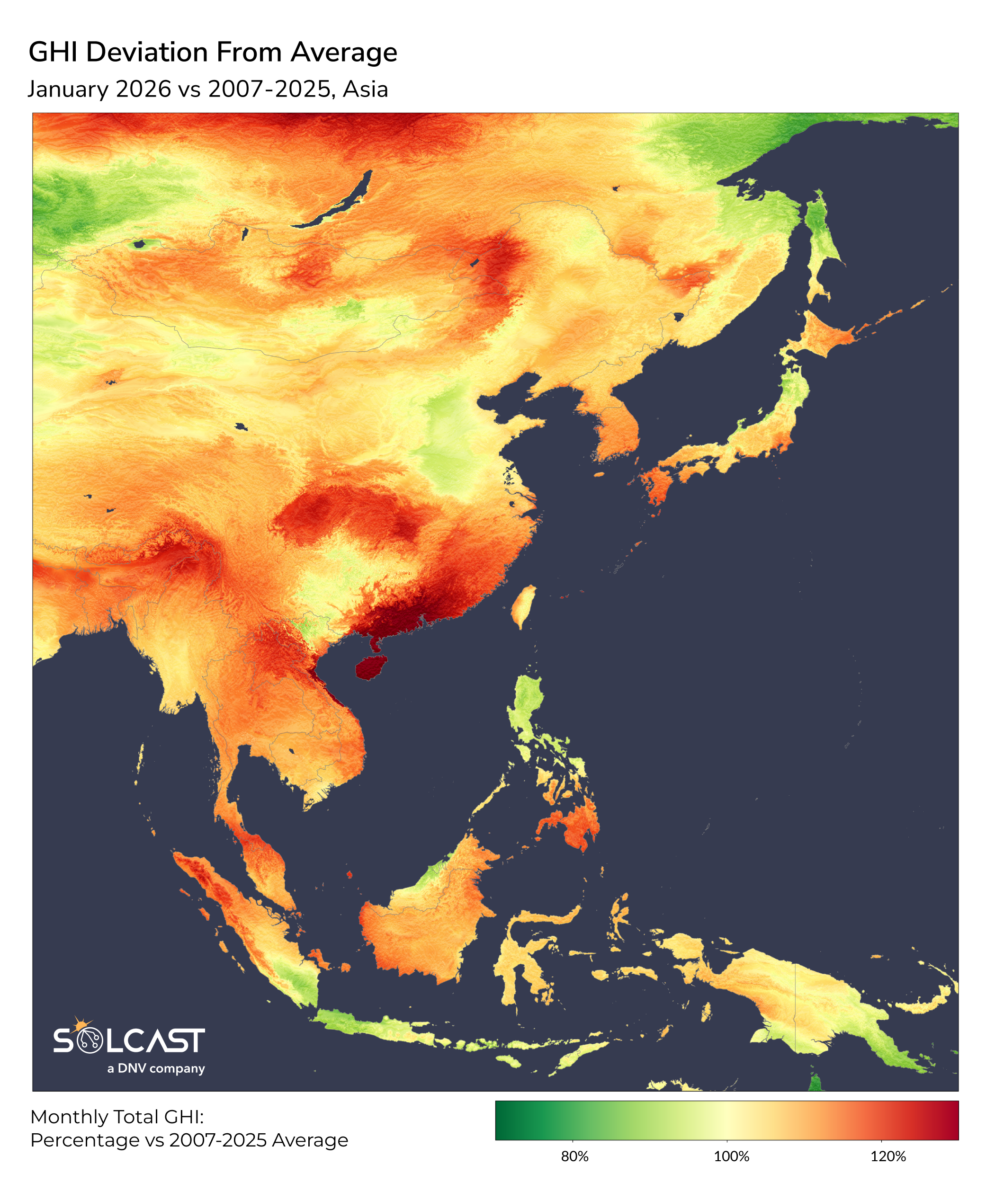
In a new weekly update for pv magazineSolcast, a DNV company, reports that in January, most of East Asia experienced normal to above-average solar radiation, with southeastern China seeing peaks due to reduced cloud cover and low aerosol levels under persistent La Niña effects. In contrast, the Philippines experienced below-average insolation from early Tropical Storm Nokaen, while other regional cities such as Seoul, Tokyo and Taipei posted modest gains.
Most of East Asia recorded normal to above-normal solar radiation in January as weak La Niña conditions continued to influence regional weather patterns. The biggest gains were in southeastern China, where suppressed cloud formation and reduced aerosol impacts delivered a strong start to the year for solar companies, while unusual early tropical storms in parts of the Philippines brought significant precipitation and radiation losses. With two days left in January at the time of publishing, this data uses live data from January 1-29 and forecasts for January 30-31 from the Solcast API.
Insolation in southeastern China rose well above historical averages in January, with Hong Kong more than 25% above average. A dominant Siberian high-pressure system, with temperatures in parts of Siberia more than 10 degrees below normal, extended into western China. The resulting northerly flow brought drier air to southeastern China, reducing both precipitation and cloud formation. This radiation pattern is consistent with typical La Niña effects, even though the La Niña signal was weak and faded toward neutral in late January. In addition, lower than normal aerosol levels contributed to above-average insolation in coastal areas of China.
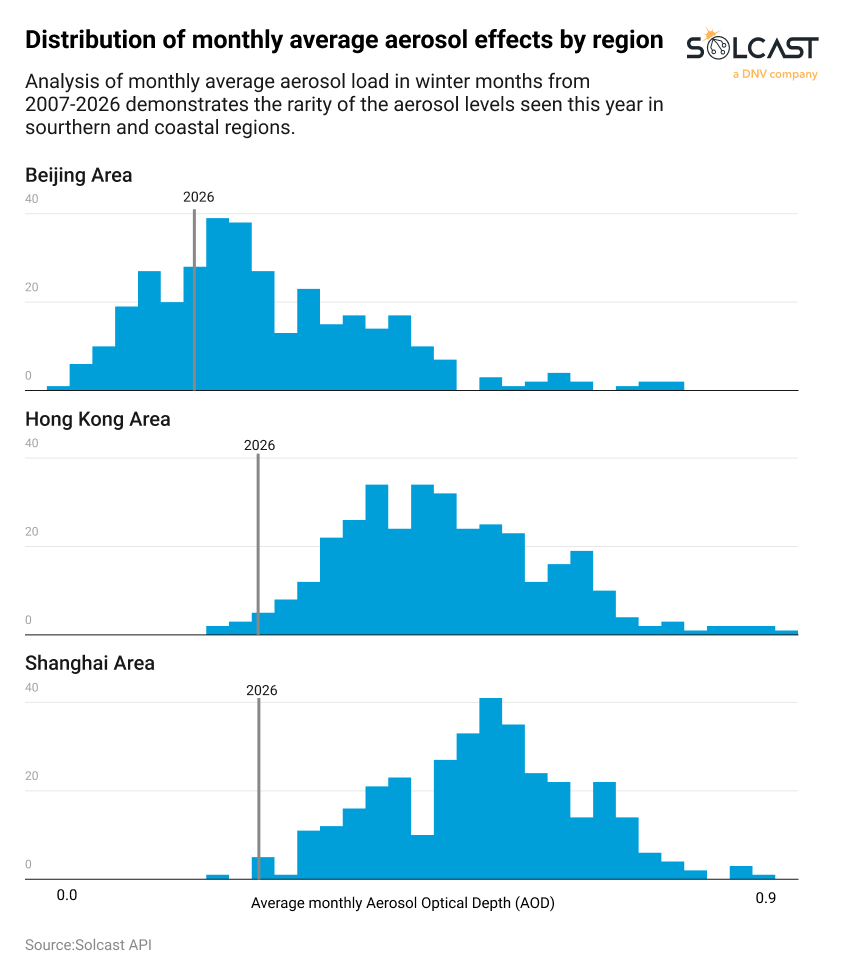
In a continuation of the 2025 irradiation and aerosol pattern, many parts of China, particularly low-lying industrial areas, saw a significant decrease in aerosol burden and a corresponding increase in available irradiation. Both the Hong Kong and Shanghai regions experienced significantly lower average winter aerosol loads than the historical average for the winter months of 2007-2026. While this supported exceptionally high insolation in Hong Kong through January, Shanghai recorded slightly above-average insolation, despite a rare snowfall late in the month. Beijing, on the other hand, has historically had lower aerosol loads, but still experienced slightly below average insolation due to the prevailing cloud cover.
Elsewhere in East Asia, insolation levels were generally normal to above normal this month. Seoul and Tokyo recorded irradiance levels 5 to 10% above the January average, and Taipei saw an increase of more than 10%. Across the maritime continent, insolation and precipitation anomalies were close to normal.

The most significant negative radiation anomaly in the region was associated with Tropical Storm Nokaen (Ada), which marked an unusually early start to the 2026 Pacific typhoon season. Upon landfall in January – the first time since 2019 – Nokaen brought heavy rainfall and heavy cloud cover to the central and northern Philippines. Daily rainfall could reach up to 200 mm, causing mudslides and widespread disruptions. Irradiance in the northern Philippines fell by as much as 10% below average, while the southern parts of the archipelago, spared from the worst of the storm, saw insolation rise to 10% above average.
Solcast produces these figures by tracking clouds and aerosols worldwide at a resolution of 1-2 km, using proprietary satellite data AI/ML algorithms. This data is used to drive irradiance models, allowing Solcast to calculate high-resolution irradiance, with a typical deviation of less than 2%, as well as cloud tracking predictions. This data is used by more than 350 companies that manage more than 300 GW of solar energy worldwide.
The views and opinions expressed in this article are those of the author and do not necessarily reflect those of the author pv magazine.
This content is copyrighted and may not be reused. If you would like to collaborate with us and reuse some of our content, please contact: editors@pv-magazine.com.
Popular content

