

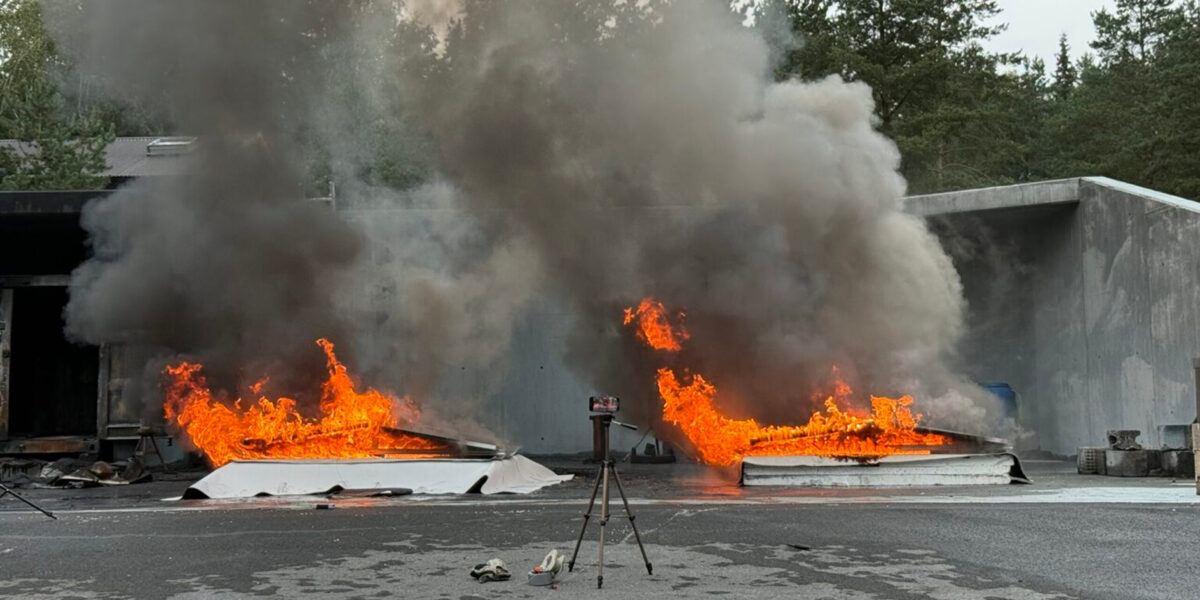
Norwegian fire safety specialist Bridgehill has developed a fire-resistant roof membrane designed for use under rooftop PV systems. The company says the product is intended to limit heat transfer and flame spread in commercial and industrial installations subject to strict fire safety and insurance requirements.
Bridgehill, a Norwegian developer of advanced fire blankets and related fire protection solutions, has developed a fire-resistant roof membrane specifically for PV systems. It says the Fireblock membrane is built into roof structures as an additional passive fire protection layer under PV systems. The company said it is designed for flat and pitched roofs and can be installed in both new construction and renovation applications.
According to Bridgehill, the membrane uses an intumescent mechanism that is activated when exposed to high temperatures. The company said an acid-generating component decomposes under heat, causing a carbon-containing material to dry out and create a stable carbon layer. A blowing agent embedded in the membrane releases gases, causing the material to expand and creating a mechanically robust, thermally insulating barrier.
Bridgehill said internal fire tests showed surface temperatures above the membrane as high as 900 degrees Celsius, while temperatures below the membrane remained around 150 degrees Celsius after 25 minutes of simulated fire exposure. The company says this performance is intended to protect load-bearing roof structures, insulation and technical installations.
The company said the membrane maintains water-repellent and waterproof properties during a fire, reducing damage from firefighting water. Bridgehill said the white surface of the membrane has a high albedo and can reflect light onto the back of bifacial PV modules, potentially increasing energy yield.
Bridgehill estimates installation costs at about $30 per square foot. The company said the product is in the final stages of market launch, during which country-specific certifications, test reports and installation guidelines will be released.
Bridgehill said the membrane can be installed directly under PV systems on top of existing waterproofing, creating a continuous fire barrier without altering standard flat roof structures. It can also be placed between insulation and waterproofing layers on flat roofs, especially in new construction or major renovations.
For pitched roofs, Bridgehill says the membrane can be installed under or over bitumen sheets during new construction or full renovation. For existing roofs, the company says it offers a retrofit option where the membrane is placed on top of the existing bitumen seal under the PV system without removing the roof covering.
Bridgehill said the product can be integrated into common roof structures to help planners and installers meet rooftop PV fire protection requirements.
This content is copyrighted and may not be reused. If you would like to collaborate with us and reuse some of our content, please contact: editors@pv-magazine.com.
