

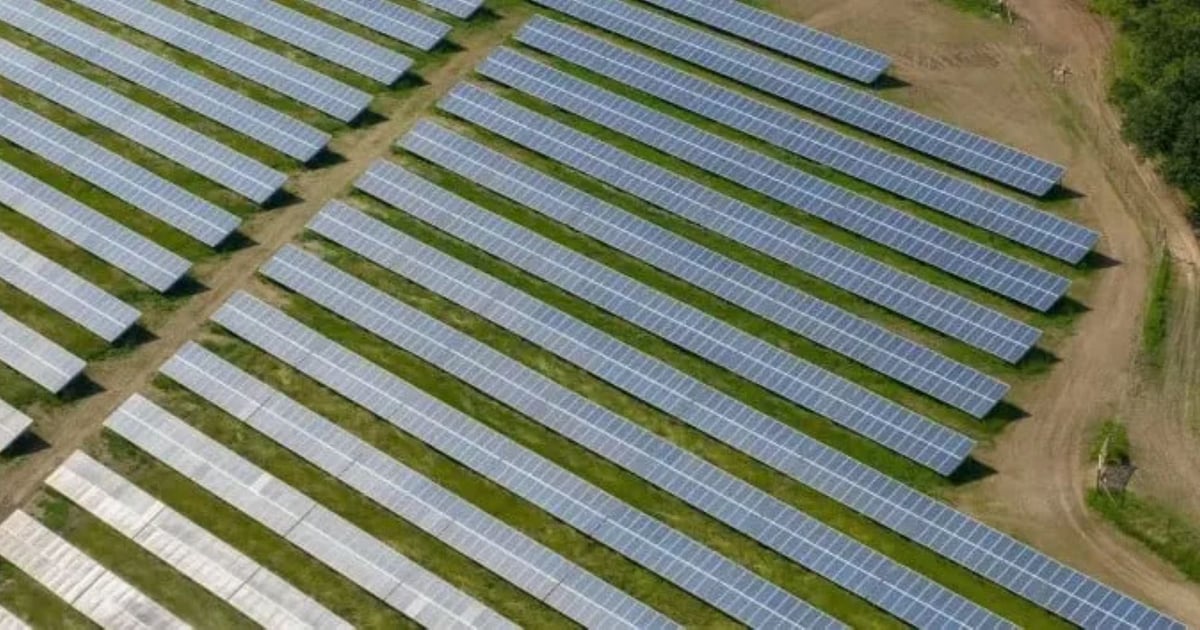
The UK government has awarded Contracts for Difference to 4.9 GW of solar PV, securing revenues for a record number of solar projects.
Allocation round 7a (AR7a) of the Contracts for Difference (CfD) support scheme represented the highest number of individual projects (155) and the largest capacity awarded to solar PV projects in the UK since the start of the CfD scheme.
The solar strike price achieved at the auction was £65.23/MWh, over 10% cheaper than the last allocation round, AR6, when the previous record for solar allocated was set. AR6 3.3 GW of solar energy allocated for 93 projects. We report based on total export capacity, not at peak level.
Which solar power plants have received CfDs?
Of the 155 PV projects secured in AR7a, 12 were in Wales and 11 in Scotland.
Projects that have received CfDs include Island Green Power’s Nationally Significant Infrastructure Project (NSIP) West Burton, approved in early 2025awarded for a total of 480 MW spread over three contracts.
Last week, during an event organized by Solar Power Portal’s publisher Solar Media, Bob Psaradellis, CEO of IGP, called the CfD the “gold standard” for investment opportunities.
Notably, West Burton was the only NSIP awarded. Josh Cornes, analyst at Solar Media Market Research, said: “Given that this is the highest capacity allocated in a single CfD round, it was a surprise to see that only one NSIP was awarded, while seven were eligible. Whether this is due to several of the eligible projects being for sale remains to be seen.
“Two NSIPs were awarded contracts in AR6, Little Crow and Longfield, and it was expected that at least two would also have been awarded by 2026,” he added.
Also receiving contracts Bicker Fen, ratified March 2024, Lark Hill solar, energized 2024and three of the eight projects acquired by TotalEnergies in June last year: Cobwood, Bluebell Wood and East End.
Comparison with previous years
Using 2024 benchmark prices, the solar strike price was £64.09/MWh in AR4, £65.49/MWh in AR5 and £72.92/MWh in AR6. Bertalan Gyenes, consultant at LCP Delta, said the significantly lower strike price this round indicates that last year’s cost of capital reductions are feeding into the CfD.
In AR4, 67 projects totaled 2.2 GW, in AR5, 56 projects totaled 1.9 GW, and in AR6, 93 projects totaled 3.3 GW.
Cornes noted that “perhaps the most surprising” about the AR7a results was that the average capacity per project was only 31.6 MW, “the lowest in any previous allocation round.”
Source: solar energy market research.
Before these results, it had been steadily increasing, with AR6 having an average capacity of 35.3 MW, Cornes said.
An in-depth analysis of the results and an overview of which developers received contracts, using Solar Media Market Research analysis, will be published on Solar energy portal tomorrow.
Industry feedback
UK Energy Secretary Ed Miliband said the AR7a results show “once again” that clean energy is the “right choice”. He noted that, according to figures from the Department for Energy Security and Net Zero (DESNZ), the price for new onshore wind and solar is “more than 50% cheaper than the cost of building and operating new gas”.
The strike price for onshore wind power, also included in the AR7a auction, was £72.24/MWh, while DESNZ charged £147/MWh as the cost of building and operating new gas-fired power stations.
Meanwhile, trade association Solar Energy UK estimates that this auction round will contribute £370 million to the UK economy in gross value added.
Chief executive of Solar Energy UK Chris Hewett called the results a “milestone for the solar sector”, and “a positive testament to that [solar PV] provides the cheapest available electricity”.
According to energy consultancy the Energy and Climate Intelligence Unit (ECIU), this auction round, in combination with the offshore wind round (AR7, the results of which were announced on January 14), will reduce British gas imports by more than 80 TWh per year.
It also said that by 2030, when the final projects awarded in AR7 and AR7a, the projects secured through this auction will generate around 10% of the UK’s generation.
However, as Lucy Dolton, head of renewable generation at energy consultancy Cornwall Insight, noted, meeting project timelines will be a challenge.
“Historically, renewable energy projects in the UK have faced delays, often due to grid connection backlogs and planning delays. With AR7 and part of AR8 representing the only realistic pipeline for pre-2030 capacity, sticking to planning will be essential.
“AR7 is a step forward, but its impact will depend on Britain’s ability to deliver these projects on time, ready the electricity grid and build the storage to support them.”
