

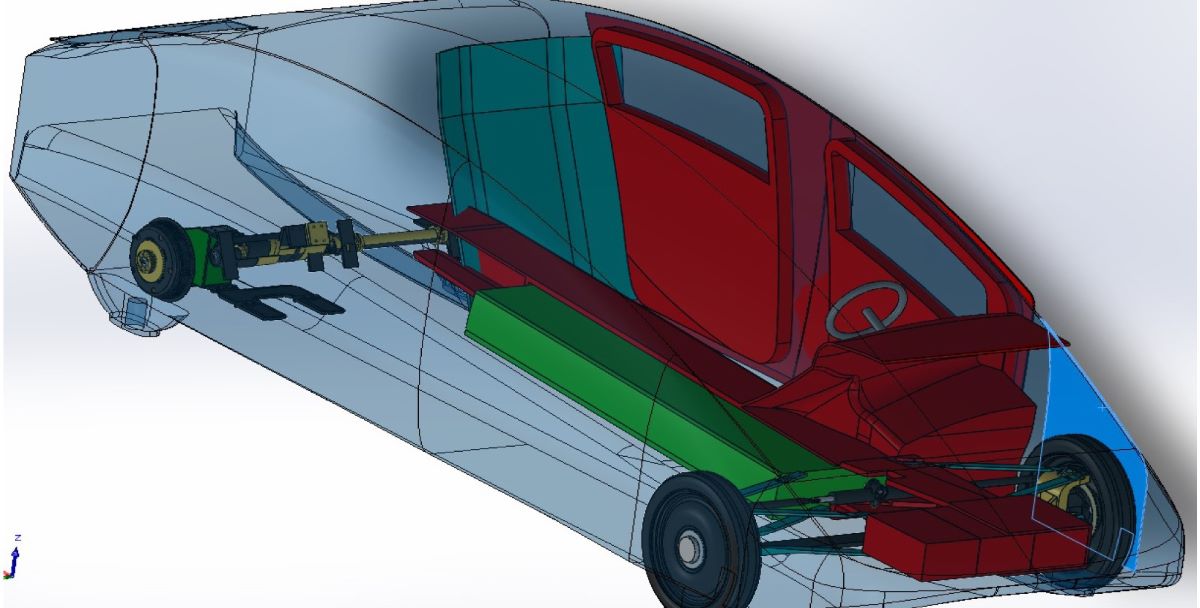
Researchers from the University of Bologna conducted crash simulations to qualify a new 350kg solar-powered passenger vehicle for the next edition of the 3,000km Bridgestone World Solar Challenge (BWSC) on the Australian continent.
A research team from Italy’s University of Bologna conducted crash simulations to qualify a new four-seater solar-powered car that will compete in the 3,000km Bridgestone World Solar Challenge (BWSC) on the Australian continent.
The solar electric vehicle, named Emilia 5, is a Cruiser class participant for the 2025 BWSC event. The Cruiser class is one of three solar car categories of the biennial event that organizers created to introduce concept cars to encourage “innovative, sustainable and potentially practical features that could find their way into real-world design”.
Emilia 5 measures 4,500 mm x 1,510 mm x 1,230 mm and weighs just 350 kg. The motorcycle has a maximum speed of 120 km/h. It is powered by solar panels from Italian module manufacturer Solbian, which uses Maxeon cells. The car’s chassis is made of carbon fiber reinforced plastic (CFRP).
It is the fifth model created by the Italian Onda Solare team and the third in collaboration with the University of Bologna. “The team started competing in 2003 with its first vehicle, a solar bicycle. The University of Bologna joined in 2013 with Emelia 3, a Challenger class vehicle. The next car, Emelia 4, was a Cruiser Class vehicle. It won the 2018 American Solar Challenge and the 2021 iLumen European Solar Challenge,” says research leader Giangiacomo Minak told pv magazine.
Minak noted that Emilia 5 has some of the same elements as Emilia 4, such as the powertrain, which the team designed itself. “What is new is the use of recycled carbon fiber material in the parts used at the front and rear of the vehicle. We also used recycled molds. The interior is more spacious and comfortable for four passengers. The doorways are designed for passengers with physical disabilities,” Minak said.
“We have also adapted the design for strong crosswinds. Despite changes, the aerodynamics will be at least as good as Emelia 4. The color will be Ferrari red,” said Minak, adding that the group recently received funding from the Italian National Center for Sustainable Mobility (MOST), which is supported by the NextGenerationEU programme.
The crash simulations include three mandatory tests: a frontal impact test, a side impact test and the rollover impact test. The team used Ansys LS-Dyna 2023 R1 software and LS-Dyna R13. The latter was used to generate seat belts and to measure cockpit intrusion.
Referring to the vehicle’s aerodynamics, which allows it to reach speeds comparable to those of road vehicles, the researchers claimed that it is not unreasonable that the vehicle could be in a situation similar to the crash tests similar to those which subject small road vehicles such as city vehicles to cars.
The impact simulations required a lot of computing power because almost the entire vehicle, including seats, seat belts and sled test, had to be verified. “Crash simulations on composite materials often only involve simple components, such as plates subjected to a bending impact, a low-speed impact, barriers exposed to ball impacts or pipes with different cross-sections exposed to an axial impact,” the team explains out.
Another challenge in numerically modeling CFRP components is that they have ‘anisotropy’, mechanical properties that change depending on the orientation of the loads.
“Through three crash test simulations using Finite Element Method (FEM) software, as required by competition guidelines, the vehicle demonstrated robust resistance to deformation,” the team concluded.
The team presented its findings in the study “Research into the crashworthiness of a carbon fiber reinforced plastic solar vehicle,” published in Composite structures.
With this series of tests completed, the Emilia 5 design will progress towards participation in the next BWSC. In the meantime, Minak said, the Italian team is preparing for the eight-day Sasol Solar Challenge in South Africa in mid-September.
Image: Onda Solare
This content is copyrighted and may not be reused. If you would like to collaborate with us and reuse some of our content, please contact: editors@pv-magazine.com.
