

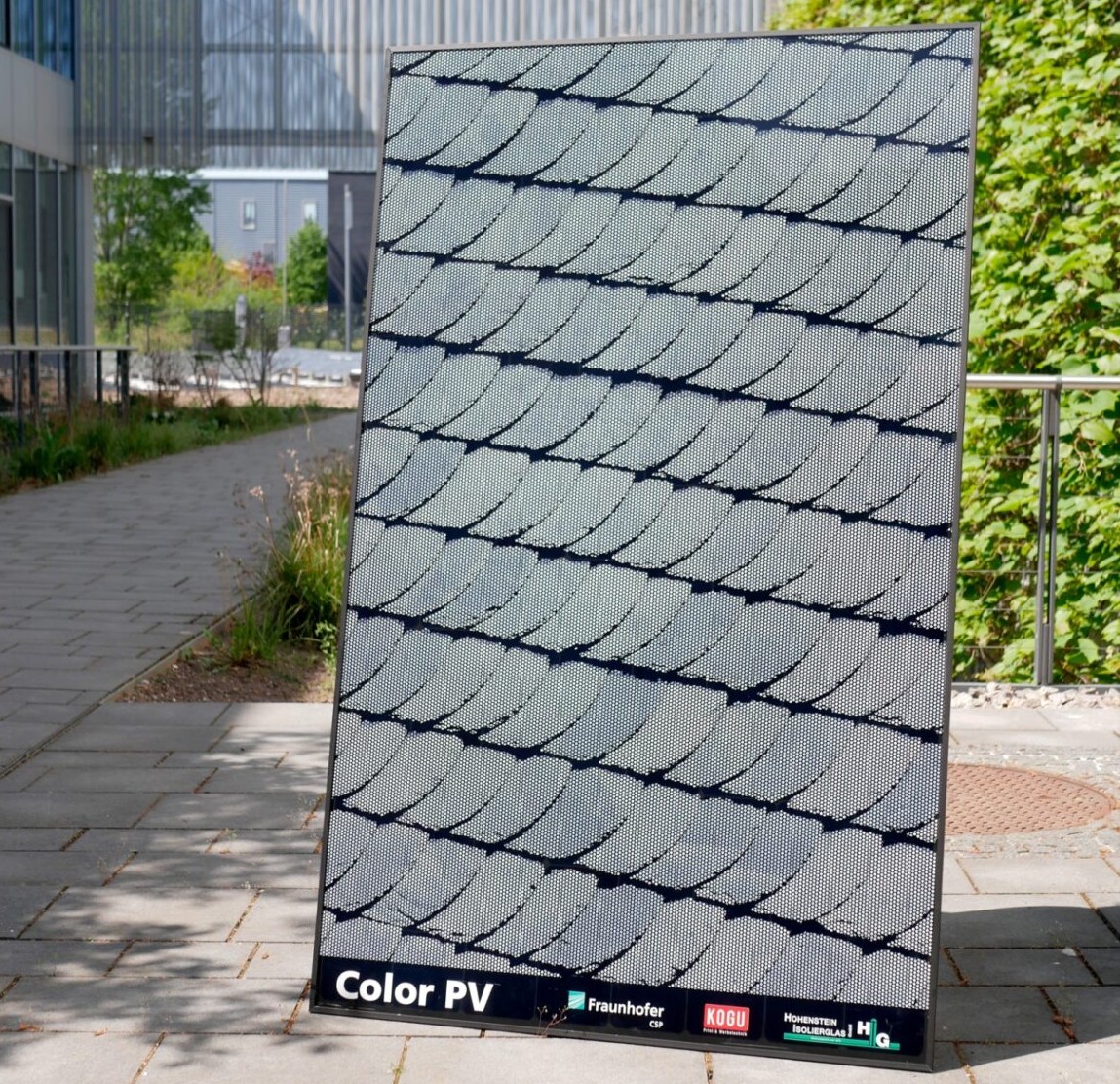
Fraunhofer CSP researchers in Germany are developing printing and coloring technologies to make conventional silicon PV panels less visible when installed on building facades, roofs and balconies.
The Fraunhofer Center for Silicon Photovoltaics (Fraunhofer CSP) in Germany develops printing and coloring technology for conventional cover glass of silicon PV modules, thin glass plates and foils. It is intended as a retrofit solution for panels used on solar facades, roofs and balconies.
In a two-year project codenamed Colipri that started in February 2025, the researchers are refining a solution that adds color to PV modules for use in, for example, historic buildings or other construction applications, making them less visible and more acceptable to consumers, while keeping efficiency losses and additional costs low.
“Together with our project partners, we can offer all steps required for the module retrofit process to customers. We are currently working to make the processes for individual solutions more cost-effective,” says Charlotte Pfau, project manager at the Fraunhofer Institute for Microstructure of Materials and Systems. pv magazine.
A process has been developed to retrofit completed commercial modules. “The process is characterized by the fact that it can be applied to all types of commercial modules with front glass and for all cell technologies, regardless of the size and efficiency behavior of the modules,” said Pfau.
Organic inks are used to print on films, while ceramic inks are used to print on glass. The glass-ceramic color matrices are intended to provide high reliability and long-term stability. According to the group, tests are being carried out with various printing inks, such as spectrally selective pigments, including ceramic interference colors, to minimize efficiency losses.
Further improvements to printing inks and cartridges, as well as processes to increase efficiency, are underway as part of the project. It involves developing printing parameters and optimized print files necessary to produce individualized designs on the cover glass of modules, as well as on glass plates and films.
The maximum acceptable efficiency loss depends “strongly on the design and colors” and is limited to approximately 20% when optimized. “The goal is to further reduce these losses through improved printing inks and cartridges without significantly compromising the design,” Pfau explains.
German project partners Flachglas Nord-Ost GmbH and Hohenstein Isolierglas GmbH support the efforts with a focus on glass printing and polymer film printing respectively.
Fraunhofer CSP is responsible for the design and evaluation of the retrofit solutions, as well as for the development of efficiency-optimized printing screens and optical layers, high-resolution data sets and the establishment of measurement methods and test samples. In addition, a new model for estimating returns and performance losses is under development.
This content is copyrighted and may not be reused. If you would like to collaborate with us and reuse some of our content, please contact: editors@pv-magazine.com.
