

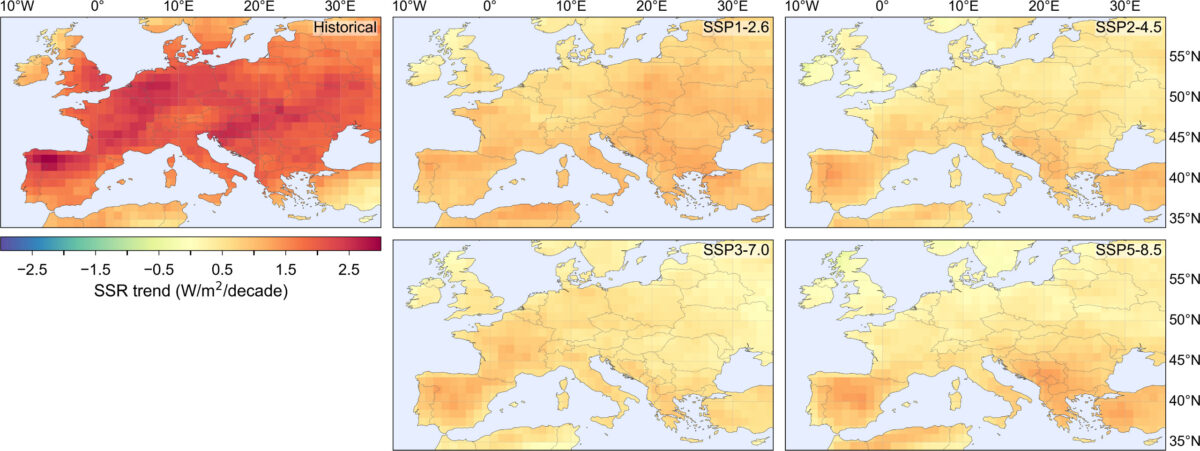
Research analyzing surface solar radiation data from the past three and next three decades shows that Europe has become sunnier at an average rate of 2.4 W per decade. This increase in solar radiation is expected to slow over the next thirty years.
Surface solar radiation across Europe is increasing due to changing cloud patterns and reducing air pollution, according to new research findings.
The research, a collaboration between solar data and software company Solargis, the University of Malaga and the University of Murcia, is said to be one of the most comprehensive solar radiation surveys carried out in Europe to date, analyzing surface solar radiation data from the past 30 years and the next 30 years.
The findings are presented in the research paper “Past, current and future solar radiation trends in Europe: multi-source assessment of the role of clouds and aerosols”, available in the magazine Remote sensing of the environment. The dataset includes ground-based observations, five historical gridded datasets and an ensemble of 30 CMIP6 climate models with projections in four different forcing scenarios.
The researchers found that the amount of sunlight reaching Europe’s surface has increased by an average of 4.8% over the past thirty years, equivalent to an additional 2.4 W per decade between 1994 and 2023. Central-west Europe has experienced greater growth than other parts of Europe, with north-east France, the Benelux and western Germany recording an increase of almost 11%, or 4.7 Watt per decade, between 1994 and 2023. decade. The research paper adds that the upward trend in irradiance is at lower levels in other areas including Britain, Scandinavia, the Italian peninsula and the Balkans.
According to the first commentary on the findings, changes in cloud opacity and opacity are responsible for about 80% of the total increase in solar radiation, with the reduction in aerosol pollution, known as the aerosol direct effect (ADE), accounting for the remaining 20%.
Further analysis in the research paper adds that the indirect role of aerosols, or the first indirect aerosol effect (AIE), is crucial for determining cloud opacity, and therefore increases the importance of aerosol pollution beyond the initial 20%. The conclusion of the research report attributes 1/5 of the impact to ADE, 2/5 to the first AIE and 2/5 to changes in cloud cover. “That is, the cloud-related changes would be twice as important as ADE on a regional scale,” the article explains.
An analysis of solar radiation forecast data for the period 2024 to 2054 indicated that the increase in solar radiation in Europe will slow down over the next three decades. Lead researcher José Antonio Ruiz-Arias, professor at the University of Malaga, says this finding is consistent with the result of climate models.
“Despite the efforts of the scientific community to accurately predict surface solar radiation levels, long-term projections of solar radiation involve a high degree of uncertainty due to the complexities surrounding the nonlinear behavior of the atmosphere and our limited knowledge of aerosol levels and their interactions in the atmosphere,” Ruiz-Arias said. “It is therefore important for the global solar community to continue to improve existing data sets, closely monitor atmospheric changes and reevaluate how solar radiation affects us locally on the ground.”
Ruiz-Arias added that changing radiation levels are having a major impact on the solar industry, directly affecting long-term production, sustainability and project financeability.
“Outside the energy sector, a brighter Europe translates into more energy, rising temperatures and changed precipitation patterns,” Ruiz-Arias said. “These factors have a broad impact on social patterns and almost all economic sectors, from agriculture and tourism to education.”
This content is copyrighted and may not be reused. If you would like to collaborate with us and reuse some of our content, please contact: editors@pv-magazine.com.
