

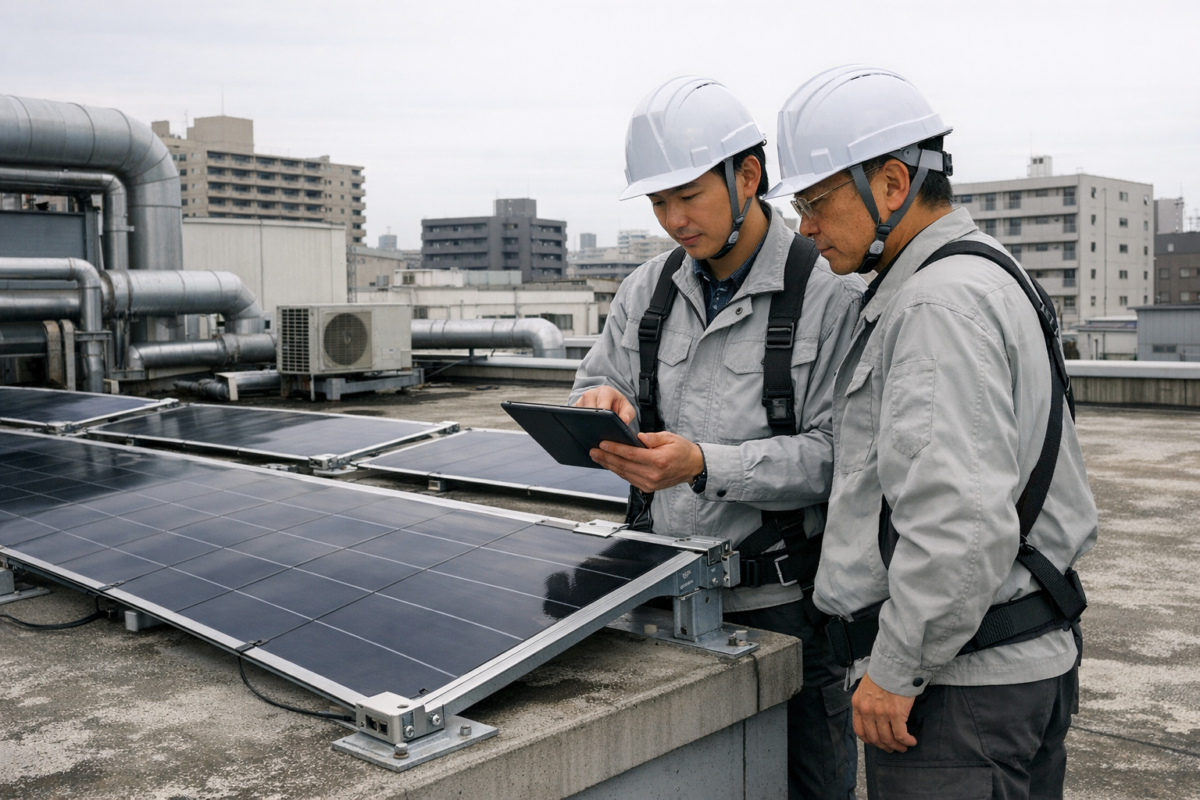
NEDO, Japan’s State Energy Research Agency, has published new design and construction guidelines for PV systems using flexible solar cells, including perovskite, chalcopyrite and thin crystalline silicon technologies, as suitable locations for conventional solar installations in the archipelago become increasingly scarce.
The new guidelines cover the design of structural loads, frameless mounting methods and flammability considerations for building-mounted systems. NEDO said in a press release this week that they were developed by a working group that builds on existing standards in architecture and electrical engineering. It noted that it compiled these with input from the National Institute of Advanced Industrial Science and Technology, the Structural Performance Evaluation Institute and the Japan Photovoltaic Energy Association (JPEA).
Japan has one of the highest solar capacity per land area of any major economy, and the available sites for conventional systems are shrinking. Flexible, lightweight cells are intended for low-load roofs and walls of buildings where conventional panels cannot be used. Areas that, according to NEDO, remain largely unused because structural design guidelines are limited. Past damage from typhoons, snowfall and heavy rains has also raised community concerns about the safety of solar equipment, and the guidelines are intended to address these.
Perovskite solar cells in particular are advancing through joint public-private development under Japan’s Green Innovation Fund, and domestic capital investments toward gigawatt-scale mass production have begun, targeting 2030. NEDO said the guidelines are designed to give project developers and designers a consolidated reference for safe deployment as that commercial pipeline develops.
The guidelines only apply to building-mounted systems. Livestock facilities, horticultural structures and indoor installations are excluded. Evaluations of structural safety under wind and snow loads, and electrical safety through combustion and destructive testing, have not yet been completed. A revised edition is expected in 2027 at the latest.
Japan’s Seventh Strategic Energy Plan, which was approved by the Cabinet in February 2025, called for maximizing renewable energy deployment while managing land use and community constraints – the policy context from which the flexible PV push emerges, and these guidelines, follow directly from that.
Japan has set a target of deploying 20 GW of perovskite solar capacity by 2040, setting the scale of ambition underpinning the country’s flexible PV policy. In September 2025, Japan’s Ministry of the Environment opened grant applications for two programs aimed at early deployment of perovskite. The first supported locations with high self-consumption or backup power functionality, requiring film-type perovskite cells generating at least 5 kW in locations with a load capacity of 10 kg/m² or less. The second promoted the integration of batteries alongside perovskite installations.
In October 2025, NEDO launched a six-year research and development program under the Green Innovation Fund to advance mass production technologies for tandem perovskite solar cells, running from fiscal year 2025 to 2030, with real-world demonstration tests on rooftop and ground-mounted systems.
In May 2025, PXP Corp. and JGC Japan Corp. with a one-year, 1 kW grid-tied trial of chalcopyrite solar panels on an industrial building in Yokohama. The PXP modules weigh 2 kg/m² and have a power of 100 to 120 W/m². JGC developed a non-penetrating plate-based mounting system for industrial roofs; Initial results showed that one worker could install 100 m² per day. PXP has secured JPY 1.5 billion in financing for a planned 25 MW chalcopyrite module factory and is separately developing perovskite-chalcopyrite tandem cells.
