

Scientists in Hungary found that ground-mounted PV modules at an intermediate height of 1.1 m achieve the highest efficiency and power output due to improved airflow and lower cell temperature. Their research also estimated levelized electricity costs at $0.0843/kWh and 577.78 kg of CO₂ reduction over 25 years, noting that the results are specific to concrete surfaces.
A research team from the Hungarian University of Agriculture and Life Sciences has investigated the effects of altitude on the performance of ground-mounted PV modules.
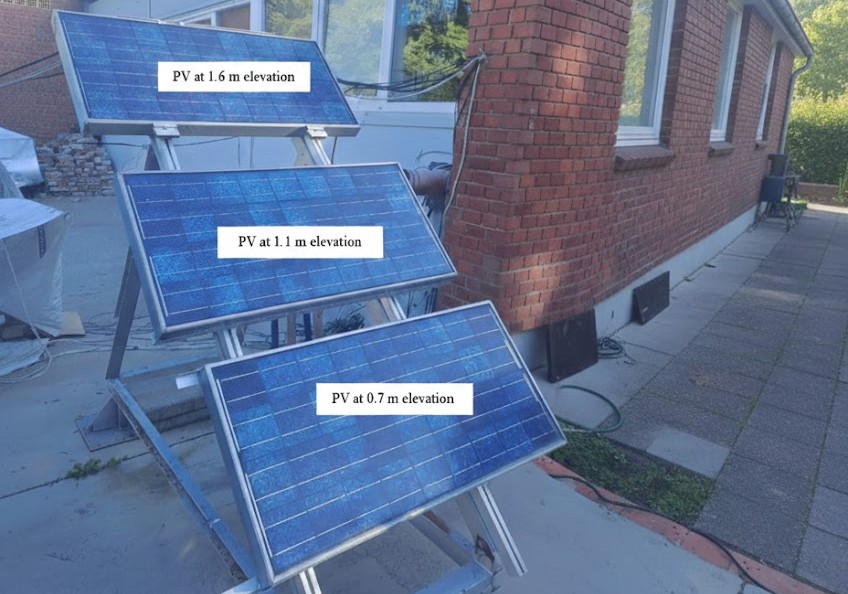
The controlled field experiment was conducted using matched polycrystalline modules at different heights to isolate the effects of module elevation above the concrete.
“While extensive research has optimized PV performance through adjustments in tilt angle, azimuth and row distance, systematic investigations into module height in conventional ground-mounted PV systems remain limited,” the scientists said. “Existing studies have mainly investigated height effects within specific applications such as green roofs, agricultural voltaic systems and floating PV installations or as part of broader thermal management strategies, without explicitly addressing height as an independent design parameter.”
The team’s experiment took place in Gödöllő, central Hungary, on September 21, 2025, from 10 a.m. to 4 p.m. The experimental setup included three identical PV modules, each mounted at a fixed tilt angle of 45° and facing south to ensure uniform solar exposure. All modules had an area of 0.55 m2, with a maximum power of 60 W each. They were mounted on the same plane, each at a different height: 0.7 meters, 1.1 meters and 1.6 meters.
The academics used a carefully designed experimental setup to identify the optimal height for maximizing energy yield and improving the overall performance of the photovoltaic system. They explained that a series of precisely calibrated instruments were used to ensure accurate and thorough data collection, carried out at short intervals over several hours, allowing them to collect a substantial data set for analysis.
The research team reported that the PV module mounted 1.1 m above the ground consistently delivered the best performance, with a peak power of 39.1 W and an average efficiency of 6.67%. Modules at heights of 0.7 m and 1.6 m recorded lower average power of 25.34 W and 19.70 W, respectively, and average efficiency of 5.35% and 4.29%, respectively. They attributed the superior performance at 1.1 m to improved airflow and moderate albedo, which reduced cell temperatures and increased electrical output.
The team added that statistical analysis using Analysis of Variance (Anova), a statistical method used to determine whether there are significant differences between the means of three or more groups, and Tukey’s Honestly Significant Difference (HSD) test, a post-hoc statistical method, confirmed that the differences in power and efficiency across different heights were highly significant, with the pairwise mean differences exceeding critical thresholds. They suggested that mounting PV modules at an intermediate height of 1.1 m in the study area could significantly increase energy yield, improve thermal management and increase system reliability.
After economic and environmental assessments, the researchers concluded that the setup would deliver a levelized cost of electricity (LCOE) of $0.0843 per kWh and reduce 577.78 kg of CO₂ over 25 years. However, they noted that the results are specific to concrete surfaces and that the effects of alternative ground materials, such as vegetation, on radiation reflectance and thermal behavior have not yet been investigated.
Their findings were presented in “Analysis of the effects of height on the power and efficiency of ground-mounted photovoltaic modules”, published in Scientific reports. Researchers affiliated with the Hungarian University of Agriculture and Life Sciences and Ethiopia’s Hawassa University conducted the study.
This content is copyrighted and may not be reused. If you would like to collaborate with us and reuse some of our content, please contact: editors@pv-magazine.com.
