

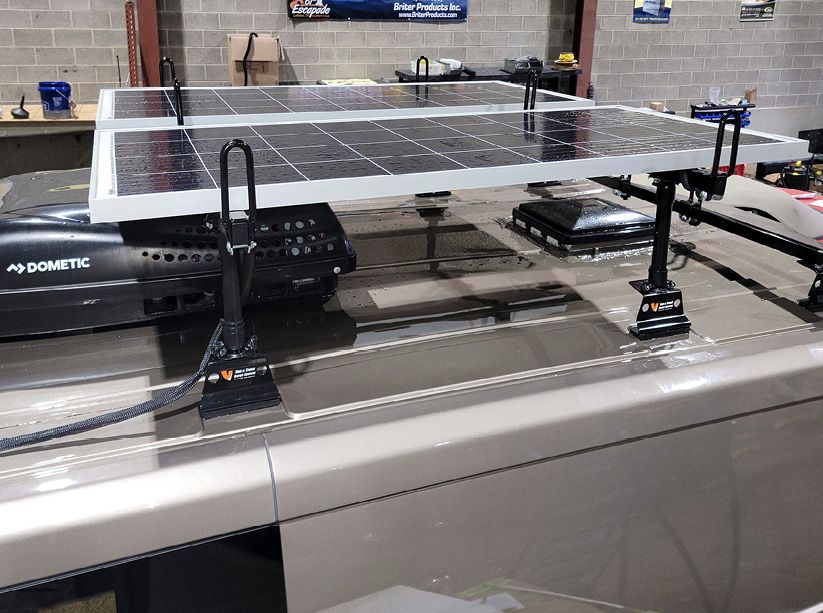
The appeal of the open road is strong in the United States, where highways can weave through breathtaking landscapes. Recreational vehicles (RVs) make adventures easy, but powering portable homes with diesel generators is a poor solution for today’s traveler. Briter Products President Avanti Lalwani tells pv magazine how her company is putting solar energy on wheels.
From pv magazine 24/10
There are more than 11 million RVs in the United States, each with different energy needs. The latest data from the RV Industry Association shows that demand for RV-related products should be at an all-time high.
In South Bend, Indiana, a manufacturer is offering custom solar and energy storage solutions to deliver clean energy without diesel. Briter Products assembles solar panels for RVs, as well as battery storage and inverters – a power plant on wheels.
Briter assembles and sells solar panels for RV roofs; has branded lithium ferrous phosphate (LFP) 12 V, 100 A batteries, with a display showing charge status; and also stocks other RV-related products such as bunk bed ladders and collision avoidance equipment. What sets the company apart is its unique approach to building custom RV energy systems.
Custom made
Briter Products president Avanti Lalwani shared this pv magazine that the company tailors solar energy systems to the specific needs of each RV user – from weekend campers to those who live in their RV full-time.
The solar and storage systems offered by Briter range from a single roof module, intended to charge a typical 12 V battery system, up to a roof array with a capacity of 1.2 kW to 2 kW, integrated with four LFP -batteries in a compartment. enough to achieve “complete independence of power” in most parts of the United States, Lalwani said.
“We avoid one-size-fits-all generic installations. We take the time to gather knowledge and information about the camper itself,” says Lalwani. “We don’t just take the individual’s itinerary, we also want to know their personal needs and their hopes and expectations for their camper. We take their built-in component tree and then configure it to support their travel goals. In my opinion it comes very close to a tailor-made shirt. Everyone’s arm length is slightly different. Everyone’s neck size is different. The same goes for cooling in a camper, it’s very different. One device may require 2 A DC [direct-current] and then another can draw up to 100 amps DC in a residential style refrigerator. Everything is therefore tailor-made for each individual owner and the energy systems.”
The right balance
According to Lalwani, the core of that approach is rigorous testing of the system balance. This often happens on site at the customer. Briter Products encourages potential buyers to test their energy system at the company’s headquarters. It also creates an opportunity for Briter Products to educate customers on things like PV wiring and how it differs from a typical RV electrical system, as Lalwani explained.
“There is a lack of knowledge in our field about solar photovoltaics,” she said. “One of the big challenges we encounter is that several groups do not use photovoltaic wire, do not understand the changes in the internal resistance of different components or think ‘wire is wire’ and thus use any wire.”
“Given that RV roofs are made of completely different materials than building roofing materials and the heat generated by the panels and wires on the roof, especially if they are accidentally mounted directly to the roof, panels and wires can become directly hot sunlight become as hot as [71 C] – not using PV wire can cause significant damage to the roof.
“That is a very big challenge and is the reason we have implemented a program where we encourage customers to camp with us.”
Road ready
In the quest for greater efficiency, Briter Products operates a semi-automated production line to assemble its own solar panels, which are tested for efficiency on site. It’s not the cheapest way to do things – although there is some tax support for renewable energy production through the US Inflation Reduction Act (IRA) – but it is a valuable approach, according to Lalwani, who said RV installations can be particularly vulnerable are for malfunctions. such as micro-squatting.
“RVs travel thousands and thousands of miles every year and the vibrations [when driving on] our highway system and the constant change in environment and temperature require a heavier panel,” she said. “It requires a panel with more robust material and we want to keep that under control, it is quite critical.
“When we install solar panels on people’s RVs, we always add vibration dampening rubber pads so that they are minimally exposed to that in the beginning. We have a limited amount of real estate on that RV roof, so we need to make sure our solar panels are truly producing at the highest level possible, without the onset of micro-cracks and power loss.
State aid
The IRA isn’t the only government intervention that’s good for Briter Products. Potential legislation banning the use of diesel generators could increase demand for zero-emission energy solutions, as Lalwani explained.
“In the United States, California is often at the forefront of innovation. “To improve air quality, the California Air Resources Board recently passed regulations banning the use of generators across the state,” the Briter chief said. “What we’re finding is that solar and lithium battery systems allow RVers to camp indefinitely in California without the need for shore power and without the need for a [diesel] generator.”
Lalwani added that 16 other U.S. states are considering similar legislation, which if passed would impact RV owners who previously had no interest in solar energy.
“As the government increases its need for environmental protection, we’re seeing that people who wouldn’t really be interested in solar, wouldn’t be interested in lithium iron phosphate batteries, they’re now saying, ‘well, I still want to go camping.’ she said.
The views and opinions expressed in this article are those of the author and do not necessarily reflect those of the author pv magazine.
This content is copyrighted and may not be reused. If you would like to collaborate with us and reuse some of our content, please contact: editors@pv-magazine.com.
