

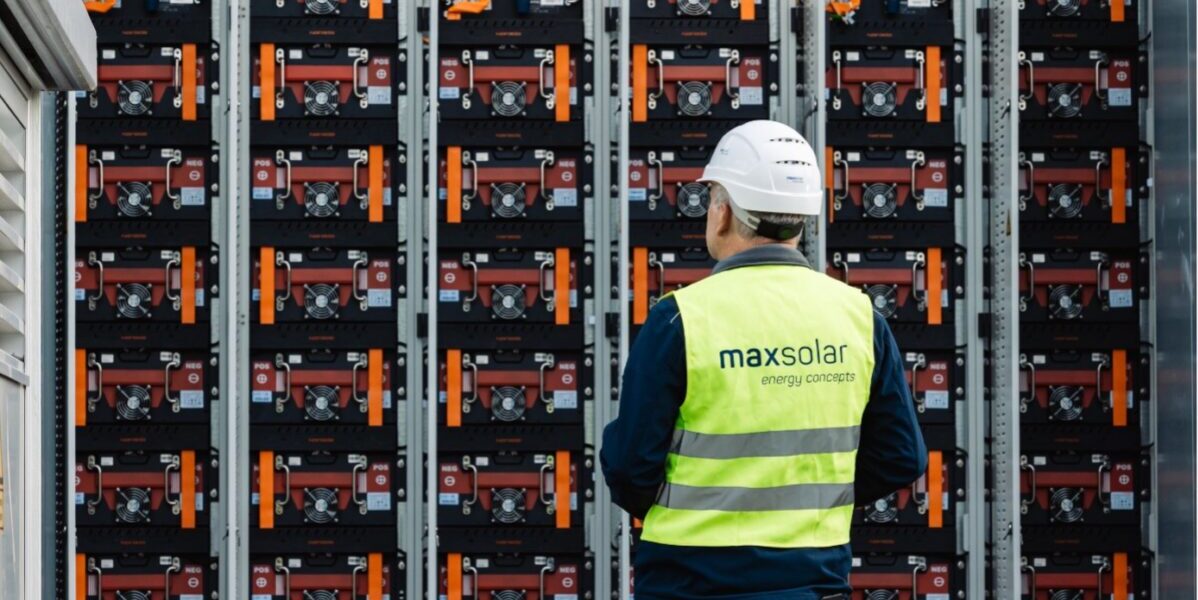
The German Fraunhofer Institute for Energy Economics and Energy System Technology IEE (Fraunhofer IEE) says in a new position paper that large-scale battery storage systems in medium-voltage grids must be technically prepared for future grid-forming operation, with the aim of bridging the gap between current regulations and potential system stability requirements.
The German Fraunhofer IEE has published a new position paper calling for early technical preparation of distribution networks for network-forming functions. Under the term ‘grid-forming readiness’, the authors outline a concept in which large-scale battery storage systems connected to medium-voltage grids could contribute to system stability, islanding capability and resilience in the future – without having to operate in grid-forming mode today.
As the energy transition progresses, the conventional rotating masses that historically supported frequency and voltage stability are diminishing. They are being replaced by power electronics-based generation and storage technologies, including photovoltaic, wind and battery systems. As a result, services such as frequency control, short-circuit current, fault management and disturbance recovery are increasingly provided via inverter-based control systems.
At the same time, regional resilience strategies – such as temporarily separating network sections from the main network and operating them in a stable island mode – are gaining importance. Battery energy storage systems could enable this functionality, provided their control architecture is designed accordingly. With several gigawatts of new large-scale battery capacity expected in the coming years, the institute warns that failure to ready these assets would mean missing a strategic opportunity to strengthen resilience.
Readiness concept
To date, regulatory and technical discussions have largely focused on a binary distinction between ‘grid-following’ and ‘grid-forming’ systems. Grid-following units synchronize with an existing voltage and frequency reference, while grid-forming units can determine these references themselves. According to Fraunhofer IEE, this distinction is too simplistic.
The institute identifies a gap between the current operational framework and potential future requirements for grid-building functionality. Investment decisions are made without clarity about which system services will be needed in ten or twenty years. Adjusting assets later can prove technically complex and economically inefficient.
The proposed concept of ‘grid-forming readiness’ aims to close this gap. It requires that systems be designed and categorized so that they can perform a grid-building role when necessary, even if these capabilities are not activated during normal use. Technical readiness is thus separated from immediate operational obligations.
The institute recommends giving priority to large-scale battery storage systems in medium-voltage networks in an initial phase. These installations are considered particularly suitable for networking applications due to their communications infrastructure, manageability and long asset lifespan.
Their local impact can also make the implementation of regulations more manageable. Although the concept could later be expanded to other technologies and voltage levels, Fraunhofer IEE proposes to first gain practical experience in the medium-voltage segment.
The position paper outlines several use cases to be considered in the design phase, including island operation and regional supply capacity, support for black start and system recovery, stabilization of weak networks, provision of immediate reserves and energy reserves for emergency scenarios.
To ensure transparency and comparability, the authors propose standardized functional classes and defined test procedures that allow plants to verify their lattice-forming capabilities.
Integration of standards
A central recommendation is to formally define “grid-forming readiness” in technical standards and application rules. The article assigns a key role to the VDE Association for Electrical, Electronic & Information Technologies and its standardization department, the DKE German Commission for Electrical, Electronic & Information Technologies, as well as VDE FNN. These bodies would specify technical classes, verification methods and activation parameters and embed them into the existing regulatory framework.
In addition to technical aspects, the article also examines the perspectives of stakeholders, including manufacturers, asset operators, grid operators, policy makers and regulators. It is about financing, investment security and long-term system responsibility.
According to Fraunhofer IEE, the main benefit of network readiness lies in early anticipation of future stability and resilience requirements. By decoupling technical capacity from immediate operational mandates, the approach seeks to avoid costly retrofits while ensuring long-term system operability.
The position paper is available for download on the institute’s website.
This content is copyrighted and may not be reused. If you would like to collaborate with us and reuse some of our content, please contact: editors@pv-magazine.com.
