

Night time in solar PV systems lasts an average of 16 hours, requiring significant storage or alternative generation to meet demand. Hydropower plants and batteries are critical, with hydropower plants providing long-term, cheap storage for cloudy or windless periods. Complementary strategies include wind, load shifting and dispatchable generation, while the high penetration of solar and wind is reshaping grid operations and pricing.
From a solar perspective, the night lasts an average of 16 hours, longer in winter and shorter in summer. How can we cover night-time electricity demand in a sustainable energy system?
By far the most important storage technologies are pumped hydro energy storage and batteries, both in terms of power (GW) and energy (GWh).
Wind is great because it often blows at night. In some places, wind and sun are correlated. Shifting loads from night to day is also useful. Dispatchable hydro, geothermal, bio and nuclear generation helps, although these are small or non-existent in most countries.
The rise and rise of rooftop solar, solar farms and wind farms is forcing major changes in the operation of electricity grids. Typically, coal and gas generation is pressured by low or negative prices during the day and learns to operate flexibly. Curtailments of solar and wind energy are common.
Figures 1 and 2 show the average midnight to midnight generation over 28 days in February (late summer) in the Australian National Electricity Market (NEM) and in the state of South Australia.
In the NEM, average coal production ranged from 16 GW during the evening peak to 10 GW around noon. Most coal will be retired as NEM moves towards 82% renewables by 2030.
In South Australia (Figure 2), coal has already been retired. Solar and wind energy will meet an average of 100% of demand by 2027. The balance is provided by gas, batteries, electricity trade with eastern states, and overbuilding of solar and wind energy combined with frequent curtailment.

Most renewable electricity systems require a large amount of storage to get through the nighttime, wet and windless days and weeks.
Batteries are becoming increasingly important due to the deployment of many large utility batteries (typically 2-4 hours) and a large home battery support program. Soon enough battery power and energy capacity will be available to cover most evening and morning peak periods, which will significantly reduce prices. The balancing emphasis then shifts to expensive nighttime hours and wet and windless weather.
Roughly speaking, an average of 16 hours of storage is required for the night between two sunny days. Covering one cloudy day requires 40 hours of storage, while a cloudy week requires 160 hours of storage. Storage of this duration is well beyond the reach of current batteries, but well within the range of pumped storage.
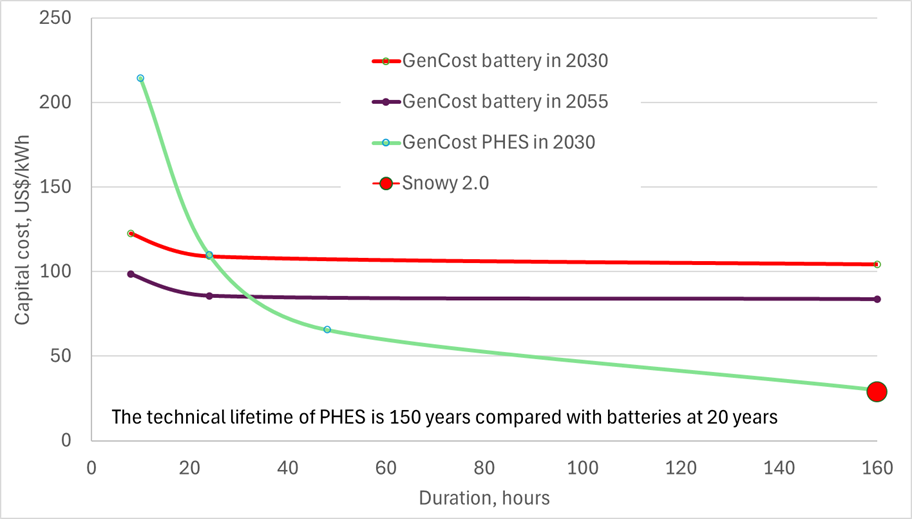
Figure 3 shows the recent cost of capital estimates of GenCost for storage as a function of duration. These estimates are widely used in Australia. If we compare utility batteries with pumped hydroelectric power plants in the year 2055, the crossover point is a duration of about 30 hours.
However, the technical lifespan of pumped hydropower plants is 150 years, compared to that of batteries with a lifespan of 20 years, shifting the transition point to a much shorter duration, largely depending on the assumed discount rate. Pumped hydro storage is expected to remain highly competitive for overnight and extended storage.
Also shown Snowy 2.0 pumped hydro which stores 350 GWh of energy (13 kWh per Australian) with a duration of 160 hours, and will be completed in 2028 at a cost of approximately $10 billion ($29/kWh). Snowy 2.0 can generate 2.2 GW for 10 hours most nights and can then be recharged when it’s sunny and windy. This will yield 8,000 GWh in one year. Importantly, Snowy 2.0 can produce at full capacity for 160 hours during the occasional expensive wet and windless week. Over its 150-year lifespan, Snowy 2.0’s capital cost is less than one cent per Australian per day.
Most countries and regions have many sites that can match the quality of Snowy 2.0 and offer very low costs and long-lasting storage.
Authors: Prof. Ricardo Rüther (UFSC), Prof. Andrew Blakers/ANU
Andrew.blakers@anu.edu.au
rruther@gmail.com
ISESthe International Solar Energy Association is a UN accredited member NGO founded in 1954 working towards a world with 100% renewable energy for all, used efficiently and wisely.
The views and opinions expressed in this article are those of the author and do not necessarily reflect those of the author pv magazine.
This content is copyrighted and may not be reused. If you would like to collaborate with us and reuse some of our content, please contact: editors@pv-magazine.com.
Popular content

